

Why in news?
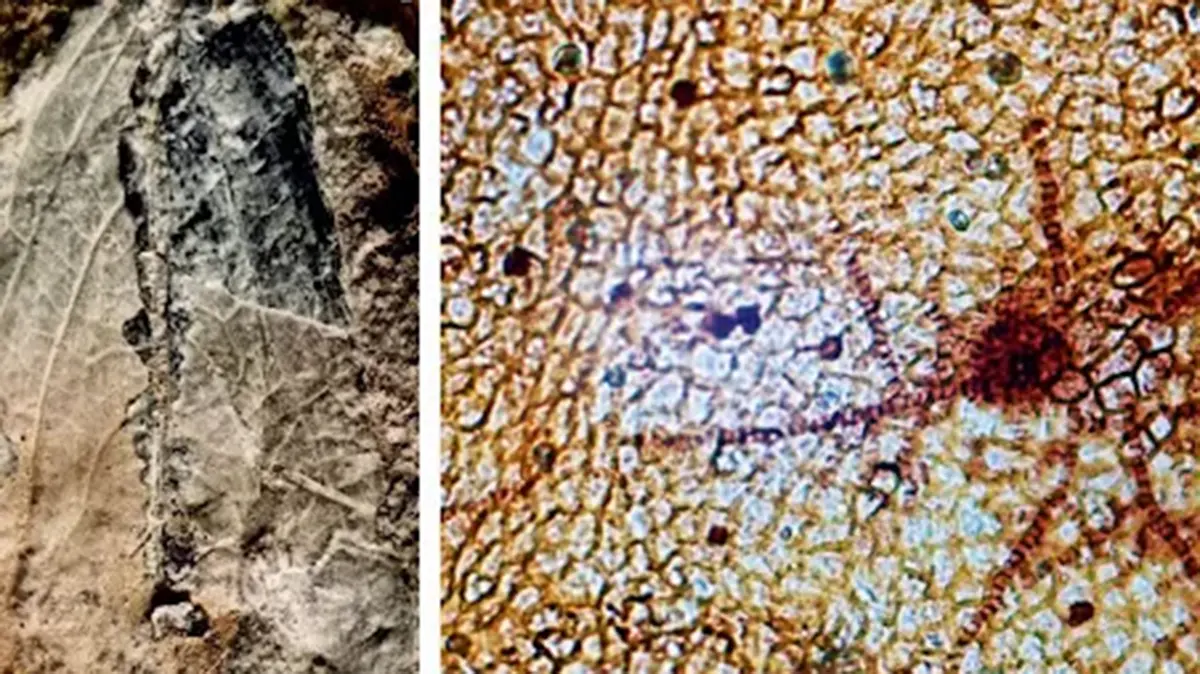
Researchers have described Vizellopsidites miocenicus, a new fossil fungal species preserved on a leaf from Himachal Pradesh's Siwalik sediments. The paper appeared online in the New Zealand Journal of Botany on 18 September and received fresh coverage on 26 September. The material comes from the Mandi area and is associated with deposits roughly 8–12 million years old. Its microscopic structures reveal more than the presence of an ancient fungus: they preserve evidence of its relationship with a host leaf. Comparisons with living relatives support an interpretation of warm, humid conditions. The discovery concerns a newly described fossil species, not a living organism recovered or revived from the rock.
Reading a leaf as an ancient habitat
A fossil leaf can preserve more than the outline of the plant that produced it. Its surface may retain traces of organisms that lived on or interacted with it. In this case, the fungal remains occur on fragments of the leaf's cuticle, its protective outer layer. Their position helps researchers study a relationship within an ecosystem rather than two unrelated fossils found nearby.
The term epifoliar means associated with a leaf's surface. The new fungus belongs to the ascomycete group, often called sac fungi. The authors interpret the preserved association as an external parasitic relationship with the host plant. That interpretation rests on the fossil structures and their position. It is not a direct observation of feeding or disease in a living Miocene plant.
Where the specimen fits in geological time
The material was recovered from Middle Siwalik sediments in the western Himalayan region of Himachal Pradesh. The Siwalik succession records sediment deposited along the Himalayan foreland over long periods. These rocks can preserve biological material from environments very different from the present landscape. Their geological context supplies the framework within which a fossil's age and significance are interpreted.
The study assigns the material an approximate age range of 12–8 million years within the Miocene. That range is an estimate associated with the deposits, not a measurement showing that one leaf is exactly 12 million years old. It also should not be presented as the definition of the entire Miocene epoch. Geological units, age estimates and the age of an individual specimen answer different questions.
How microscopic structures became visible
According to the research report, the team collected compressed fossil leaves and isolated their surviving cuticular material. Chemical preparation helped separate the thin leaf layer from surrounding material. Examination under a light microscope then revealed dark fungal structures. This illustrates why a specimen that appears unremarkable at ordinary scale can preserve a much richer record when prepared and examined appropriately.
The work was conducted by Sampa Kundu and Mahasin Ali Khan of Sidho-Kanho-Birsha University in Purulia. The original paper describes branching fungal threads, called hyphae, divided into cells by internal walls. It also identifies circular reproductive structures beneath the fungal network. These details provide the basis for comparison with other fossil and living forms.
What makes it a different species?
Taxonomic description requires a distinctive combination of features, not simply a fossil from a new location. Here, the researchers examined the arrangement and shape of the fungal threads and reproductive structures. The paper describes dark, branching, net-like hyphae with strongly marked internal divisions. Its comparisons relate the thread pattern and reproductive bodies to different modern fungal forms.
The accompanying research account contrasts the specimen with the previously described Vizellopsidites siwalika. The new species has larger cells and a looser branching network in that comparison. Those distinctions should not be reversed or transferred indiscriminately between the two names. The evidence is morphological: it concerns preserved form, rather than a newly sequenced genome from a living organism.
How a fungus can help reconstruct climate
Organisms occupy environments that meet their biological needs. Fossils can therefore act as indirect indicators, or proxies, of past conditions. Researchers compare the preserved organism with living relatives and consider the habitats those relatives occupy. The new study interprets its fungal evidence as consistent with warm, humid conditions in the ancient Siwalik forest.
A proxy is not a thermometer left running for millions of years. Its interpretation depends on identification, preservation and how well modern ecological comparisons apply to the past. Other fossils and geological evidence can strengthen or refine the picture. One microscopic specimen cannot independently provide an exact temperature, rainfall total or complete map of Himalayan vegetation.
The National Park Service's explanations of fossil climate reconstruction illustrate this wider method. Leaf features, living relatives and other records can contribute different pieces of evidence. Their agreement is more informative than any one indicator treated in isolation. The same principle helps place the Himachal finding within a larger reconstruction rather than making it carry every climatic conclusion alone.
Why relationships are an important part of the fossil record
Lists of ancient species describe who was present, but preserved interactions help explain how an ecosystem functioned. A fungus attached to its host offers evidence about that connection. It can inform questions about plant surfaces, fungal diversity and the environments in which those associations occurred. The record is valuable precisely because such small structures are easily overlooked or poorly preserved.
There are also limits to what absence means. Failure to find similar fungi in another deposit does not prove that none lived there. Preservation and sampling can strongly influence which organisms enter the fossil record and which researchers later recover. Further specimens can help test whether the newly described form was widespread or restricted to particular conditions.
Conclusion
Vizellopsidites miocenicus adds a microscopic plant–fungus relationship to the known record of the Himalayan foreland. Its preserved form supports a new species description and contributes to an interpretation of warm, humid ancient conditions. The strength of the finding lies in connecting organism, host and geological setting. Broader reconstructions will benefit from additional specimens and other independent environmental evidence.