

Why in news?
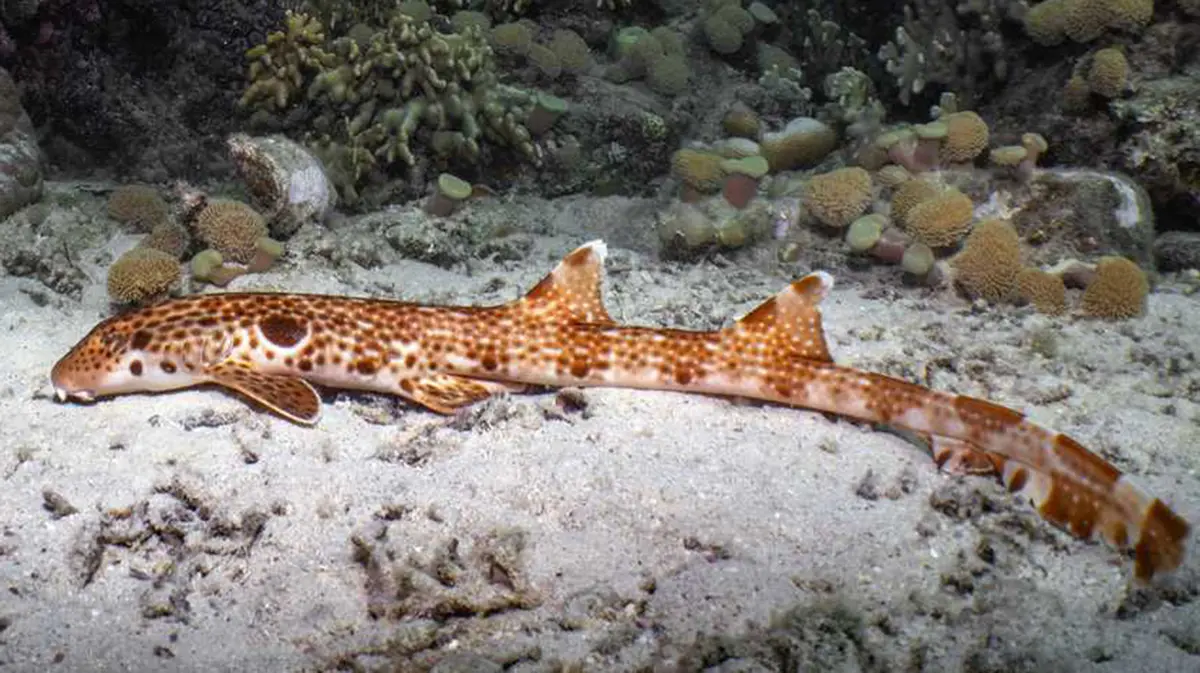
Marine biologists announced a new species of walking shark, named Hemiscyllium dudgeonae, discovered in March 2025 in Milne Bay, Papua New Guinea. The find drew attention again in 2026 when scientists published detailed descriptions and explained its significance for marine biodiversity.
Background
Walking sharks belong to the bamboo shark family and are known for using their pectoral and pelvic fins like legs to “walk” across shallow reef flats and even between tide pools. The new species was identified during surveys supported by the Australian government. Researchers conducted genetic analyses and numerous dives before confirming it as distinct from known species. It is named after ecologist Christine Dudgeon for her contributions to shark research.
Distinct characteristics
- Appearance: The shark is small, measuring less than one metre, with a slender body and unique pattern of dark spots. Its fins are adapted for “walking”.
- Habits: Walking sharks can survive out of water for short periods. They move between tidal pools at low tide to hunt crustaceans and small fish.
- Range: Their distribution is limited to coral reefs around Australia, Indonesia and Papua New Guinea. The new species seems confined to Milne Bay, making it vulnerable to habitat loss.
Conservation importance
- Species status: Because of its restricted range, H. dudgeonae may be classified as a threatened species once assessed. Protecting its coral habitat is essential.
- Research value: Walking sharks help scientists understand how species adapt to extreme environments and how locomotion evolves among fishes.
- Public interest: Their unusual “walking” ability captures public imagination, providing an opportunity to raise awareness about marine conservation.
Conclusion
The discovery of Hemiscyllium dudgeonae highlights how many ocean species remain unknown. Protecting coral reefs and funding research will ensure that such rare creatures survive and continue to fascinate future generations.