

Why in news?
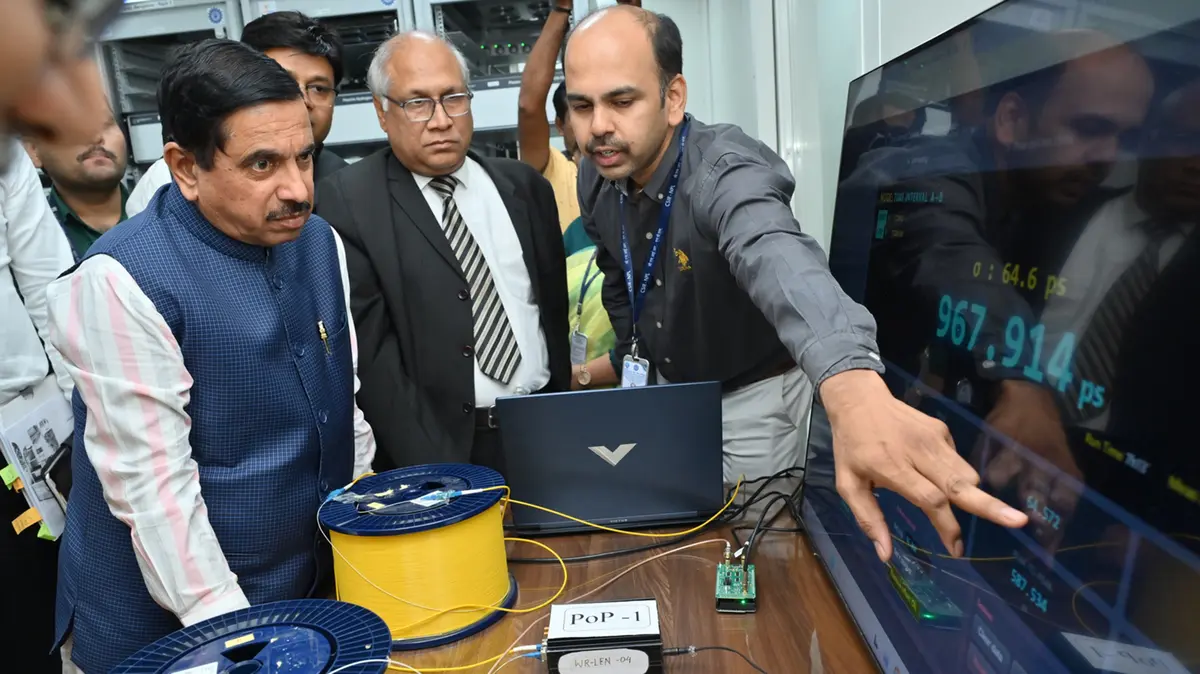
India commissioned a precise time-dissemination network using White Rabbit technology. The demonstration connected Bengaluru with the National Stock Exchange facility in Chennai. It delivered Indian Standard Time with sub-nanosecond synchronisation. The project supports the wider “One Nation, One Time” initiative.
Background
Modern digital systems need shared time, while telecom networks use timestamps to prevent data conflicts.
Electricity grids compare distant disturbances, while financial markets use precise timestamps to sequence transactions.
Even tiny clock differences can confuse records, investigations and automated decisions.
What is Indian Standard Time?
Indian Standard Time is India’s civil time, set 5:30 ahead of Coordinated Universal Time.
Coordinated Universal Time is commonly written as UTC within international timekeeping systems.
The Council of Scientific and Industrial Research’s National Physical Laboratory maintains India’s national time scale.
It is therefore commonly called the CSIR–National Physical Laboratory, or CSIR-NPL.
Its clocks produce UTC(NPLI), where NPLI denotes India’s National Physical Laboratory, before adding 5:30 for Indian Standard Time.
How does India maintain accurate time?
CSIR-NPL maintains five caesium atomic clocks, which measure extremely regular atomic changes.
Hydrogen masers stabilise short intervals while CSIR-NPL compares its time scale internationally.
International comparisons connect India with the Bureau International des Poids et Mesures, which coordinates world reference time.
Simple distinction: A time zone states the clock value for a region. Time dissemination securely carries that correct value to users and machines.
What is White Rabbit technology?
White Rabbit is an open-source system for highly accurate clock synchronisation over Ethernet networks.
The European Organization for Nuclear Research, known as CERN, developed the original technology.
CERN introduced it publicly during 2012 for scientific facilities needing shared precision time.
The technology later entered an international Precision Time Protocol standard during 2020.
White Rabbit combines three functions to keep connected clocks aligned within one nanosecond.
- Precision Time Protocol exchanges accurate timing messages between connected devices.
- Synchronous Ethernet keeps the devices operating at the same clock frequency.
- Continuous link measurement estimates and corrects signal travel delays.
A nanosecond is one-billionth of a second, while “sub-nanosecond” means an even smaller difference.
Why must the system correct network delay?
Timing signals travel through fibre and electronics, creating small delays before reaching each device.
White Rabbit measures and corrects unequal network delays affecting signals in opposite directions.
The network can therefore remain precise even across long fibre connections.
What was demonstrated in India?
The network connected Bengaluru’s Regional Reference Standards Laboratory (RRSL) with the National Stock Exchange facility in Chennai.
The demonstration involved several institutions and carried official Indian time through a secure terrestrial network.
- The Department of Consumer Affairs coordinated the national policy initiative.
- CSIR-NPL provided the national reference time and metrology expertise.
- The Indian Space Research Organisation contributed specialised technical support.
- Bharat Sanchar Nigam Limited supported the communication network.
- The Securities and Exchange Board of India supported financial-sector coordination.
- The National Stock Exchange provided the receiving financial-market location.
Name clarification: RRSL means Regional Reference Standards Laboratory, not a remote-sensing centre.
Why does India need a national time network?
Many systems obtain precise time from satellite-based navigation services.
Such signals can face jamming, spoofing, weak reception or external dependence.
Jamming blocks genuine signals, while spoofing presents false ones as genuine.
A national fibre network adds a secure, traceable route without immediately replacing every satellite timing service.
Future links can support finance, power, telecom, transport, governance and data centres.
Conclusion
White Rabbit can carry India’s official time with extraordinary precision and traceability.
The demonstration is an early step towards secure nationwide time synchronisation.