

Why in news?
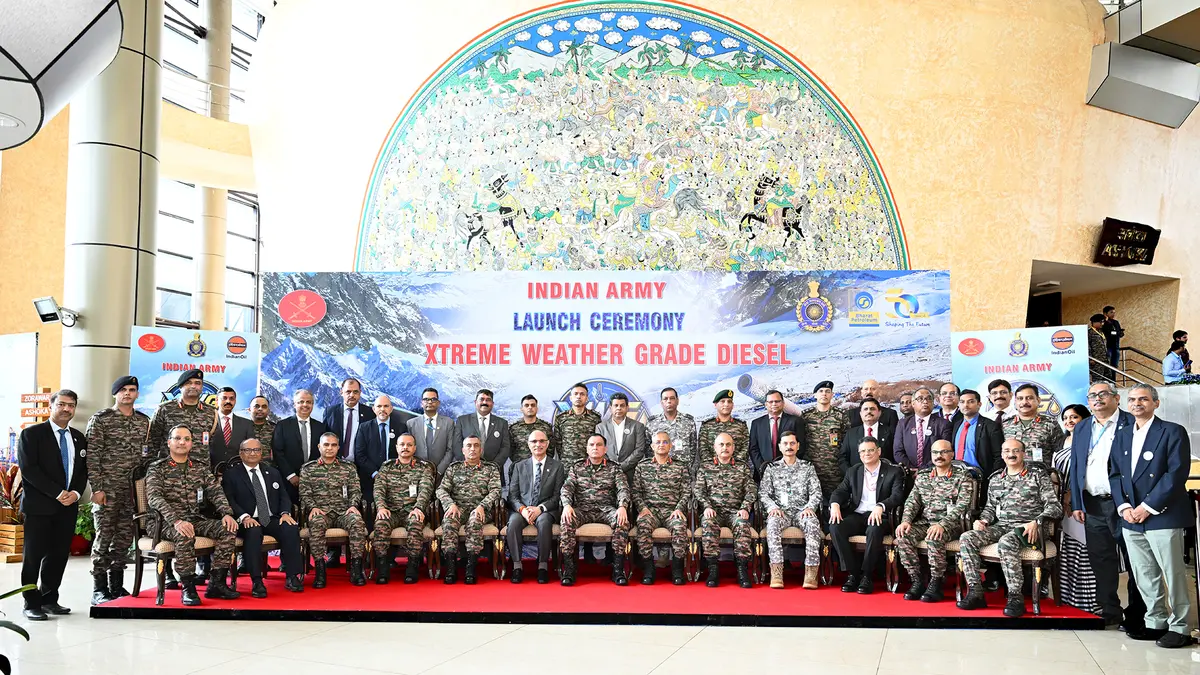
Army Chief General Dhiraj Seth launched Xtreme Weather Grade diesel in New Delhi.
The launch occurred on 31 July 2026 after development within one year.
The Indian Army and oil-marketing companies jointly developed the specialised indigenous fuel.
It remains usable at temperatures reaching minus 42 degrees Celsius.
Background
Diesel contains many hydrocarbons, including wax-like molecules that respond strongly to cold.
Very low temperatures can cause wax crystals to form and enlarge.
These crystals thicken the fuel and may block filters or narrow fuel lines.
An engine can then struggle to start or lose fuel during operation.
Such failures threaten mobility in high-altitude and snow-bound military areas.
What is Xtreme Weather Grade diesel?
Xtreme Weather Grade diesel is commonly shortened to XWG diesel.
It is formulated to preserve cold-flow performance under severe winter conditions.
The official release states that it remains effective down to minus 42 degrees Celsius.
It meets Bharat Stage VI requirements and Indian Standard 1460:2025 specifications.
The Army can use it across its existing fleet without modifying engines.
Vehicles also need no fresh type approval, known technically as re-homologation.
Important fuel properties
The cloud point marks the temperature where visible wax crystals first appear.
The pour point indicates the lowest temperature at which fuel can still flow.
Cold-filter plugging tests assess whether chilled fuel can pass through a standard filter.
These measures describe different behaviours and should not be treated as synonyms.
The official statement gives overall low-temperature effectiveness rather than every laboratory value.
Standards and emissions
Bharat Stage VI primarily controls pollutants from vehicles and the fuels serving them.
It sharply limits sulphur content, helping modern exhaust-treatment systems operate effectively.
Indian Standard 1460 specifies quality requirements for automotive diesel fuel.
Cold performance is an additional operational requirement for extreme-weather service.
Therefore, an emission standard and a cold-flow rating answer different technical questions.
Operational significance
- Reliable fuel supports combat vehicles, supply trucks and engineering equipment.
- Improved cold starts reduce dangerous manual heating and improvised winter practices.
- Fleet compatibility avoids costly engine changes across many vehicle types.
- Domestic production can reduce dependence upon imported specialised winter fuel.
- Civilian vehicles and equipment in severe winters may also benefit.
Fuel performance alone cannot solve every high-altitude vehicle problem.
Batteries, lubricants, cooling systems, tyres and maintenance also face extreme cold.
Conclusion
XWG diesel improves winter mobility by solving a specific cold-flow weakness in conventional fuel.