

Why in news?
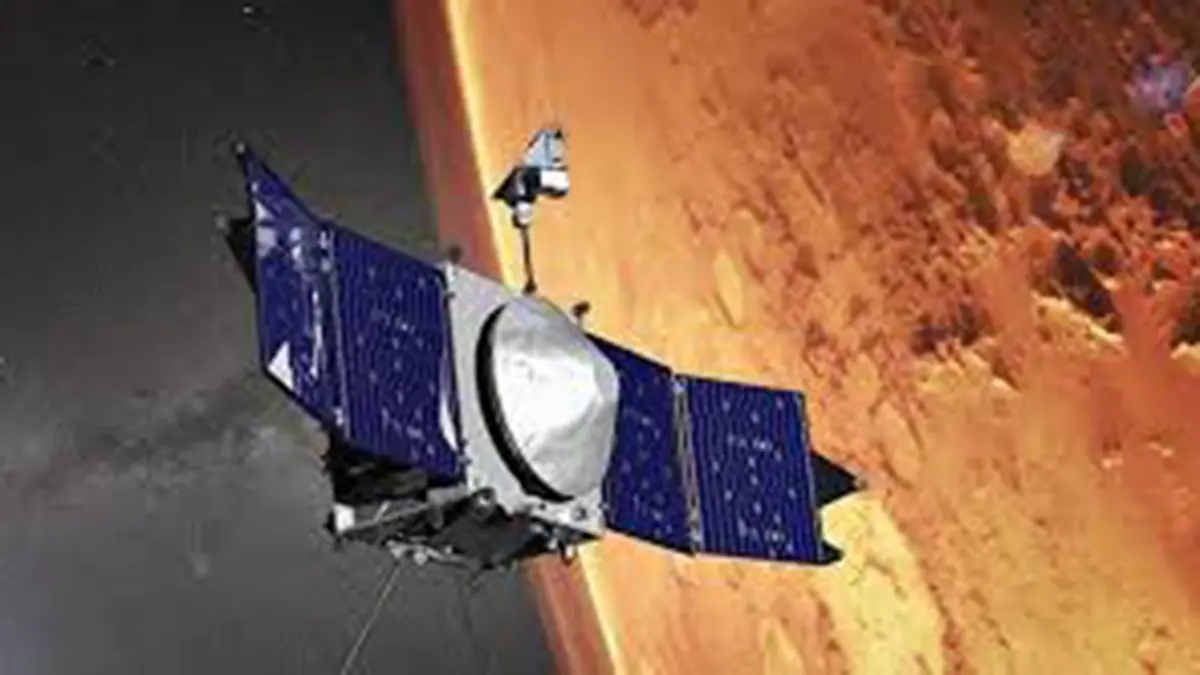
NASA’s Mars Atmosphere and Volatile Evolution (MAVEN) spacecraft recently detected the Zwan‑Wolf effect in the Martian ionosphere. The phenomenon, long predicted but never observed on an unmagnetised planet, was recorded during a powerful solar storm in December 2023. Scientists reported their findings in May 2026 and said the event will help explain how space weather interacts with planets that lack global magnetic fields, like Mars.
Background
The Zwan‑Wolf effect was first theorised in the 1970s by space physicists B. J. Zwan and R. A. Wolf. They predicted that intense streams of charged particles could squeeze and rearrange plasma along magnetic field lines, creating a localised density depletion. On Earth the planet’s strong magnetic field confines these flux tubes, but Mars has no global magnetosphere. Until MAVEN’s discovery it was unclear whether flux‑tube dynamics could occur around unmagnetised bodies.
What MAVEN observed
- During the 27 December 2023 solar storm, MAVEN detected large streams of ions flowing into the upper atmosphere along localised magnetic field lines draped over Mars.
- The incoming plasma compressed the local ionosphere, creating a region of low density that matched the predicted characteristics of the Zwan‑Wolf effect.
- Scientists linked the event to flux tubes generated by Mars’s interaction with the solar wind. Although Mars lacks a global field, crustal magnetic anomalies can form localised lines that behave like flux tubes.
- The observation suggests that space weather can erode the Martian atmosphere more efficiently than previously thought, as compressed plasma channels allow charged particles to penetrate deeper.
Implications
- Understanding the Zwan‑Wolf effect on Mars may improve predictions of atmospheric loss and climate evolution on unmagnetised planets.
- The findings also inform planning for crewed missions, because intense space‑weather events could expose astronauts to higher radiation levels when the ionosphere is compressed.
- Similar mechanisms may operate at Venus or Titan, so scientists plan to look for analogous signatures in data from other missions.
Conclusion
MAVEN’s detection of the Zwan‑Wolf effect demonstrates that even planets without global magnetic fields can experience complex space‑weather dynamics. The event provides a natural laboratory for studying how charged particles interact with thin atmospheres and offers insights into the long‑term evolution of Mars and other bodies.
Source: NDTV