

Why in news?
The Union government announced a conditional relaxation of sugar stockholding limits for bulk consumers on 18 September 2026. Such consumers may hold up to 30 days of consumption, compared with the existing 15-day limit. However, stocks above the first 15 days must come from sugar imported under specified routes: the Advance Authorisation Scheme and Tariff Rate Quota. The limit for purchases from the open market remains 15 days of consumption. The measure aims to give industrial users more flexibility before the festival season without drawing the entire additional requirement from domestic supplies. Weekly stock disclosure remains part of the arrangement, making the source of the extra sugar central to understanding the announcement.
What advance authorisation normally does
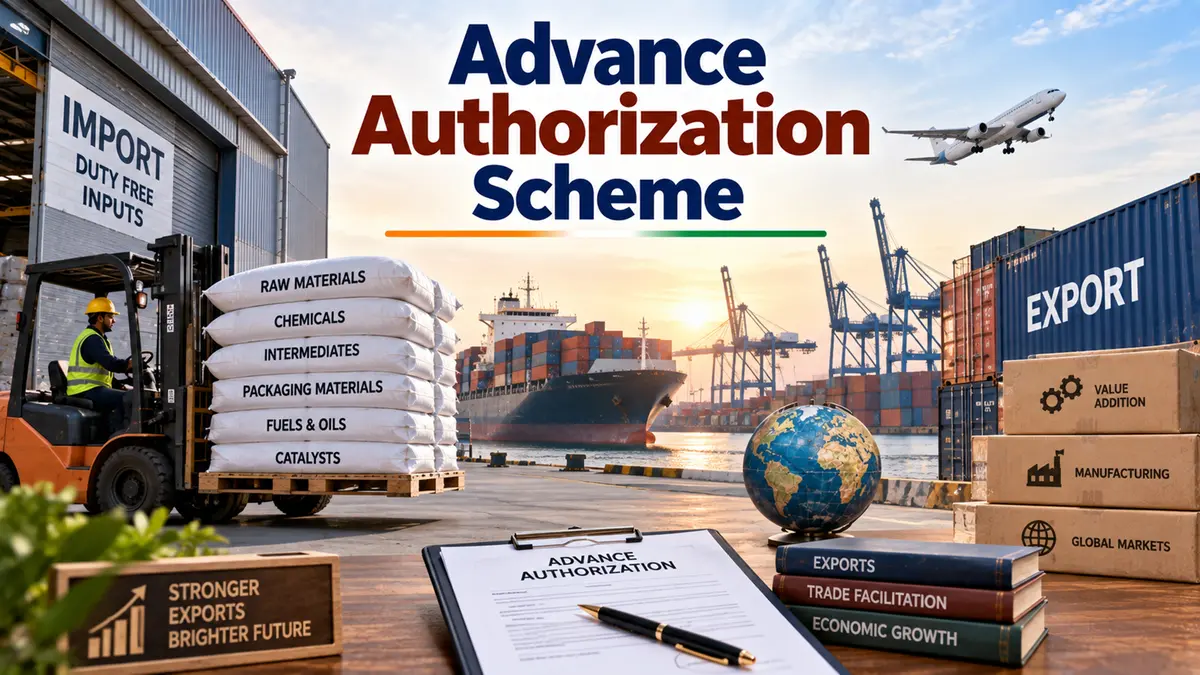
The Advance Authorisation Scheme supports production for export by permitting eligible inputs to be imported without specified duties. It is administered through the Directorate General of Foreign Trade under the Foreign Trade Policy. The central link is between an imported input and an export product. The scheme is therefore not a general permission to import any commodity cheaply for unrestricted sale in the domestic market.
Under the policy, inputs normally need to be physically incorporated into the export product, with allowances for normal wastage. Certain materials consumed in production, including eligible fuel or catalysts, can also qualify under the rules. A manufacturer exporting its own products may apply. A merchant exporter may use the scheme with a supporting manufacturer, subject to the applicable conditions. The arrangement recognises that the seller and the actual producer are not always the same business.
Why input norms and export obligations matter
Duty-free imports must be related to the quantity and nature of the product being exported. Standard Input Output Norms help define this relationship for specified products. Other routes under the policy allow assessment where standard norms are unavailable or where particular conditions apply. These mechanisms prevent the scheme from becoming an unlimited entitlement to import materials unrelated to the promised production.
An authorisation also carries an export obligation and documentation requirements. Records must connect the inputs, manufacturing activity and eligible exports. The policy generally requires a minimum level of value addition, with product-specific exceptions. The often-quoted 15 per cent figure is therefore not a universal rule applying identically to every product. The relevant authorisation, policy provisions and procedural requirements must be read together.
The actual-user condition is especially important. The authorisation and imported materials are not freely transferable simply because an export obligation has been completed. The policy separately addresses disposal of products manufactured using duty-free inputs. This distinction prevents confusion between an imported raw material, the authorisation attached to it and the finished product produced from it. Each can have different treatment under the rules.
How the sugar announcement should be read
The September release concerns a stockholding relaxation for bulk consumers, not a wholesale rewriting of the trade scheme. It specifies imported sugar as the source for stocks exceeding 15 days. It also preserves the 15-day limit on open-market purchases. Calling this only a “doubling of the sugar limit” would omit its central restriction. The additional allowance cannot simply be filled through more domestic open-market purchases.
Consider a purely illustrative consumer using ten tonnes a day. Fifteen days of consumption would equal 150 tonnes, while 30 days would equal 300 tonnes. The announcement does not mean that the consumer can obtain all 300 tonnes from the open market. The additional portion must meet the specified imported-source condition. This example explains the arithmetic; actual compliance depends on the applicable definition of consumption and the implementing requirements.
The release also requires bulk consumers to disclose stocks every Friday through the food department's online portal. Such reporting helps authorities examine availability and whether stock accumulation is consistent with the policy. The announcement must be read alongside import and customs conditions. In particular, it should not be used to infer that every authorisation holder has received unrestricted permission to resell imported inputs.
Why a tariff-rate quota is a different route
A Tariff Rate Quota (TRQ) applies one tariff treatment to imports within a specified quantity and another outside it. Typically, the tariff within the quota is lower. This is a way of controlling market access through quantities and duty rates. It is not the same mechanism as an export-linked authorisation. The government's sugar release names both routes, so leaving out the quota route would give an incomplete account.
The policy objective is to balance industrial continuity with domestic market stability. Additional inventory can help manufacturers plan production, while a sourcing condition seeks to limit pressure on existing domestic stocks. Whether the measure achieves that balance depends on imports, distribution, compliance and demand. Its announcement alone does not establish a guaranteed reduction in retail prices or uninterrupted supplies for every user.
Conclusion
The sugar measure combines greater stockholding flexibility with a specific imported-source restriction. Understanding advance authorisation explains why this is more complex than a simple increase in domestic purchasing power. Export obligations, actual-user rules and stock disclosures continue to matter. The essential distinction is between permission to hold additional qualifying sugar and a general exemption from the conditions governing its import and movement.