

Why in news?
A new climate modelling study warns that a complete collapse of the Atlantic Meridional Overturning Circulation could release large amounts of carbon stored in the deep ocean into the atmosphere. The researchers estimate that a shutdown would increase atmospheric CO₂ by 47–83 parts per million and cause about 0.2 °C of additional global warming, offsetting any cooling effect from weaker ocean currents.
Background
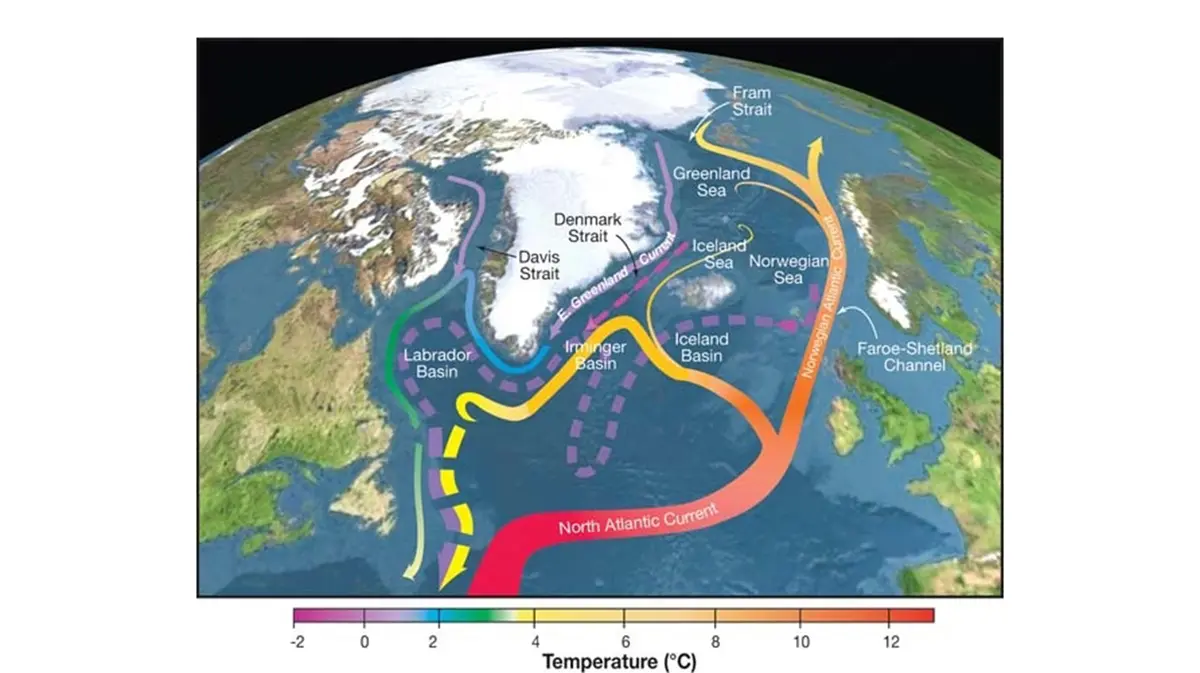
The AMOC is a system of ocean currents that forms part of the global “conveyor belt.” Warm, salty surface water flows northward from the tropics along the Gulf Stream. In the high latitudes of the North Atlantic, it cools, becomes denser and sinks into the deep ocean before travelling southwards at depth and eventually upwelling in the Southern Ocean. This circulation transfers heat to northern Europe, moderates regional climates, and helps distribute nutrients and carbon.
Implications of a collapse
- Carbon release: The modelled collapse triggers deep convection in the Southern Ocean. Carbon‑rich waters that were previously isolated rise to the surface and release CO₂, increasing atmospheric concentrations and adding to global warming.
- Climate effects: A shutdown could lead to significant cooling in the Arctic (up to 7 °C) while warming Antarctica by around 6 °C. Changes in rainfall patterns could shift tropical rain belts, affecting monsoons in Africa, Asia and the Americas.
- Sea level rise: Slower overturning would reduce northward transport of warm water, causing sea levels to rise along the North American east coast.
- Early warning: Observations show that the AMOC has weakened in recent decades, but a full collapse is not imminent. Scientists emphasise reducing greenhouse‑gas emissions to lessen the risk of crossing critical thresholds.
Source: Nature Communications · NOAA