

Why in news?
Delegations from Armenia and Azerbaijan met in Aghveran, Armenia, for the thirteenth session of their commissions on border delimitation and security. They agreed on guidelines for mapping the interstate border and documenting the process, signalling progress in normalising relations.
Background
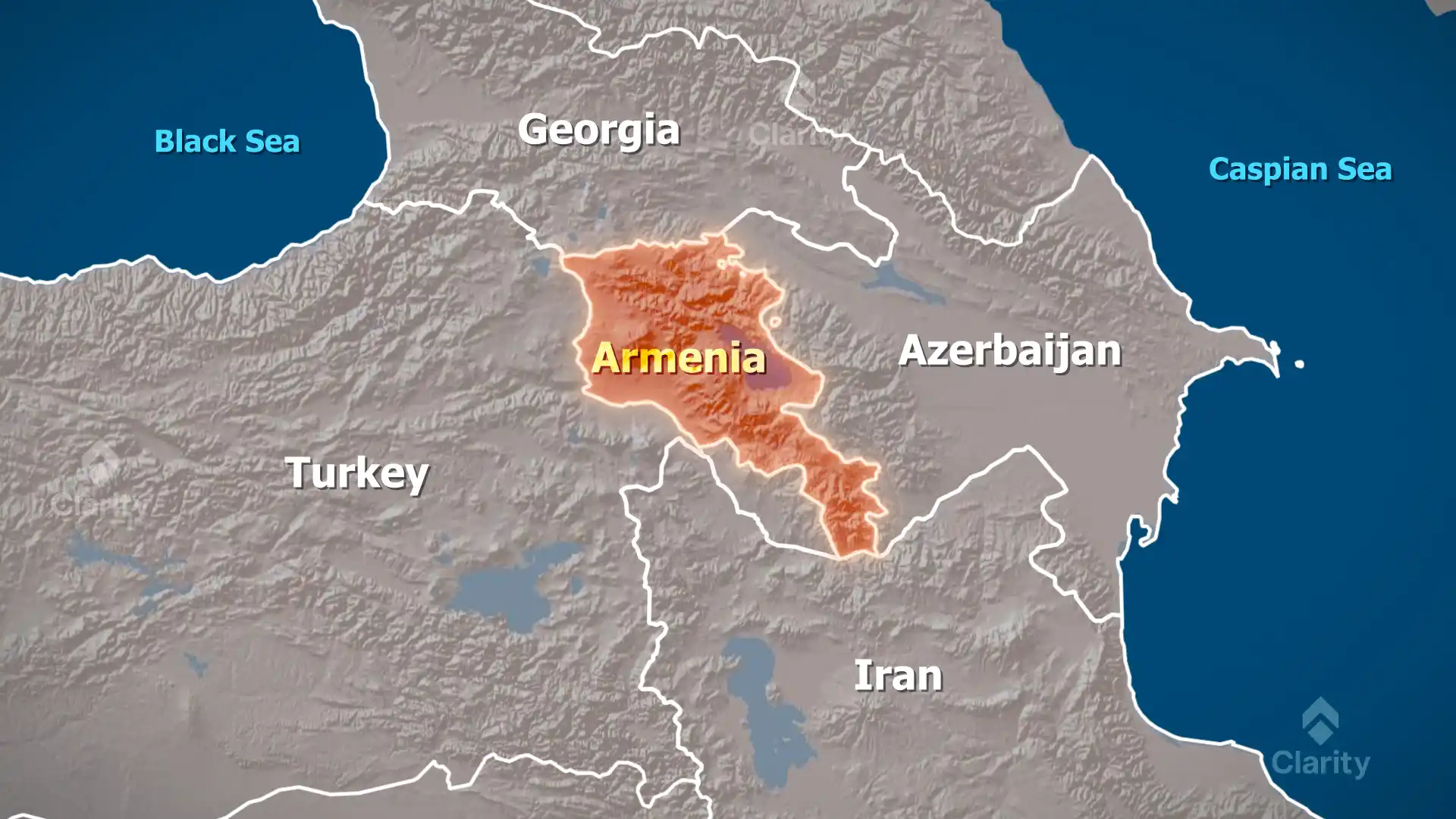
Armenia is a landlocked country in the South Caucasus. Bounded by Georgia, Azerbaijan, Iran and Turkey, it covers about 29,800 square kilometres and has a population of roughly 3.2 million. Much of the country lies on the Armenian Highland, giving it an average elevation around 1,800 metres. Mount Aragats (4,090 m) is the highest point.
Armenia is often called the world’s first Christian nation after King Tiridates III adopted Christianity as a state religion in the early fourth century. Over centuries the region was ruled by Persian, Ottoman and Russian empires. After the collapse of the Soviet Union in 1991 Armenia declared independence. Since then it has faced conflict with neighbouring Azerbaijan over Nagorno‑Karabakh, a mountainous enclave that was part of Soviet Azerbaijan but inhabited mostly by ethnic Armenians. A war in 2020 allowed Azerbaijan to recapture several districts, and a 2023 offensive led to the dissolution of the self‑proclaimed Republic of Artsakh. Many residents fled to Armenia.
Key points
- The April 2026 meeting established methods for creating border maps and verifying coordinates.
- Both sides emphasised adherence to the Almaty Declaration of 1991, which calls for recognising Soviet‑era administrative borders.
- Delimitation aims to prevent accidental incursions and reduce the risk of renewed conflict.
- The process is part of broader efforts to normalise relations, reopen transport links and promote trade.
- Civil society groups hope that clear borders and peace agreements will allow refugees to return and protect cultural heritage.
Conclusion
The delimitation talks between Armenia and Azerbaijan offer cautious hope for lasting peace in the South Caucasus. Progress will require political will, respect for international principles and attention to the humanitarian needs of people affected by decades of conflict.