

Why in news?
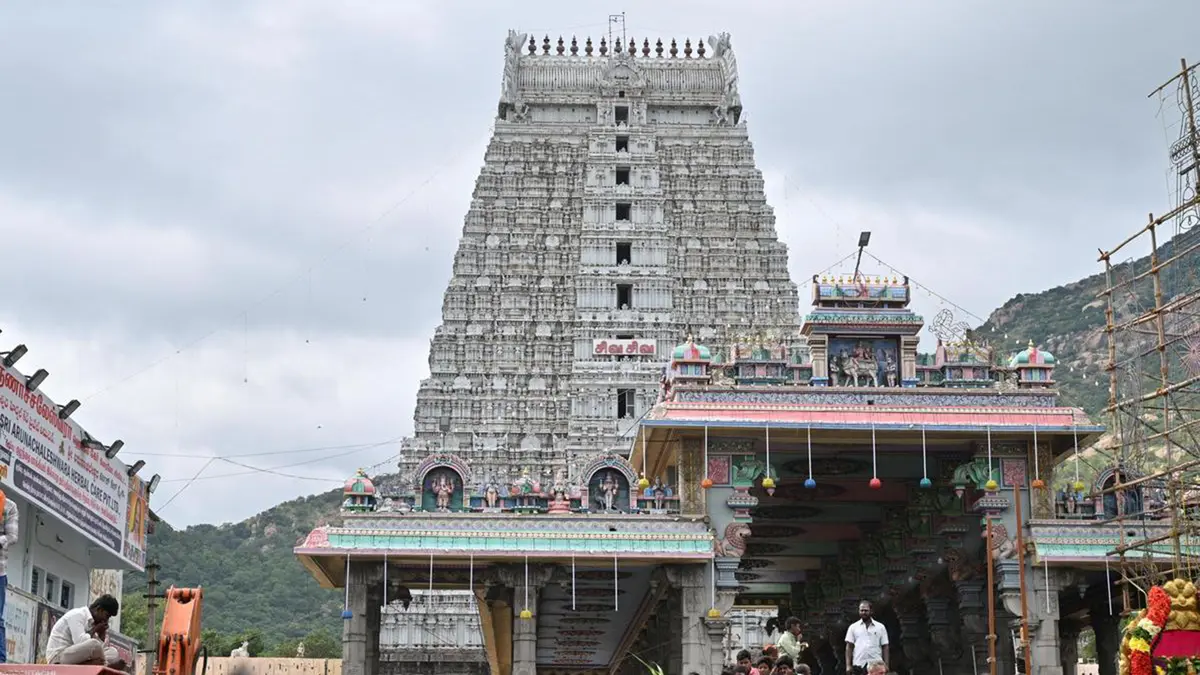
Police arrested a man over unauthorised access inside Arunachaleswarar Temple. He allegedly used duplicate keys to admit devotees for worship. The incident occurred at Tiruvannamalai in Tamil Nadu. It raised concerns about access control within a major heritage complex.
Background
Arunachaleswarar Temple, also widely called Annamalaiyar Temple, stands at the base of Arunachala Hill in Tiruvannamalai.
The principal deity is Shiva as Arunachaleswarar or Annamalaiyar, alongside the goddess Unnamulai Amman.
The sacred hill rises about 800 metres above sea level and is revered as Shiva’s own form.
Why is the temple religiously important?
The temple is one of five Pancha Bhoota Sthalams, where Shiva temples represent the basic elements.
| Temple | Location | Represented element |
|---|---|---|
| Arunachaleswarar | Tiruvannamalai, Tamil Nadu | Fire or Agni |
| Ekambareswarar | Kanchipuram, Tamil Nadu | Earth or Prithvi |
| Jambukeswarar | Tiruchirappalli, Tamil Nadu | Water or Jala |
| Sri Kalahasteeswara | Srikalahasti, Andhra Pradesh | Air or Vayu |
| Thillai Nataraja | Chidambaram, Tamil Nadu | Space or Akasha |
The central sacred story
During a traditional dispute between Brahma and Vishnu, Shiva appeared as an endless pillar of fire.
Neither deity found its limits, so Arunachala represents Shiva’s boundless fiery form.
The temple worships this divine fire through a linga, while treating the hill itself as sacred.
A short construction history
Arunachala’s literary traditions predate the surviving complex, whose stone structures developed through several royal periods.
- Ninth century: Early Chola rulers began major parts of the present stone structure.
- Later Chola period: Rulers added inscriptions, shrines and endowments.
- Hoysala period: Patrons contributed during their influence in the Tamil region.
- Vijayanagara period: Major gateways, halls and enclosures expanded the complex.
- Nayaka period: Further additions continued the Vijayanagara architectural tradition.
No single ruler built the whole temple, whose present form records many centuries of patronage.
Architecture
The temple is a major Dravidian architecture example covering about 25 acres.
Five concentric precincts organise shrines, courtyards and processional spaces, with large walls separating their zones.
Four major gopurams, or gateway towers, face the main directions and carry many sculptures across rising tiers.
The eastern Rajagopuram rises 66 metres, and its eleven tiers make it among India’s tallest temple gateways.
The complex contains a renowned thousand-pillared hall, generally associated with the Vijayanagara period.
Karthigai Deepam
Karthigai Deepam, the temple’s most famous festival, celebrates Shiva’s appearance as the endless pillar of fire.
A large beacon burns on Arunachala Hill, visible from far across the surrounding plain during the festival.
The beacon forms part of a longer temple festival that brings very large gatherings to Tiruvannamalai.
Girivalam
Girivalam means devotional circumambulation, with pilgrims walking about fourteen kilometres around the sacred hill.
Many devotees perform it during each full moon along a route containing eight directional Shiva lingas.
They follow the directional sequence of Indra, Agni, Yama, Nirriti, Varuna, Vayu, Kubera and Ishana.
Why access control matters
The complex combines worship and history, while restricted areas may contain ritual objects, records or sensitive entrances.
Duplicate keys can bypass supervision, create crowd risks and weaken protection for heritage or temple property.
Security measures should respect worshippers while clear procedures protect both religious practice and historic fabric.
Conclusion
Arunachaleswarar Temple unites landscape, theology, architecture and worship, requiring both sensitive management and strong accountability.