

Why in news?
Indian and Chilean officials reviewed their trade negotiations in Santiago on 26 August. Both sides are pursuing a Comprehensive Economic Partnership Agreement, called CEPA. They aim to conclude negotiations before the end of 2026. Market access and critical minerals remain important parts of the discussions.
The latest talks
India’s Commerce Secretary Rajesh Agrawal met Chilean Vice-Minister Paula Estévez Weinstein. Their governments said most negotiating chapters were closed. Work continued on market access, critical minerals and other sensitive issues. A target date does not guarantee a final agreement.
India identified health care, medicines, energy, minerals and agriculture as promising sectors. Machinery and engineering also formed part of the agenda. Chile sees India as a large market for export diversification. Both sides described a balanced outcome as necessary.
A CEPA usually reaches beyond tariff reductions. It can include services, investment, standards and customs procedures. The final scope depends on agreed text. Ratification or domestic legal steps may follow signature.
Existing trade framework
India and Chile signed a Preferential Trade Agreement in March 2006. It entered into force during 2007. The two countries expanded it during May 2017. The expanded arrangement covers many more tariff lines.
India offered preferences on 1,031 tariff lines. Chile offered preferences on 1,798 lines. The covered products include chemicals, medicines, machinery and agricultural goods. Rules of origin determine which goods qualify.
A preferential agreement is narrower than a comprehensive partnership. It can lower duties on selected products without covering the wider economy. CEPA negotiations seek a deeper structure. Sensitive domestic sectors still need safeguards and adjustment time.
Chile’s exact geographic setting
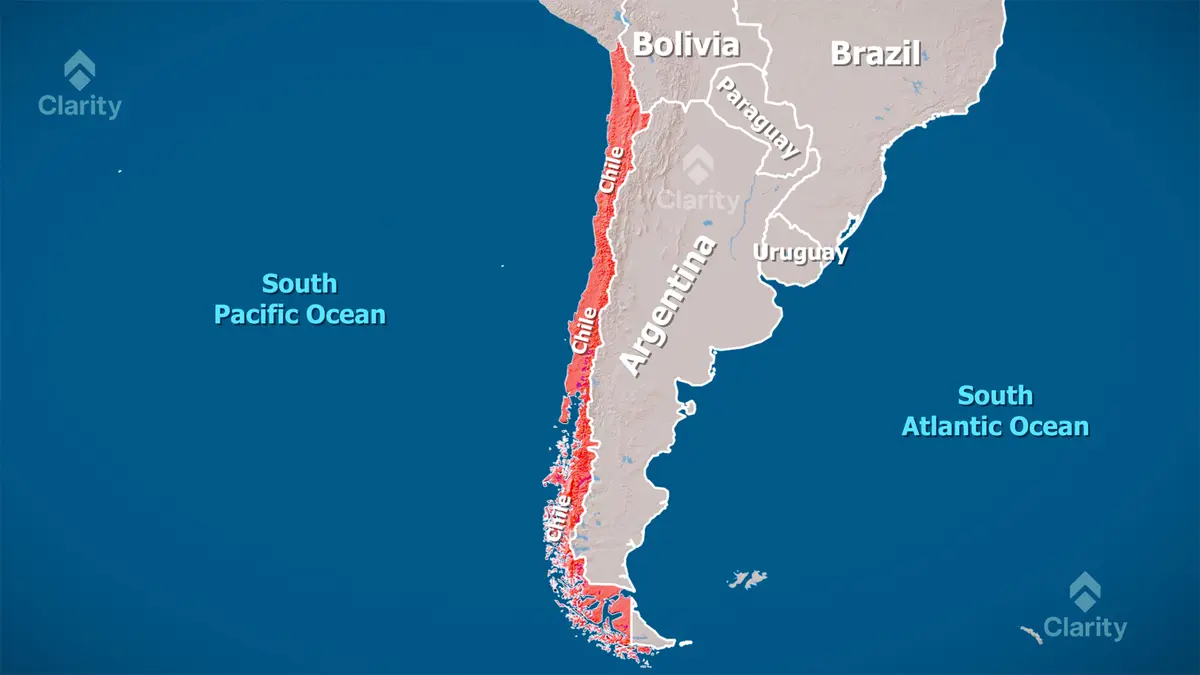
Chile forms a long coastal strip in south-western South America. The Pacific Ocean lies to the west. The Andes rise along the eastern side. Peru, Bolivia and Argentina share its land borders.
The country extends roughly 4,300 kilometres from north to south. Its average width is about 180 kilometres. The north contains the Atacama Desert. Central Chile has Mediterranean conditions, while the south contains forests, fjords and glaciers.
This geography shapes logistics and production. The Andes hold major mineral deposits. Central valleys support fruit and wine. Pacific ports connect Chile with Asian markets across a long sea route.
Copper, lithium and strategic supply chains
Chile was the leading mined-copper producer during 2024. The United States Geological Survey placed its share near twenty-four per cent. Chile was also the second-largest lithium producer. These rankings correct claims that it led both commodities.
Copper is central to electrical networks, motors and renewable-energy systems. Lithium is important in many rechargeable batteries. India’s energy transition will increase demand for both. A trade agreement may improve access and encourage investment.
Mineral partnership involves more than raw imports. Processing, recycling and research can create wider value. Long contracts may reduce supply uncertainty. They should not produce excessive dependence on one country or technology.
Environmental and social considerations
Copper mining can consume water and create tailings. Lithium brine operations occur in arid salt-flat ecosystems. Water balances affect communities and biodiversity. Commercial agreements cannot replace strong environmental assessment.
Indigenous communities may hold rights and knowledge in mineral regions. Consultation must be early and meaningful. Transparent monitoring can build confidence in projects. Buyers can also require responsible sourcing across their supply chains.
Climate change intensifies Chile’s drought and water stress. Mining policy must reflect local scarcity. Technology can improve efficiency but cannot remove every impact. Trade growth should therefore include measurable sustainability commitments.
Opportunities and negotiating challenges
Indian medicines and health services may find a wider Chilean market. Chile can expand food, wine and mineral exports. Digital and professional services create additional opportunities. Small businesses need simple procedures to use any preferences.
Agricultural access requires sanitary and phytosanitary rules. These protect health but can become complex barriers. Regulators need scientific dialogue and transparent timelines. Recognition should not weaken safety.
Rules of origin must prevent goods from merely passing through one country. Customs systems should also verify claims efficiently. Services commitments must protect public regulation and personal data. Careful drafting matters more than the agreement’s label.
Long shipping distances raise freight and inventory costs. Reliable port links and predictable customs can partly offset them. Businesses also face exchange-rate and commodity-price risk. A CEPA creates conditions, but firms still make the commercial decisions.
Negotiations have advanced, but no CEPA exists yet
The governments target completion during 2026. Final text, signature and domestic procedures still remain necessary.
Conclusion
The Santiago meeting moved India–Chile economic talks closer to a possible agreement. Existing preferences give the partnership a working base. Copper, lithium, medicines and agriculture offer strong complementarity. Sustainability and sensitive sectors need careful final provisions. A successful CEPA should create usable opportunities while preserving responsible regulation.