

Why in news?
Egypt's antiquities authorities have announced a pyramid-shaped tomb at Bir al-Shaghala in Dakhla Oasis, in the country's Western Desert. The 24 September announcement describes a mud-brick monument associated with a married couple. A Greek funerary inscription helps place it around the late third or early fourth century of the Common Era. Egyptian religious imagery appears alongside that Greek text within a Roman-period setting. This combination makes the discovery valuable for understanding how communities expressed identity and beliefs under Roman rule. It is a newly reported burial monument, not an Old Kingdom royal pyramid or evidence that pyramid-shaped tombs were previously unknown here.
An oasis within the Western Desert
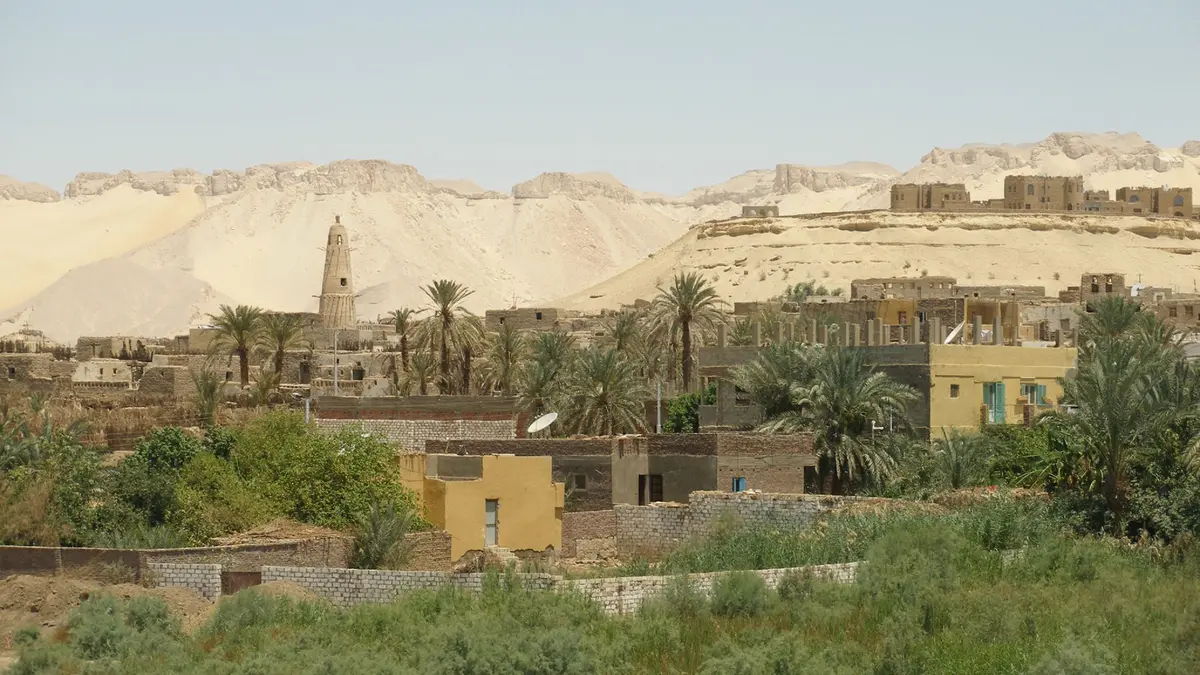
Dakhla lies in Egypt's New Valley Governorate, west of the Nile Valley. The oasis is connected by the desert road towards Farafra to the north and Kharga to the east. Mut is its principal settlement. These relationships locate the discovery within Egypt's inland oasis system, rather than on the Mediterranean coast or within the Nile floodplain.
An oasis is a place where accessible water supports settlement and vegetation within an otherwise dry landscape. Dakhla's wells and springs explain why habitation could persist in this desert setting. Its archaeological remains therefore belong to a lived landscape of water, cultivation and movement. The surrounding desert did not make its communities completely isolated from wider cultural influences.
A cemetery with a longer research history
Bir al-Shaghala is a cemetery near Mut, not the name of the whole oasis. Earlier archaeological work documented substantial tombs combining excavated spaces, mud-brick construction and sandstone architectural elements. A study in the French Institute of Oriental Archaeology's bulletin described another tomb with a pyramidal upper structure. That earlier publication establishes a local architectural context; it does not describe the same newly announced discovery.
The distinction changes how the news should be understood. The importance of a newly excavated tomb can lie in its inscriptions, decoration and relationship to surrounding burials. It need not be the first example of its general shape. Comparing monuments within one cemetery can reveal both shared conventions and choices made for particular individuals.
What the new evidence says
The official account describes a stepped approach, sandstone entrance and decorated burial spaces. Its Greek elegy contains nineteen lines. Egyptian elements include a winged solar disc and funerary religious imagery. A stone inscription refers to a man named Psychtis. The suggestion that he held a judicial role remains a preliminary interpretation, rather than a settled biographical fact.
The language of an inscription, the style of a building and its political period answer different questions. A Greek text need not make a tomb Greek in every respect. Equally, Egyptian imagery does not place it automatically in the age of the great royal pyramids. Here, the evidence allows several traditions to be studied together without collapsing them into one label.
How archaeologists build a chronology
A tomb's history can involve construction, initial burial, later visits and reuse. The official announcement mentions pottery and a coin associated with Emperor Constantine, alongside the architectural and written evidence. Such objects help investigators examine the sequence of use. Their presence does not mean that every part of the monument was built at exactly the same time.
This is why an archaeological date is usually assembled from several kinds of evidence. An inscription can identify people or provide a historical setting. Construction details can be compared with other monuments, while objects must be understood in their excavated positions. The reported Roman-period dating is more informative than a rounded description such as “1,700 years old” used alone.
Water connects the ancient setting with the present
The wider desert region depends heavily on groundwater. The Nubian Sandstone Aquifer System extends beneath parts of Egypt, Libya, Sudan and Chad. The Global Environment Facility describes it as a major store of ancient groundwater. Much of this water accumulated under earlier climatic conditions, so extraction cannot be treated as drawing from a rapidly replenished annual supply.
The four countries agreed on a shared management programme in 2013. Its concerns included groundwater monitoring, water quality and the consequences of increased abstraction. This modern issue helps explain the enduring geographical significance of desert water sources. It does not, by itself, reconstruct the precise water supply used by the occupants of the newly discovered tomb.
Conclusion
The Dakhla discovery adds a specific household's funerary evidence to an already significant oasis cemetery. Its strongest contribution is the connection between a dated inscription, local architecture and several cultural traditions. Further study can refine the occupants' identities and the monument's sequence of use. The oasis setting remains essential to understanding why this community existed in the desert at all.