

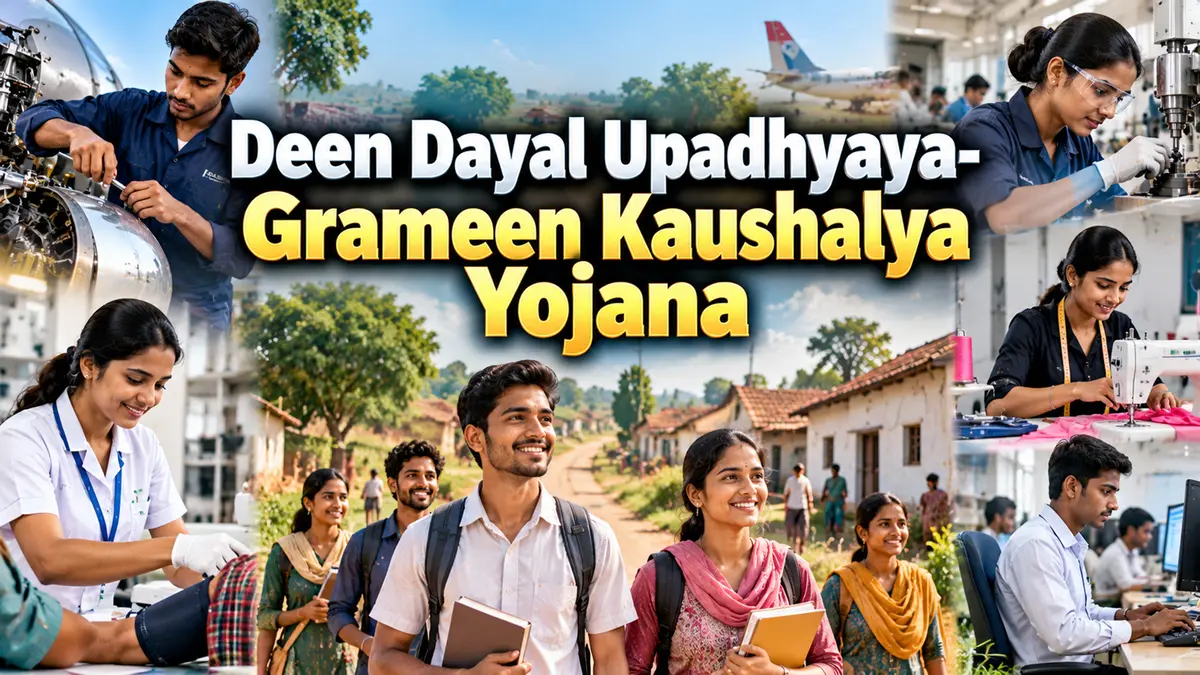
Why in news?
The Ministry of Rural Development plans to begin 2,015 training batches in October, covering about 70,000 rural young people. Announced on 25 September, the expansion spans 24 states and Union territories. It falls under Deen Dayal Upadhyaya–Grameen Kaushalya Yojana, commonly called DDU-GKY, which connects skills training with employment opportunities for rural youth from poor households. The announcement comes within a wider allocation of training targets under the revised programme. Its significance is the planned movement from approved projects into actual training. The figures describe upcoming batches and intended participants, not people who have already completed courses or secured lasting jobs. Those outcomes will depend on training quality, employer demand and support after placement.
Why a rural livelihoods programme includes skills training
Launched on 25 September 2014, DDU-GKY forms part of the rural livelihoods framework administered by the Ministry of Rural Development. It seeks to help poor rural households diversify their sources of income. Training is intended to open access to work that requires identifiable skills, rather than merely provide a certificate. The programme therefore connects selection, counselling, instruction, assessment, placement and follow-up. Each stage addresses a different obstacle between a young person's interest in work and sustained earnings.
The standard target group is poor rural youth aged 15–35. The revised guidelines allow a higher upper-age limit for specified groups, including women and persons with disabilities. They also require trainees to be at least 18 by completion of training. Eligibility therefore cannot be reduced to one age range without its qualifications. The guidelines set inclusion requirements at state level, including at least 33% women and at least 5% persons with disabilities.
What the revised framework changes
The 2.0 guidelines were issued on 5 May 2025 with applicability from 1 April 2025. Projects approved and commenced by 31 March 2025 continue under the earlier guidelines and associated instructions. This transition matters when comparing different training batches. An older project's conditions cannot automatically be presented as the rules for a newly approved one, or vice versa. The programme's name continues, but the applicable framework depends on the project's position within that transition.
The new approach places greater emphasis on verified employment lasting at least six months. The employment may be continuous or non-continuous, and may involve more than one employer. The guidelines recognise wage employment, self-employment and gig work, subject to their requirements and evidence. An appointment letter alone is not equivalent to six months of paid work. This is why verification of earnings and continued engagement forms part of the programme's assessment.
Training must connect a learner with a real occupation
The guidelines specify a minimum course duration of 576 hours, including required non-domain components. Domain training teaches the particular occupation; other instruction supports communication, digital use and employability. Courses are aligned with recognised skill qualifications. Depending on the occupation, workplace training can complement classroom learning. These elements should fit together: a learner needs practical competence, but also the ability to understand instructions and function within the workplace.
The ministry's September backgrounder describes courses running from three to twelve months. The duration should reflect the work being taught, not serve as a measure of quality by itself. A well-equipped classroom is also insufficient if the instruction does not match available jobs. Employer engagement, trainer competence and independent assessment therefore matter alongside the number of seats. The guidelines require assessment and certification rather than treating attendance as proof of occupational ability.
Why placement is not the end of the process
Taking a first job can involve moving away from one's home district or state. Accommodation, transport, unfamiliar working arrangements and separation from family can make that transition difficult. Migration support centres are intended to provide help such as counselling, accommodation assistance and information about employment. Their purpose is to address reasons a trained person might leave suitable work. They do not remove every risk associated with migration or guarantee that every placement is appropriate.
The revised framework provides six months of post-placement support and tracks retention over a year. The published cost norms provide ₹7,620 in post-placement support and a separate ₹5,000 retention incentive subject to conditions. These amounts serve different purposes and should not be described as the worker's salary. The retention provision is linked to employment over a 365-day period, with a permitted limit on breaks. Evidence of employment remains necessary to establish eligibility.
Further learning is also part of the design. The guidelines provide a route for upskilling and reskilling after at least twelve months of verified placement. That reflects the difference between obtaining an entry-level job and building a career. A first course may create an opening, while later training can help a worker take on more demanding responsibilities. Whether that progression occurs must be assessed from actual work and learning records.
Reading the expansion figures correctly
The 25 September announcement reports training targets of about 5.6 lakh allocated across more than 1,200 projects. It also describes a wider target exceeding nine lakh across 31 participating states for 2026–28. These are different levels of the programme's planning pipeline. An allocation authorises or plans activity; a batch opening begins delivery; certification records assessed completion; verified placement records employment. Adding these categories together would count intentions and outcomes as though they were the same thing.
The practical test is therefore a sequence of results. Did the intended learners join, complete relevant training and pass assessment? Did employers provide suitable work, and did earnings continue beyond the initial placement? Answers should be examined for different groups and locations, not only as an overall total. This would show whether the expansion broadens opportunity for people facing the greatest barriers, rather than simply increasing administrative throughput.
Conclusion
The planned October batches represent a substantial next step in delivering rural skills training. Their value will depend on how effectively instruction, assessment, employment and post-placement support connect. The revised framework makes sustained, evidenced work more central to that judgement. Success should ultimately be visible in reliable earnings and better employment choices for trainees. The number of approved projects or announced seats cannot establish those outcomes.