

Why in news?
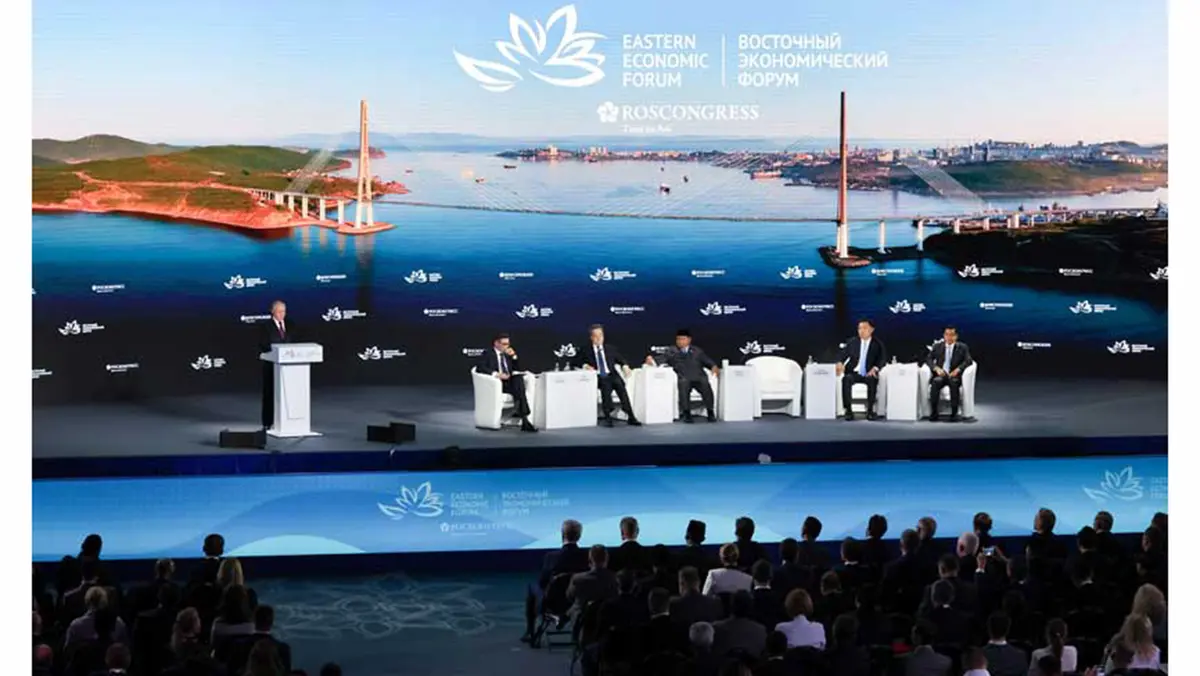
Russia held the eleventh Eastern Economic Forum in Vladivostok from 1 to 4 September 2026. The meeting took place at Far Eastern Federal University on Russky Island. Its theme connected regional development with benefits for residents. Government, business and foreign delegates discussed investment, technology, logistics and Asia-Pacific cooperation.
What the 2026 forum covered
The official programme contained more than seventy sessions across five broad tracks. One track addressed living and working conditions across the Far East. Others covered private investment, technology, infrastructure and international cooperation. The programme linked large projects with population and social concerns.
Russia’s Roscongress Foundation organised the event with federal government support. Indonesian President Prabowo Subianto attended as the principal foreign guest. Delegations also came from governments, companies and multilateral organisations. Their participation reflected the region’s outward economic orientation.
Different reports later gave conflicting totals for agreements and their stated value. This edition therefore does not present one total as settled fact. Announced agreements can also include intentions rather than completed investment. Delivery matters more than headline figures.
Why Russia created the forum
The Eastern Economic Forum has met annually since 2015. It promotes development across Russia’s large but sparsely populated eastern territory. The region holds minerals, forests, fisheries and major energy resources. Yet distance, climate and limited infrastructure raise project costs.
The wider Far Eastern Federal District covers eleven federal subjects. Russia’s Federation Council gives its area as about 6.95 million square kilometres. That exceeds forty per cent of Russia’s territory. Its population remains below eight million, producing a very low average density.
Federal policy uses tax incentives, special development zones and public infrastructure to attract capital. Supporters expect jobs, processing industries and stronger Asian trade. Critics watch environmental risks, labour shortages and dependence upon raw-material exports. Local benefits depend upon how projects are designed and governed.
Vladivostok and the region’s geography
Vladivostok stands beside Peter the Great Gulf on the Sea of Japan. It lies close to China and North Korea within Northeast Asia. The city is Russia’s principal Pacific port and hosts its Pacific Fleet. Russky Island sits across a narrow strait from the urban centre.
The Far East stretches from Pacific coasts to Arctic seas. It has land borders with China, Mongolia and North Korea. Across the Bering Strait, its far north-east faces the United States. Japan lies across neighbouring seas to the south-east.
This position connects Arctic routes, Pacific shipping and Eurasian rail corridors. It also makes the region strategically sensitive. Ports need roads, railways, power and reliable winter operations. Economic plans therefore have both commercial and security dimensions.
India’s interest in the Russian Far East
India and Russia have a bilateral programme for Far East cooperation from 2024 to 2029. It includes resources, energy, agriculture, transport and other possible sectors. India seeks diversified energy supplies and commercial access. Russia seeks investment and broader Asian partnerships.
The proposed Chennai–Vladivostok Eastern Maritime Corridor is central to this discussion. It would link India’s east coast with Russia’s Pacific gateway. The route can pass through Southeast Asian and Northeast Asian waters. Actual savings depend upon ports, cargo, insurance and operating conditions.
India has also discussed coking coal, hydrocarbons, diamonds and skilled manpower. Each sector needs commercial and environmental assessment. Political goodwill cannot make an uneconomic project viable. Sanctions and payment arrangements create additional practical constraints.
What the forum can and cannot achieve
A forum can introduce investors, coordinate agencies and announce policy support. It cannot guarantee financing or construction. Large Far Eastern projects face long distances and difficult weather. Transparent contracts and measurable milestones are essential.
Development should also consider Indigenous communities and fragile ecosystems. Mining, logging and ports can transform local land and water. Consultation and environmental assessment must begin before construction. Social services should grow alongside industrial capacity.
International participation gives Russia economic and diplomatic visibility in Asia. However, geopolitical tensions shape technology, banking and shipping choices. Partners will judge individual projects on risk and return. The forum’s importance therefore lies in follow-through, not ceremony alone.
Conclusion
The Eastern Economic Forum highlights Russia’s effort to develop its vast Pacific territory. Vladivostok’s geography gives that effort regional and strategic weight. India has genuine interests in resources and maritime connectivity. Projects still require viable finance, safeguards and dependable logistics. Future results should be measured through completed investments and local benefits.