

Why in news?
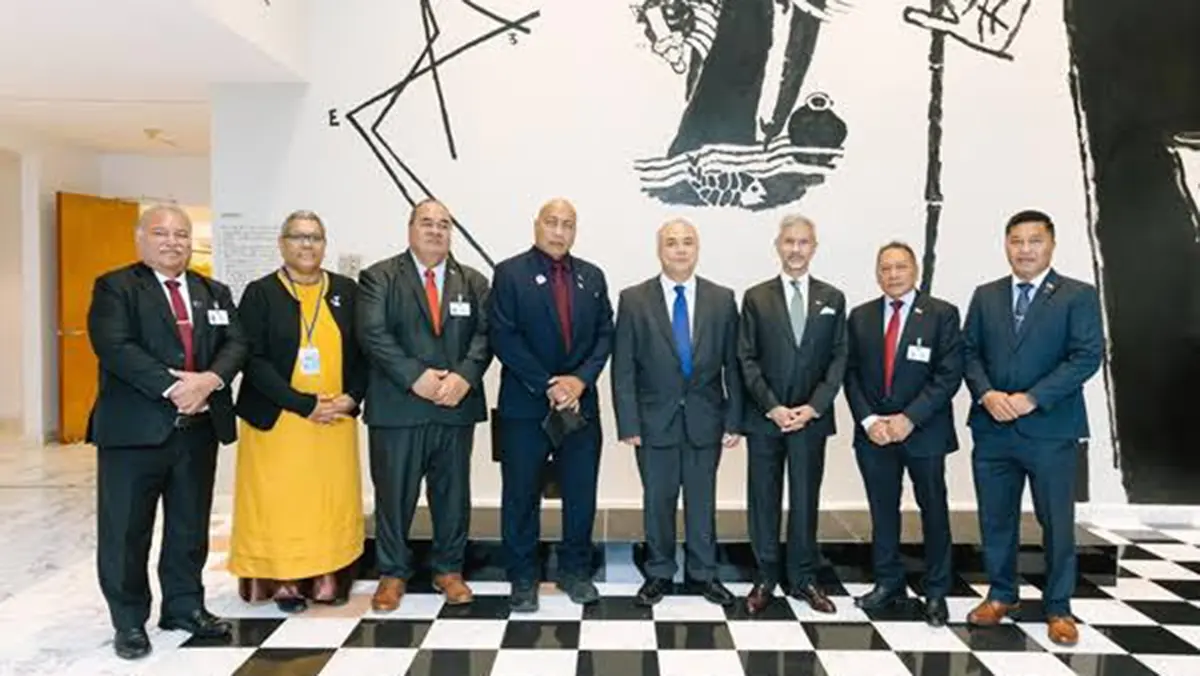
External Affairs Minister S. Jaishankar chaired the second foreign ministers' meeting of the Forum for India-Pacific Islands Cooperation on 23 September. Held in New York alongside the United Nations General Assembly, the meeting reviewed cooperation with Pacific partners and the 2023 action plan. The forum connects India with 14 Pacific island partners across a widely dispersed ocean region. Discussions covered renewable energy, climate action, disaster resilience, education, healthcare and capacity building. These subjects address practical service and infrastructure needs shaped partly by distance and island geography. The official account welcomes progress but does not certify that every earlier project is complete. This was a ministerial review, not a new leaders' summit.
How the forum developed
The Forum for India-Pacific Islands Cooperation, usually called FIPIC, began with a leaders' meeting in Suva, Fiji, in November 2014. A second summit followed in Jaipur in August 2015. These meetings created a regular framework for India's engagement with Pacific island partners. The framework allows shared priorities to be discussed together while bilateral relationships continue alongside it.
The third summit took place in Port Moresby, Papua New Guinea, in May 2023. India announced a 12-point action plan covering areas including health, skills and infrastructure support. The September 2026 meeting returned to that cooperation agenda. The sequence matters because reviewing an existing plan is different from launching every initiative for the first time.
Who belongs to the framework?
The 14 Pacific partners are Fiji, the Cook Islands, Kiribati, the Marshall Islands and the Federated States of Micronesia. They also include Naoero, Niue, Palau, Papua New Guinea and Samoa. The remaining four are the Solomon Islands, Tonga, Tuvalu and Vanuatu. Naoero is the country formerly known internationally as Nauru; the United Nations records its 2026 name change.
These partners do not all have identical constitutional arrangements. The Cook Islands and Niue are self-governing states in free association with New Zealand. They should not be casually described as New Zealand provinces. Nor should the forum be confused with the Pacific Islands Forum, a separate regional organisation with its own membership and institutions.
An ocean region, not one geographical type
The partners are spread across the Pacific's Melanesian, Micronesian and Polynesian regions. Distances between islands, capitals and larger markets can be considerable. Their territories also vary greatly. Some include low-lying coral islands, while others have large or mountainous islands. A single description such as “small low-lying islands” cannot accurately represent every member.
Papua New Guinea, for example, occupies the eastern part of New Guinea and shares a land boundary with Indonesia. Tuvalu and Kiribati face different conditions across widely dispersed island settings. These differences influence transport, infrastructure and exposure to environmental hazards. Cooperation needs to recognise that variety rather than assume one project design will work equally well throughout the region.
What the New York meeting reviewed
The official release describes high-level participation by ministers and senior representatives, rather than asserting that all 14 foreign ministers attended. It also records the participation of the Pacific Islands Forum's Secretary-General. The participants reviewed summit outcomes and welcomed progress under India's action plan. Their discussion covered both development cooperation and coordination in regional and multilateral forums.
The release does not provide a project-by-project completion audit. It therefore supports a claim that cooperation was reviewed, not that all promised facilities are operating. The distinction is particularly relevant for infrastructure and public services. An announced facility, a constructed building and a fully staffed service represent different stages of delivery.
Why health, energy and skills belong together
Healthcare in dispersed island settings can involve travel between islands or referral to distant centres. Strengthening local capability can reduce some of that burden, while specialist services require equipment and trained personnel. A health project therefore depends on more than construction. Maintenance, supplies and continuing professional skills influence whether the service remains useful after its opening.
Renewable-energy cooperation can similarly connect equipment with wider development needs. Reliable power supports clinics, communications and other services. However, installations need appropriate system design, maintenance and operating arrangements. The September discussion's combination of energy, education and capacity building reflects related requirements. Providing hardware and developing the ability to manage it are complementary tasks.
Disaster resilience adds another connection. Infrastructure and services must function through, or recover from, disruptive events. Planning, communication and trained local institutions can be as important as the physical asset. The meeting identifies resilience as a field of cooperation. Its short public account does not establish a new uniform disaster programme for every partner.
Pacific priorities should shape the partnership
The Pacific Islands Forum's 2050 Strategy places people, ocean stewardship, climate resilience and connectivity within the region's own development vision. It emphasises partnerships that respect Pacific priorities and sovereignty. This is an important context for India's engagement: island governments are participants defining their needs, not merely locations for outside initiatives.
Ocean resources and transport connect environmental and economic interests across the region. Climate change can affect coastlines, ecosystems and infrastructure, while distance influences the cost of services. Cooperation is most useful when it responds to those practical connections and to national differences. A regional framework can organise dialogue, but projects still need locally appropriate design and implementation.
Conclusion
The September meeting maintains the link between FIPIC's summit commitments and continuing ministerial engagement. Its significance lies in reviewing cooperation across connected needs such as health, energy, skills and resilience. The next meaningful evidence will be dependable services and projects suited to the partners' differing circumstances. Respect for Pacific priorities and clear reporting on delivery will matter more than treating every announcement as a completed outcome.