

Why in news?
Japanese observations of expanding discoloured water around Fukutoku-Okanoba drew attention to the submarine volcano in September 2026. Anadolu’s 29 September account, distributed through Reuters Connect, cited Japan Coast Guard images taken on 17 September. It described darker water over an area roughly seven kilometres across, compared with the previous month. The volcano lies in the Pacific, south of Japan’s main islands, and has produced temporary islands during earlier eruptions. Changes at the sea surface can help observers detect activity that is otherwise hidden underwater. However, discolouration is an observation, not confirmation of a new major eruption. Further monitoring is needed to establish what the change represents.
Where the volcano lies
Fukutoku-Okanoba is approximately five kilometres northeast of Minami-Ioto, also called South Iwo Jima, in the Ogasawara island region. It is roughly 1,300 kilometres south of Tokyo. The volcano rises from the seabed rather than forming a permanent inhabited island. Its position near the sea surface allows some activity to become visible from aircraft and satellites, although most of the volcanic structure remains underwater.
The wider Izu–Bonin arc lies above a boundary where the Pacific plate descends beneath the Philippine Sea plate. This process is called subduction. Volcanic arcs form above such zones because processes within the descending plate and overlying mantle help generate magma. The Smithsonian describes Fukutoku-Okanoba’s rocks as trachyandesitic, a classification based on their composition. The plate setting explains the source of volcanism, while conditions near the vent influence each episode’s behaviour.
Why water changes an eruption
The depth of a submarine vent strongly influences what an observer sees. In deep water, the weight of the overlying sea creates high pressure. This can suppress the rapid expansion of gases that produces an explosive plume. A substantial eruption may therefore remain largely hidden below the surface. Nearer the surface, hot volcanic material can interact more violently with seawater.
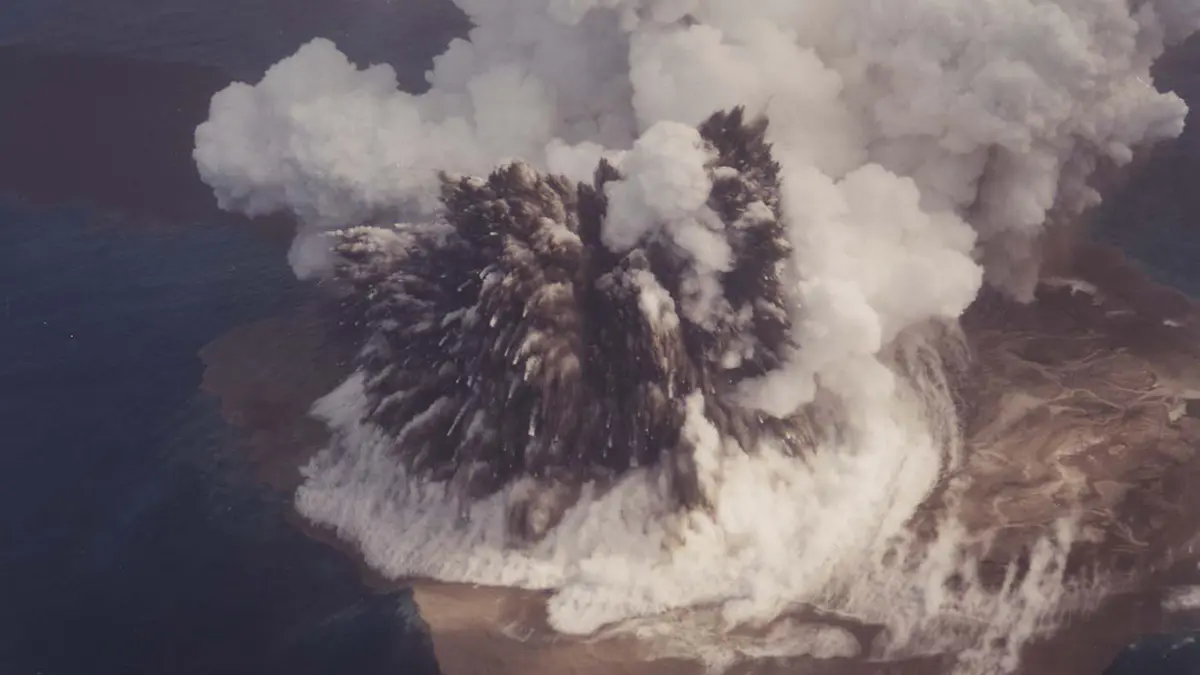
The United States Geological Survey explains that water entering a shallow active vent can generate powerful steam-driven explosions. Rapid cooling also breaks hot material into fragments. Some fragments settle around the vent, while finer material may enter an airborne plume. These processes explain how an underwater volcano can simultaneously disturb the sea, create drifting debris and pose a hazard to aircraft or vessels nearby.
Water colour provides a useful clue but needs interpretation alongside other observations. A visible patch does not directly measure the volume of magma rising below it. Its extent can also change as currents disperse material. Comparing repeated images helps establish whether a pattern is growing, shrinking or moving. It does not by itself establish the timing or scale of a future eruption.
Temporary islands and travelling pumice
The Japan Meteorological Agency’s historical catalogue records islands appearing during several earlier episodes, including those of 1904–05, 1914 and 1986. Such land can be short-lived. Waves and currents attack loose volcanic deposits, particularly before they consolidate into resistant rock. An island’s disappearance therefore does not mean the underlying volcano has vanished; the summit may simply return below the waterline.
A major eruption in August 2021 again produced a temporary island and extensive floating pumice. Pumice contains numerous spaces left by volcanic gases, which can make it sufficiently buoyant to drift. The Smithsonian records the new island’s subsequent erosion. The episode demonstrates the difference between a volcanic structure built on the seabed and the changing portion that briefly appears above sea level.
Floating debris can extend the effects of an eruption beyond its immediate location. Geological Survey accounts of other submarine eruptions describe pumice entering harbours and interfering with small-boat cooling systems. This is a general mechanism, not evidence that those impacts had already occurred around Fukutoku-Okanoba in September. It explains why monitoring includes drifting material as well as the vent and visible plume.
Conclusion
The September observations justify attention because Fukutoku-Okanoba has a history of significant shallow-water activity. They do not establish that another 2021-scale eruption is occurring. The practical task is to follow changes in the sea surface and volcanic conditions over time. Navigation and aviation decisions should rest on current official assessments, rather than treating either discolouration or a past eruption as a complete forecast.