

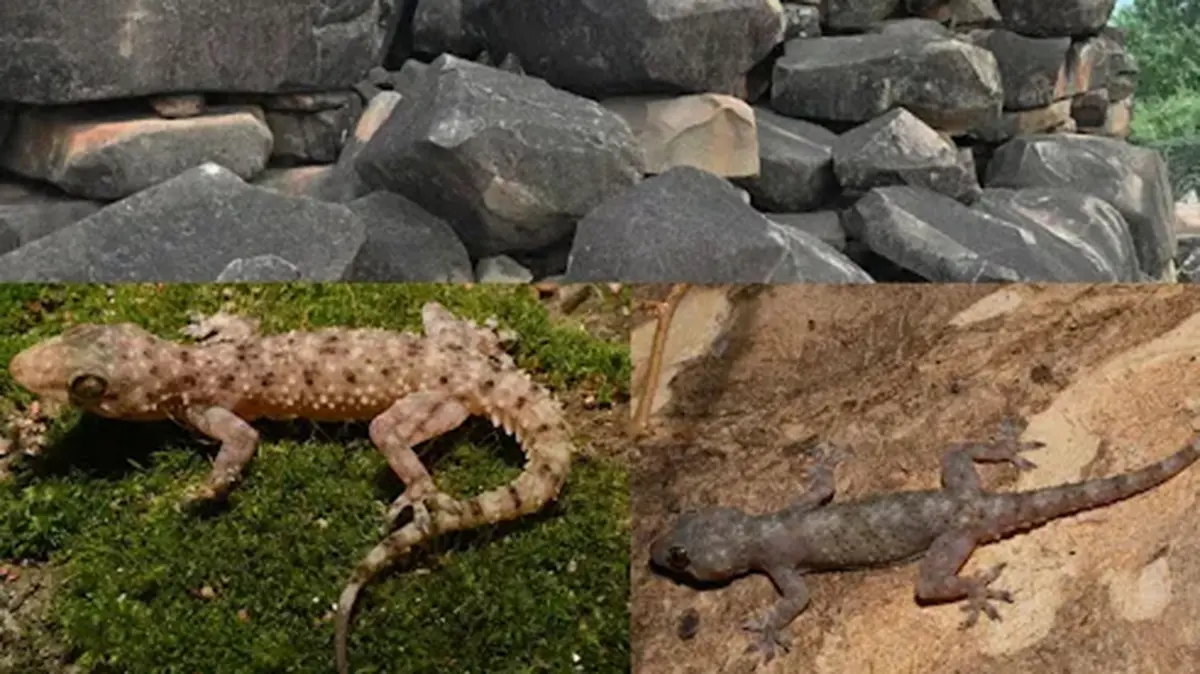
Why in news?
Researchers described two new gecko species from Telangana in the European Journal of Taxonomy on 30 September 2026. Named Hemidactylus cairnicola and Hemidactylus koyaorum, they were identified from the Nalgonda and Warangal landscapes respectively. Geckos are lizards, and these animals resemble related species closely enough to require detailed comparison. The team combined anatomical measurements with genetic evidence to show that the two populations represent distinct species. The discovery improves understanding of the Deccan region's biodiversity and identifies habitats needing closer investigation. These are newly recognised species; the announcement does not mean that the animals first appeared in September or were previously unknown to local people.
Why similar-looking animals can be different species
Both geckos belong to the genus Hemidactylus within the family Gekkonidae. A genus groups closely related species, while a family is a broader taxonomic grouping. The researchers placed them close to Hemidactylus treutleri, an already described species. Their resemblance creates the scientific problem: outward similarity alone can conceal distinct evolutionary lineages. Biologists call such difficult-to-distinguish diversity cryptic diversity.
Taxonomy is the work of identifying, describing and classifying organisms. A formal description supplies features that other researchers can check, rather than relying only on a photograph or local name. The study compared body proportions, scales and other anatomical characters. It also used genetic material to examine relationships. The strength of the identification comes from combining evidence, not from assuming that every colour difference represents a new species.
How the researchers tested the distinction
The anatomical dataset included eleven specimens: three from the Nalgonda population and eight from Warangal. Researchers compared a mitochondrial gene as well. Mitochondria are structures inside cells that carry their own genetic material; differences in its sequence can help distinguish lineages. The paper found genetic separation alongside consistent anatomical differences. It did not base recognition on one unusual individual or one striking mark.
Measurements also need careful interpretation. The described samples reached snout–vent lengths of 49 millimetres for H. cairnicola and 55.6 millimetres for H. koyaorum. Snout–vent length excludes the tail, so these figures are not total body lengths. The researchers also compared scale arrangements and proportions. A short field report cannot replace those diagnostic comparisons when identifying an individual animal.
Two local landscapes within the Deccan region
The Nalgonda species was documented around Vardhamani Gudem, between the Pendlipakala and Pedda Vagu reservoirs. Its habitat includes rocky outcrops within scrub and agricultural surroundings. Researchers observed animals on dark rock piles and exposed surfaces, with crevices providing shelter. The name cairnicola refers to cairn-dwelling: living among piles of stones. The account places an overlooked small reptile in a familiar working landscape, not only in remote forest.
The Warangal species was recorded in the Pakhal landscape, including the wildlife sanctuary and nearby sites. Its name honours the Koya people and their connection with the region's forests and hills. The paper describes pale, flower-like body markings and a distinct arrangement of scales. It also records animals sheltering beneath rocks. These observations help describe the species' immediate habitat, while broader surveys are still needed to establish its full distribution.
What the discovery does—and does not—tell conservationists
The authors report that the Nalgonda gecko is mainly active at night and forages for insects. They also observed daytime basking under some conditions. Such details show why a single visit at one time of day may miss animals using a site. Seasonal conditions, shelter and activity all affect detection. Finding only a few specimens during a survey is therefore not the same as counting the entire population.
Recognising separate species changes the questions that conservation work must ask. If animals previously grouped together occupy different, restricted habitats, each may face pressures that a broad species label conceals. Surveys can now examine where each occurs and how its habitat is changing. However, the description does not provide a complete population trend or a formal threatened-status assessment. Neither abundance nor safety from extinction follows automatically from receiving a scientific name.
Conclusion
The two descriptions turn previously unresolved variation into testable scientific identities. That gives future surveys a clearer basis for recognising the animals and studying their habitats. Surveys can now connect those identities with evidence about distribution and ecology. That work must include rocky and scrub landscapes outside well-known conservation sites, where small species can remain overlooked.