

Why in news?
Indian and Vietnamese coast guard leaders held their seventh high-level meeting in Chennai on 25 August. They reviewed search and rescue, maritime law enforcement and pollution response. Training, exchanges and ship visits also featured. Their joint sea exercise, SAHYOG-HOPTAC, was scheduled for 27 August.
What the meeting covered
Indian Coast Guard Director General Paramesh Sivamani co-chaired the meeting. Vietnam Coast Guard Vice Commandant Major General Luong Dinh Hung represented his service. The dialogue operates under a 2015 cooperation memorandum. Regular meetings help convert that framework into practical work.
The two sides reviewed professional exchanges and ship visits. They also discussed maritime search and rescue, or SAR. Maritime law enforcement and marine pollution response formed other priorities. Capacity building can include training, procedures and lessons from operations.
SAHYOG-HOPTAC was scheduled for 27 August at sea. The exercise was intended to strengthen coordination and interoperability. Because the prior official release described it as scheduled, this article does not assume its outcome. A later release would be needed for completion details.
Where Vietnam lies
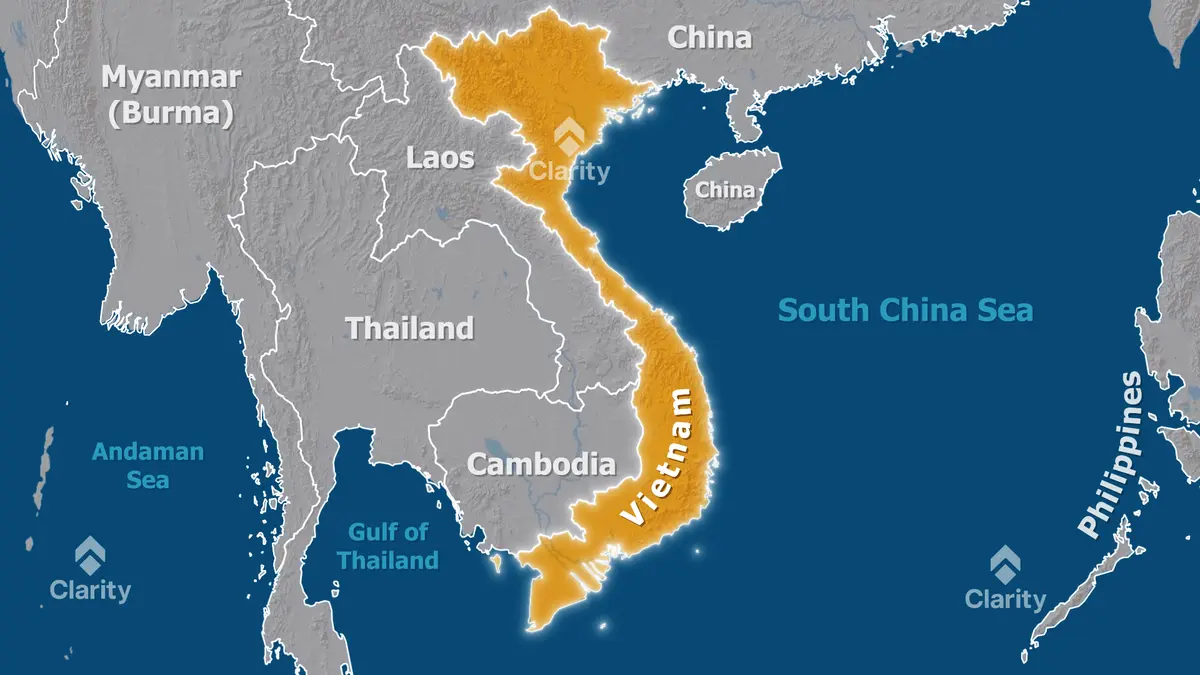
Vietnam occupies the eastern side of the Indochinese Peninsula in Southeast Asia. China borders it to the north. Laos and Cambodia lie along its western side. A long coast faces the South China Sea, which Vietnam calls the East Sea.
The country has an elongated S-shaped mainland. Mountains dominate much of the interior. The Red River delta supports the north, including the capital Hanoi. The Mekong delta forms a densely settled and productive southern region.
Vietnam’s long coast supports ports, fisheries and offshore activity. It also creates extensive rescue and pollution-response responsibilities. The adjoining sea carries major international trade routes. Several regional maritime claims remain contested.
Why coast guards cooperate
Coast guards handle problems below the threshold of conventional naval conflict. They assist vessels in distress and enforce domestic maritime laws. They can also respond to oil spills and illegal fishing. Shared procedures reduce delay when incidents cross jurisdictional boundaries.
Search and rescue depends on rapid information exchange. A drifting vessel may move far from its last reported location. Weather and currents complicate operations. Joint exercises let crews practise communication before a real emergency.
Pollution also moves across maritime boundaries. Oil and hazardous cargo can threaten fisheries and coastlines. Response requires containment equipment, surveillance and clear command arrangements. Exchanging best practices can improve preparedness without changing legal jurisdictions.
Background to the bilateral relationship
India and Vietnam established diplomatic relations in 1972. Their ties became a Strategic Partnership in 2007. They elevated this to a Comprehensive Strategic Partnership in 2016. Defence and maritime cooperation have since become important pillars.
Indian Coast Guard ships have visited Vietnam since 2001. The 2015 memorandum created a more regular institutional basis. Ship visits allow crews to discuss boarding, rescue and environmental procedures. High-level meetings can then review progress and set future priorities.
Regional significance and necessary limits
India’s Act East policy gives Vietnam a prominent regional role. Vietnam’s coast connects mainland Southeast Asia with busy sea lanes. Safer shipping benefits commerce and coastal communities. Cooperation also builds trust between two maritime agencies.
Operational cooperation should remain consistent with international law. It should not be presented as deciding contested maritime claims. Search, rescue and pollution response offer practical common ground. Clear rules also prevent miscalculation during law-enforcement encounters.
Meeting and exercise are separate events
The seventh high-level meeting occurred on 25 August in Chennai. The joint sea exercise was scheduled for 27 August. This edition records that schedule without claiming unreported results.
Conclusion
The Chennai meeting strengthened a practical India–Vietnam maritime relationship. Rescue, enforcement and pollution response address real risks across connected seas. Regular training can improve communication during emergencies. Cooperation should remain transparent and legally grounded. Its strongest value lies in safer waters, better preparedness and sustained institutional trust.