

Why in news?
Indian Naval Ship (INS) Trishul visited Alexandria, Egypt, from 14 to 17 September, the Defence Ministry announced on 19 September. The guided-missile frigate also conducted a passage exercise with the Egyptian naval ship Bernees. Such exercises allow crews to practise communication and coordinated movement while operating together at sea. The visit matters because Egypt connects the Mediterranean and Red Sea maritime regions through the Suez Canal, a major international shipping route. It also continues the defence relationship within the India–Egypt strategic partnership. This was a completed port visit and professional exercise, not an announcement of a new naval base or a mutual-defence alliance.
The ship behind the visit
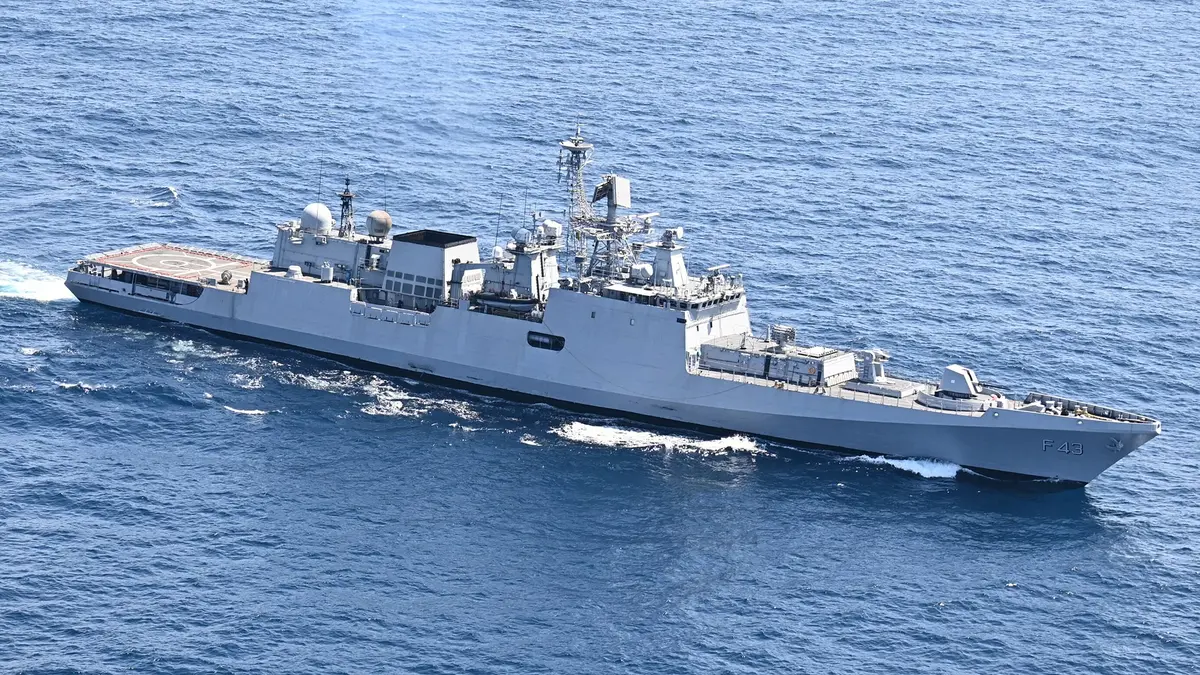
Trishul is the second frigate of the Indian Navy's Talwar class. It was commissioned on 25 June 2003. A frigate is an ocean-going warship used for roles that can include escort, patrol and protection against different maritime threats. The Defence Ministry describes Trishul as carrying a range of weapons and sensors, with the ability to operate multi-role helicopters. These capabilities allow one platform to undertake varied assignments during an overseas deployment.
An official ship profile gives its length as about 125 metres and displacement as approximately 3,700 tonnes. Displacement measures the weight of water displaced by a floating ship, corresponding to the ship's weight in that condition. It is not a statement that the frigate can carry 3,700 tonnes of cargo. This distinction separates warship descriptions from the cargo-capacity measures commonly used for merchant vessels.
What happened at Alexandria
The Egyptian ship Al Qadeer escorted Trishul on arrival. During the visit, Indian personnel paid respects at the Chatby War Memorial, and India's ambassador interacted with the crew. The programme joined diplomatic contact with naval engagement. Such a port call creates opportunities for professional exchange and demonstrates an operating relationship between the visiting navy and its host. It does not, by itself, establish permanent military access or basing rights.
The subsequent passage exercise (PASSEX) with Bernees included coordinated manoeuvres, communication drills and approaches for replenishment at sea. The last activity concerns positioning and coordination associated with transferring supplies between ships at sea. The ministry reported approaches, not necessarily an actual transfer of fuel or stores. These practical drills build familiarity with procedures and help crews work together more safely during future encounters or cooperative operations.
Alexandria belongs to the Mediterranean setting
Alexandria is on Egypt's northern Mediterranean coast, west of the Nile Delta. It is not a Red Sea port and is not itself the entrance to the Suez Canal. The canal's northern end is at Port Said, while its southern end opens towards the Gulf of Suez. Locating these places separately explains the geography of the visit more accurately than treating all Egyptian ports as part of one coastal setting.
Egypt occupies north-eastern Africa, with the Sinai Peninsula extending into Asia. It borders Libya to the west, Sudan to the south, and Israel and the Gaza Strip to the north-east. The Mediterranean lies to its north and the Red Sea to its east. These land and sea connections help explain Egypt's regional importance. The country links African, West Asian and Mediterranean spaces rather than belonging to only one maritime neighbourhood.
The Suez Canal connects the Mediterranean Sea with the Red Sea. For ships trading between Europe and the Indian Ocean, this provides an alternative to the much longer passage around southern Africa. The canal therefore connects Egypt's geography with international commerce. A naval visit at Alexandria occurs within that wider maritime setting, although the ministry's release does not assign Trishul a separate canal-protection mission.
A visit within a longer bilateral relationship
India and Egypt signed an agreement elevating their relationship to a strategic partnership during the Indian Prime Minister's June 2023 visit. Defence cooperation also rests on earlier exchanges and a September 2022 cooperation agreement. The Ministry of External Affairs describes military visits, training and exercises as recurring parts of the relationship. The September 2026 port call is therefore a continuation of cooperation, not the beginning of naval contact between the countries.
Strategic partnership is a broad diplomatic framework. It can support cooperation across several fields without creating the obligations of a formal military alliance. In naval work, its practical expression can include recurring contact and more familiarity between crews. Such familiarity is useful when ships need to communicate, manoeuvre safely or cooperate in a shared task. The value comes from usable professional relationships, not only from the ceremonial visibility of a visit.
Conclusion
Trishul's Alexandria call combined a completed diplomatic visit with practical training alongside the Egyptian Navy. Its significance is best understood through both the ship's role and Egypt's Mediterranean–Red Sea geography. Repeated exchanges can deepen operational familiarity within the wider strategic partnership. The practical gain lies in crews learning to communicate and manoeuvre together. These working relationships give substance to diplomatic cooperation in waters that connect major trading regions.