

Why in news?
A major search continued in the Java Sea after the Indonesian passenger vessel Virgo Transport 8 capsized on 13 September 2026. It had been travelling from Surabaya in East Java to Banjarmasin in South Kalimantan, on Borneo. Reuters reported that 243 people were aboard, including 30 crew members. Antara published a rescue update on 14 September. At 11:00 Central Indonesian Time, rescuers reported 108 survivors, six deaths and 129 people still missing. This was a time-specific tally, not a final outcome. The route connects two major Indonesian islands across a busy sea. The disaster highlights the dependence on domestic shipping and the difficulty of locating people dispersed at sea, while the cause remained under investigation.
Placing the sea and the voyage on the map
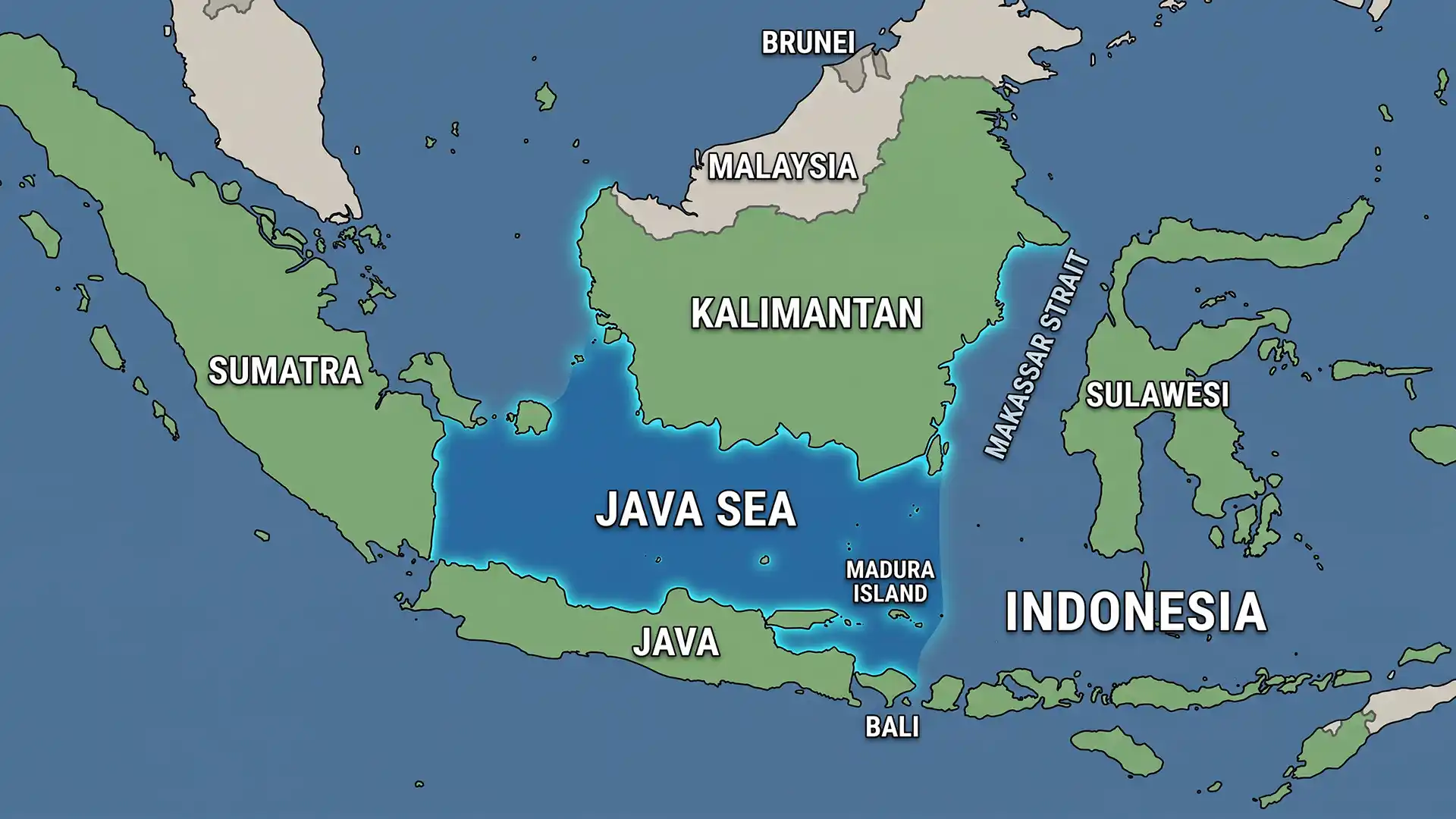
The Java Sea lies north of Java, south of Borneo and east of Sumatra. Most of Borneo’s Indonesian territory is called Kalimantan. Banjarmasin lies in its southern part, while Surabaya is on Java’s northeastern side. A voyage between these ports crosses an internal maritime space linking communities within the Indonesian archipelago.
The sea connects with neighbouring waters through several passages. To the southwest, the Sunda Strait between Sumatra and Java opens towards the Indian Ocean. To the northwest, the Karimata Strait connects towards the South China Sea. Eastern connections lead towards the waters around the Flores Sea and the southern Makassar Strait.
These relationships matter because the Java Sea is not a closed basin. Water, weather systems and shipping move across its adjoining passages. Research archived by the United States National Oceanic and Atmospheric Administration documents freshwater exchange through the Sunda Strait. The connection is a physical oceanographic pathway as well as a route visible on a navigation map.
Why a search area changes with time
A vessel’s last reported position is a starting point for rescue planning, not a guarantee of where survivors remain. Wind and currents can move people, liferafts and floating wreckage after an accident. Different objects can drift differently. Searches therefore combine position reports with updated observations, weather information and the capabilities of available vessels.
Antara’s 14 September account described the search being divided into sectors around the relevant area. Indonesia’s National Search and Rescue Agency, known as Basarnas, also announced the deployment of a rescue vessel from Balikpapan. These operational updates show a developing search rather than a single completed recovery effort.
The reported figures require the same care. The morning tally of 108 survivors and six deaths accounted for 114 of the 243 aboard. The remaining 129 were listed as missing at that time. Later transfers between rescue vessels and ports must not automatically be added as newly discovered survivors, because they may involve people already counted.
A sea route is part of everyday connectivity
For an archipelagic country, domestic shipping links places separated by water rather than by a continuous road network. Ferries carry people and, depending on the vessel, vehicles and goods. Their reliability affects family travel, supplies and local commerce. The importance of these journeys makes routine safety management a public-service issue, not merely a concern for occasional travellers.
The International Maritime Organization (IMO), the United Nations body responsible for international shipping standards, distinguishes domestic ferry operations from international voyages. Some domestic vessels fall outside the principal international passenger-ship convention’s scope. This does not mean they are unregulated; national rules and their enforcement remain central to safety.
In 2022, the IMO adopted model regulations on domestic ferry safety for incorporation into national frameworks. These provide a reference for countries improving their systems. Their existence is not proof that every provision automatically applies to every Indonesian vessel. The applicable national requirements and the vessel’s records would need to be examined separately.
What an investigation must establish
Weather can create difficult operating conditions, but the presence of bad weather alone does not establish an accident’s complete cause. Investigators may need to examine stability, loading, water ingress, machinery, communications and decisions made during the voyage. Their conclusions should follow the evidence rather than the earliest explanation circulated during an emergency.
Stability is a vessel’s ability to resist and recover from heeling. Loading arrangements and the movement of water or cargo can affect it. The IMO’s safety work treats design and operational procedures together for this reason. These are general investigative considerations, not findings that Virgo Transport 8 was overloaded or had a particular defect.
Conclusion
The Java Sea disaster combines an urgent rescue operation with a wider question of dependable inter-island transport. The immediate priority was locating those still missing. A subsequent investigation would need to explain the capsizing and identify any safety failures. Preliminary reports and evolving casualty counts cannot substitute for established findings about the cause.