

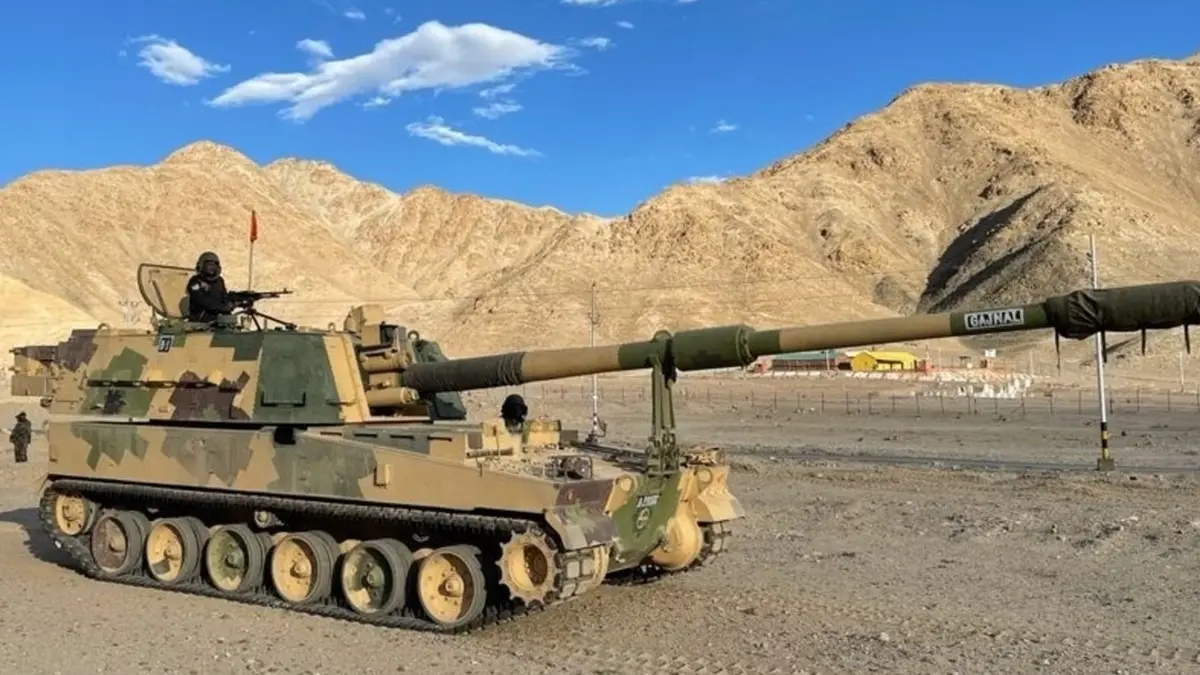
Why in news?
In mid‑June 2026 defence media reported that the Indian Army plans to acquire about 300 additional K9 Vajra‑T self‑propelled howitzers. The proposed order, estimated at more than ₹23,000 crore, would expand the Army’s fleet to around 500 guns and significantly boost its long‑range strike capability along the borders with China and Pakistan.
Background
The K9 Vajra‑T is an Indian‑specific variant of the South Korean K9 Thunder self‑propelled howitzer. After extensive field trials against Russian and European systems, the Ministry of Defence selected the K9 platform in 2015. Larsen & Toubro (L&T) signed a technology‑transfer agreement with Hanwha Aerospace of South Korea and began producing the 50‑ton tracked howitzer at its Hazira facility. The first 100 Vajra‑T guns were delivered between 2018 and 2021. In 2024 L&T received a follow‑on order for another 100 guns and the Army is now considering a larger expansion.
Features and capabilities
- Calibre and range: The Vajra‑T mounts a 155 mm/52‑calibre gun that can fire high‑explosive, smoke and precision‑guided projectiles. It has a maximum range of about 50 km and can deliver three rounds in 15 seconds or six to eight rounds per minute for short bursts.
- Fire control: A digital fire‑control system allows the gun to accurately engage targets and perform multiple rounds–simultaneous impact missions, where several shells fired at different trajectories arrive on the target at the same time.
- Mobility: The howitzer is powered by a 1,000‑hp MTU MT‑881 Ka‑500 diesel engine coupled with an automatic transmission. It can reach speeds of about 67 km/h on roads and has an operational range exceeding 360 km. The tracked chassis enables off‑road mobility and the vehicle can turn on the spot.
- Protection and crew: The 50‑ton steel hull provides ballistic protection against small arms and shell splinters. A crew of five operates the gun, including commander, driver, gunner and two loaders. The turret has automatic loading aids that reduce crew fatigue.
- Make in India: More than half of the components are manufactured in India, including the hull and major sub‑systems. The programme supports self‑reliance in defence and provides opportunities for Indian suppliers.
Strategic importance
- High‑altitude readiness: The Indian Army has deployed Vajra‑T guns in eastern Ladakh, demonstrating that the platform can operate in high‑altitude terrain as well as deserts and plains.
- Deterrence: An expanded fleet of modern self‑propelled howitzers enhances India’s deterrence and provides quick fire support for armoured formations.
- Indigenisation: Indigenous production and future upgrades help reduce dependence on imports and develop domestic industrial capability in complex weapon systems.
Conclusion
The K9 Vajra‑T combines long range, high rate of fire and good mobility. Developed under a technology partnership and built in India, it has already proven its worth in service. If the new procurement goes through, the artillery arm will gain a potent capability to respond quickly across varied terrain while advancing the goal of self‑reliance in defence manufacturing.
Sources: TW