

Why in news?
A 12 September report by Scroll examined why Kawal Tiger Reserve in Telangana has struggled to establish a resident tiger population. A long-term study found that its prey base could support a substantial tiger population, yet a resident population had not become established. The research, published online in April 2026, examined prey trends between 2010 and 2022. Its estimate of capacity is not a count of tigers actually living there. Nor does the absence of a resident population mean that no tiger ever entered the reserve. The issue is why visiting animals have not developed into a stable, breeding population, despite the availability of prey within the protected landscape.
Locating Kawal within central India
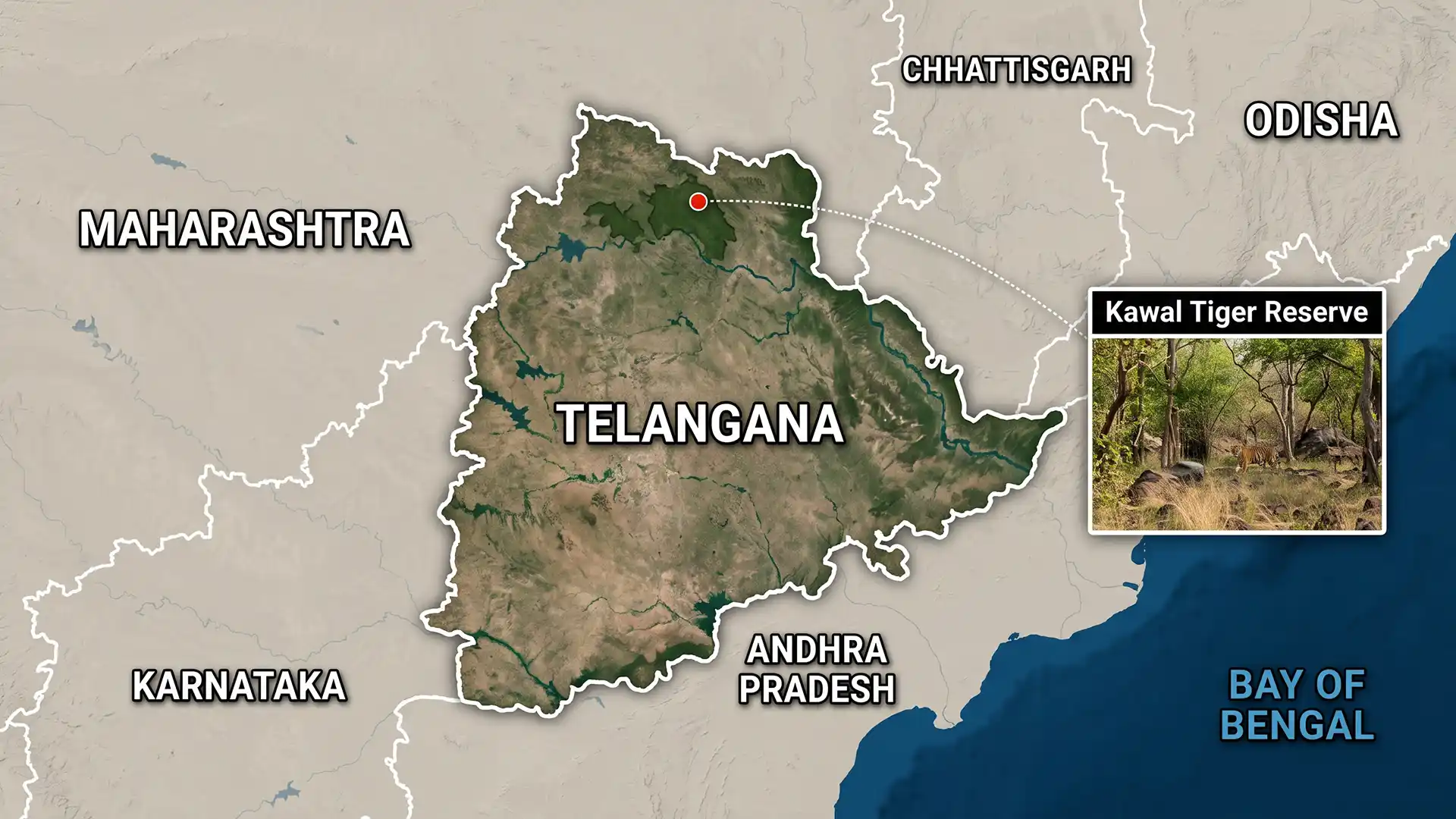
Kawal lies in northern Telangana, within the Deccan Plateau, rather than the Western Ghats. Its forests form part of the Godavari landscape. The Kadam River, which joins the Godavari, is important to this setting. Dry deciduous forest, including teak and bamboo, characterises much of the habitat. These geographical connections matter because wildlife movements extend beyond administrative reserve boundaries.
National Tiger Conservation Authority records place Kawal’s core at about 892 square kilometres, with a much larger surrounding buffer. The authority’s 2023 management evaluation gives a total area of approximately 2,015 square kilometres. Core and buffer are not interchangeable categories. Looking only at the protected centre can miss pressures along the routes through which animals must arrive.
The same evaluation discusses connections towards Maharashtra’s Tadoba-Andhari, Kanhargaon and Tipeshwar landscapes, and towards Indravati through other forest patches. These are landscape relationships, not assurances of an uninterrupted corridor. Roads, settlements and other land uses can interrupt an otherwise promising route. The relevant question is whether animals can actually pass through it safely and repeatedly.
What the prey study measured
The researchers repeatedly surveyed fixed routes to estimate populations of potential prey, rather than relying on occasional wildlife sightings. Chital increased during the study period, while several other ungulate populations were broadly stable. The analysis then related available prey to the number of tigers the reserve might support. For the core, its 2022 estimate exceeded thirty tigers.
This is a carrying-capacity estimate: an assessment of what the food base could sustain under the model’s assumptions. It is not a prediction that thirty animals will necessarily settle there. A forest can contain enough food while remaining difficult to reach. Protection, movement, survival and reproduction must all operate together before potential habitat becomes an occupied breeding landscape.
Visitors are not the same as residents
Scroll’s September report described transient tiger records and the scarcity of females among those recorded since 2015. That distinction is central to the problem. A passing male demonstrates that some movement is possible. It does not demonstrate that females can establish territories, that animals survive for years, or that cubs are being raised successfully.
Monitoring therefore needs to follow individuals over time. Repeated camera-trap records, evidence of breeding and information about survival answer different questions from a single photograph. A headline about “no tigers” can obscure these differences. Equally, one visiting animal should not be presented as proof that population recovery is already secure.
Connectivity is more than a line drawn between two reserves. A corridor needs usable habitat along the route and manageable risks where it crosses human activity. The reporting identifies infrastructure and other landscape pressures as concerns. Addressing them requires attention beyond Kawal’s boundary, including cooperation across forest divisions and state borders.
Recovery also involves people
Wildlife management cannot be assessed solely through animal numbers. Scroll also reported concerns from families affected by relocation. Those accounts need to be considered alongside ecological assessments, not treated as a separate inconvenience. Conservation decisions can change access to homes, land, work and community networks. A favourable habitat assessment does not, by itself, establish that rehabilitation has been adequate.
This creates two connected tests for the reserve’s management. One concerns ecological function: can prey populations, safe movement and breeding support recovery? The other concerns implementation: are affected people properly informed, heard and supported? Progress on one test should not be used to assume success on the other. Both need evidence gathered over time.
Conclusion
Kawal illustrates the difference between protecting an area and restoring a functioning tiger population. The prey study identifies an ecological opportunity, not a completed recovery. Making that opportunity meaningful requires usable connections, sustained protection and evidence of resident breeding animals. It also requires credible attention to affected communities. The reserve’s future should be judged through those combined outcomes rather than a single capacity figure.