

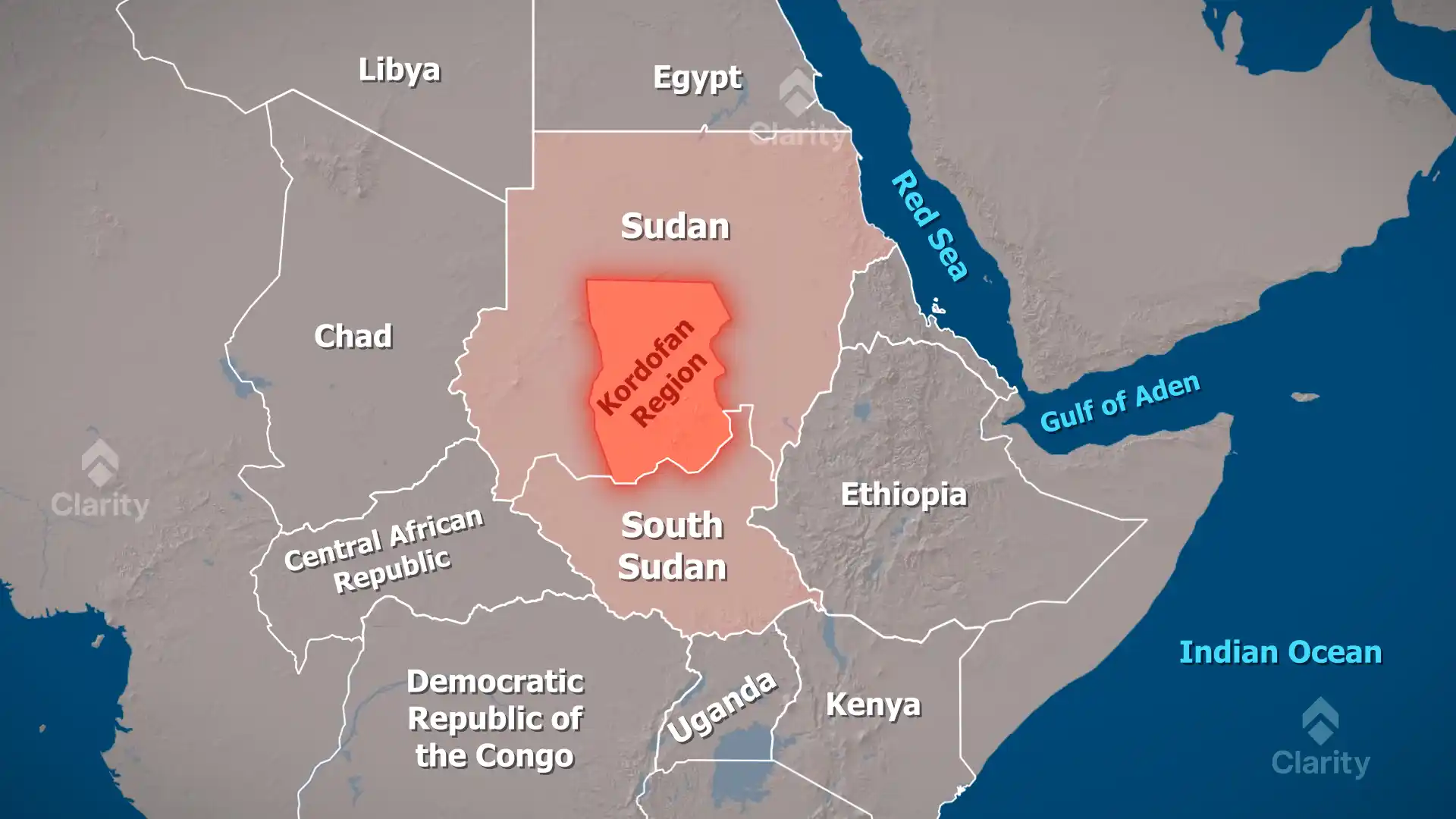
Why in news?
A drone strike by Sudan’s Rapid Support Forces (RSF) hit a vehicle carrying displaced families near Rahad in North Kordofan province, killing at least 24 people, including eight children. The attack underscores the humanitarian crisis stemming from Sudan’s civil conflict that began in April 2023.
Background
Kordofan is a historic region in central and southern Sudan. Covering roughly 390,000 km², it lies between the Darfur region to the west and the White Nile valley to the east. The region is divided into North, South and West Kordofan states, with capitals at El Obeid, Kadugli and Al Fula respectively. Its population is diverse, with Arab pastoralists forming the majority and minorities such as Nubian, Beja, Daju, Zaghawa and Darfunj peoples.
Physical and human geography
- Northern deserts: The northern Kordofan landscape is arid and sandy, supporting sparse vegetation such as acacia scrub and desert grasses. Rainfall is scarce and groundwater supplies are limited.
- Southern plains: The southern part consists of gently undulating clay plains punctuated by the Nuba Mountains, which rise to about 900 metres. The area has more rainfall and supports agriculture and cattle rearing.
- Economy: Kordofan is renowned for producing gum arabic, a key export. Other crops include groundnuts, millet and cotton. Oil fields in West Kordofan make the region strategically important.
The current crisis
Since April 2023, a power struggle between the Sudanese army and the RSF has plunged Sudan into chaos. Fighting has spread from Khartoum to regions like Kordofan, leading to widespread violence against civilians. According to international agencies, over 40,000 people have been killed and around 14 million have been displaced, creating one of the world’s largest humanitarian crises. Aid groups are calling for urgent protection of civilians and accountability for human‑rights violations.
Conclusion
The tragedy in North Kordofan highlights how local conflicts intersect with geography and natural resources. While the region’s fertile plains and gum‑arabic trade sustain livelihoods, political instability threatens to undo decades of development. International support and a lasting cease‑fire are vital to prevent further loss of life.
Source: Free Press Journal