

Why in news?
The Lanjia Saora community of Odisha has been featured in recent news and documentaries highlighting efforts to preserve its culture. This small, isolated group is categorised as a Particularly Vulnerable Tribal Group (PVTG) and faces pressures from modernisation and development.
Who are the Lanjia Saora?
The Lanjia Saora are a subgroup of the Saora or Sora people, one of the oldest tribes of Odisha. They inhabit the forested hills of Gajapati and Rayagada districts in the Eastern Ghats. According to government surveys their population is around 11,820. They speak an Austro‑Asiatic (Munda) language and practise a mixed economy of shifting cultivation and terraced paddy farming.
Distinctive lifestyle
- Remote settlements: Villages are tucked away on steep hillsides, accessible only by narrow paths. Houses are built with mud walls and thatched roofs in scattered patterns rather than rows.
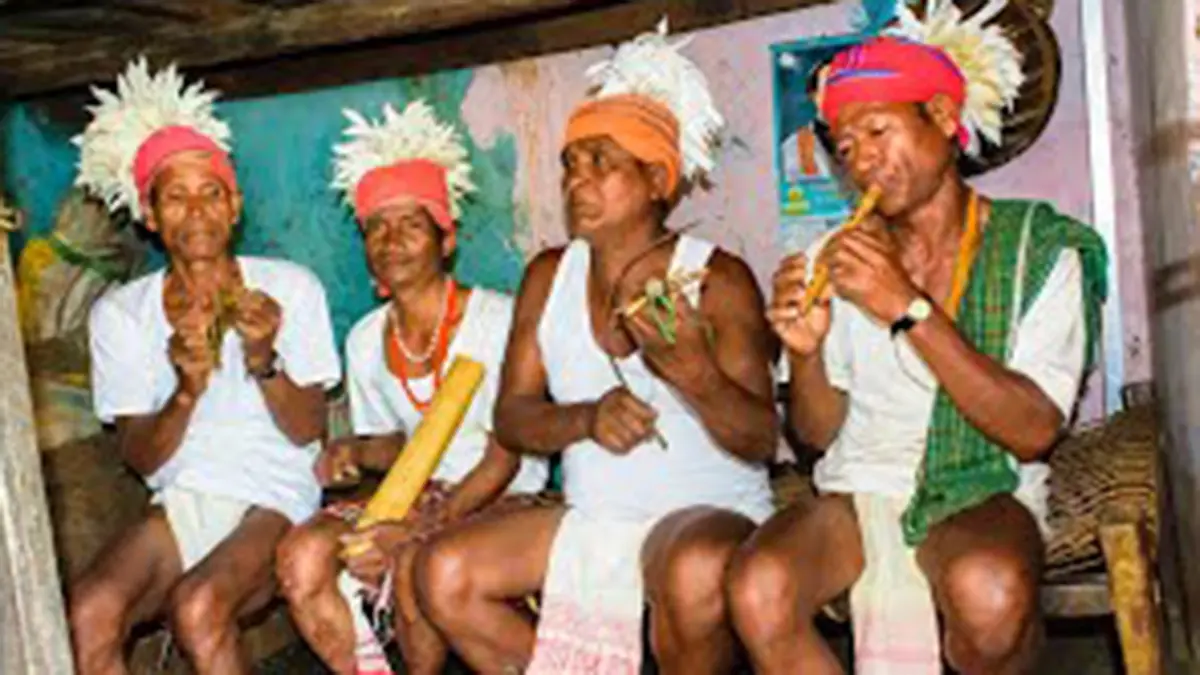
- Clothing and adornment: Men wear a loin cloth with a long flap hanging at the back, giving rise to the name “Lanjia” (tail‑like). Women wear a coarse waist cloth. They enlarge their ear lobes to insert wooden plugs and often tattoo a vertical line on the forehead.
- Terraced farming: While they also practise shifting cultivation, the Lanjia Saora excel at building stone‑bounded terraces with sophisticated water‑management systems to grow paddy on steep slopes. They supplement their livelihood through pottery, basket‑making and collection of forest produce.
Culture and beliefs
- Magico‑religious traditions: The community’s religion centres on a multitude of deities and ancestral spirits collectively known as Sonnum. Shamans, both male (Kudan) and female (Kudan Bai), act as intermediaries between the human and supernatural realms.
- Idital paintings: Ceremonial wall paintings, called idital, depict cosmological figures and are created to appease spirits. This art form has gained recognition and is now produced on paper and canvas for sale.
- Music and dance: Lanjia Saora celebrations involve songs composed spontaneously and dances accompanied by brass pipes, cymbals, gongs, umbrellas and peacock feathers. Men often adorn their turbans with white crane feathers.
- Festivals: Important rituals include Buroy‑na‑Adur, Ganugey‑na‑Adur and Tanku‑na‑Adur, among others, each marking agricultural cycles or appeasing specific deities.
Contemporary issues
- Vulnerability: Classification as a PVTG recognises the community’s low population, isolation and vulnerability to economic and cultural change. Development projects and loss of forest land threaten traditional livelihoods.
- Development initiatives: The government has established micro‑projects such as the Lanjia Saora Development Agency at Puttasing and Seranga to provide education, healthcare and sustainable livelihood support.
- Preservation of culture: Documentation of language, art and customs, along with eco‑tourism and fair trade for handicrafts, can help preserve the community’s unique heritage while improving living standards.