

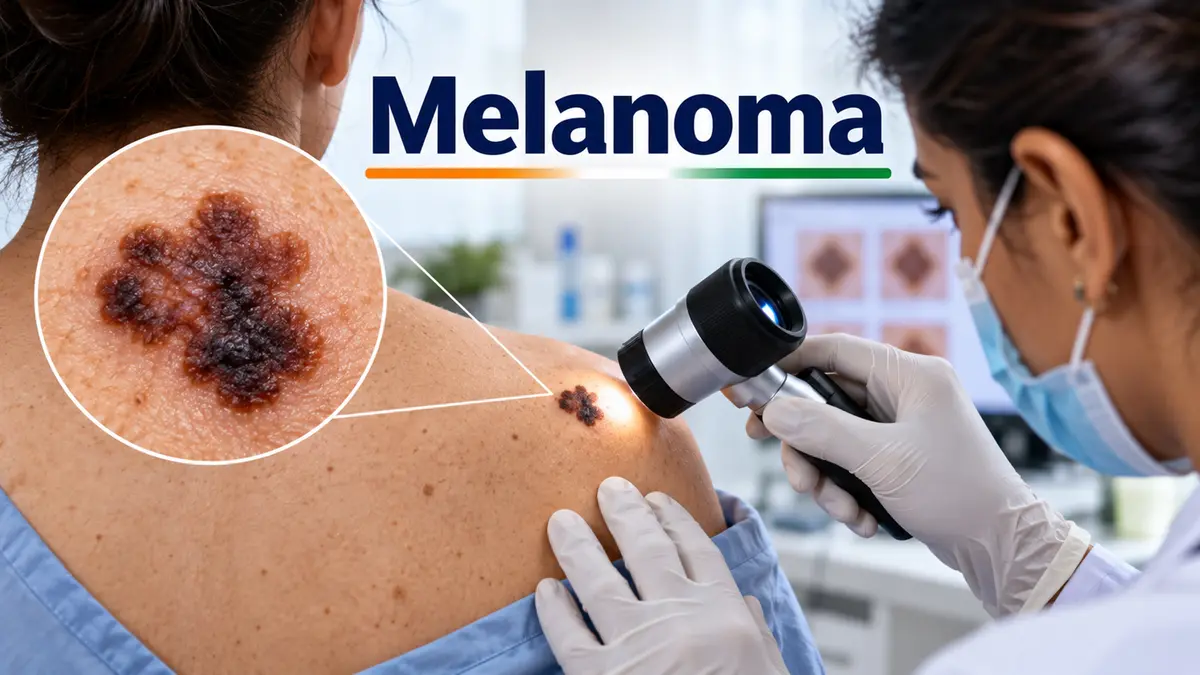
Why in news?
An oncologist’s commentary in The Hindu on 12 September 2026 called for better melanoma awareness suited to Indian patients. Professor Jyoti Bajpai argued that familiar messages about changing moles on sun-exposed skin can overlook other presentations. Melanoma is a cancer of pigment-producing cells, and it can develop on the soles, palms or beneath nails. Changes in these locations may be mistaken for ordinary injuries or infections, delaying specialist assessment. The commentary linked earlier recognition with access to increasingly effective, but individually selected, treatments. It was a clinical argument for improving awareness and referral, not a new national prevalence survey. Its message is to widen attention to suspicious changes, not to assume that every dark mark or nail band is cancer.
What makes melanoma different from an ordinary mark?
Melanocytes are cells that produce melanin, the pigment contributing to skin colour. Melanoma develops when these cells become malignant and grow abnormally. It is one type of skin cancer, distinct from basal-cell and squamous-cell cancers. Its ability to invade surrounding tissue and spread makes timely diagnosis particularly important.
A mole or pigmented patch is not automatically melanoma. Many skin and nail changes have non-cancerous explanations. Appearance can prompt a medical examination, but a diagnosis generally requires a tissue sample examined by a pathologist. This procedure, called a biopsy, investigates what the cells actually are rather than relying on colour alone.
Melanoma can also arise outside ordinary sun-exposed skin. Mucosal melanoma develops in moist tissue linings, while ocular melanoma occurs in the eye. These locations require different clinical approaches. They explain why skin-cancer awareness cannot be reduced to one picture of a dark mole appearing after sun exposure.
Why location and skin colour matter to awareness
Acral melanoma refers to disease arising on the palms, soles or beneath the nails. These sites may receive little sunlight and are not always included in routine self-observation. The National Cancer Institute’s definition makes the location clear. It does not make ultraviolet exposure the explanation for every melanoma subtype.
Ultraviolet radiation remains an important risk factor for many skin melanomas. However, people with darker skin can also develop the disease. A lower population risk is not the same as zero individual risk. Prevention messages about sun protection and messages about recognising suspicious lesions therefore serve related but different purposes.
The Indian commentary emphasised clinical experience of delayed recognition at less-expected sites. That concern is useful without converting a hospital’s experience into an exact national distribution. The proportion of acral or mucosal cases in a referral centre can differ from the proportion among all people diagnosed across the country.
What a changing lesion should lead to
The American Academy of Dermatology describes changes in shape, border, colour or size as reasons to seek assessment. A lesion that evolves, bleeds or fails to heal also deserves attention. These signs guide recognition; they are not a home diagnostic test. Some melanomas do not display every familiar warning feature.
Nail changes deserve the same balanced approach. A new or changing dark band, pigment extending around a nail, or unexplained nail damage may warrant professional review. But harmless pigmentation, trauma and other conditions can produce changes too. The point is to avoid both automatic reassurance and automatic alarm based on appearance alone.
Early detection means getting the right assessment sooner. It does not mean removing or treating an unexplained lesion without diagnosis. A clinician considers the history and examination, then decides whether specialist review or biopsy is needed. Persistent uncertainty should be resolved through that pathway, rather than through photographs or informal comparisons alone.
Why diagnosis and stage affect treatment
After melanoma is confirmed, clinicians assess its extent. The thickness and characteristics of the primary tumour, nearby lymph nodes and any distant spread can influence treatment. Surgery is central for many localised melanomas. Additional investigations or treatments depend on the disease’s features rather than being identical for every patient.
Immunotherapy has changed treatment for some patients by helping immune cells act against cancer. Immune checkpoints normally limit immune activity and help protect healthy tissue. Certain medicines block these inhibitory signals, allowing a stronger anti-tumour response. They can also cause immune-related side effects, so their use requires clinical selection and monitoring.
Targeted treatments work differently. They act on particular molecular changes involved in cancer growth, when a tumour has a suitable target. Testing tumour material can help identify whether such an approach is relevant. Neither targeted treatment nor immunotherapy guarantees a response, and the appropriate choice depends on the individual disease.
Conclusion
The immediate lesson from the Indian commentary is to make melanoma awareness more complete, not more frightening. Palms, soles, nails and other less-expected sites should not be dismissed simply because they do not fit a familiar image. Better recognition, timely biopsy when indicated and clear referral pathways connect awareness with meaningful treatment opportunities.