

Why in news?
G. Nishiyama and colleagues argue that Mercury’s long-term contraction may have been underestimated. Their study, published on 10 September 2026, compared surface roughness with mapped ridges and scarps recording the shortening of outer layers. Rough, heavily modified terrain contained fewer visible contractional structures. Some evidence of earlier deformation may therefore be concealed or difficult to identify. Published in Geophysical Research Letters, the study estimated radial contraction up to 30 per cent greater than previous calculations. This concerns the total shrinkage inferred from the geological record, not a measurement showing that Mercury is shrinking 30 per cent faster today. The finding matters because these surface features help scientists reconstruct how the planet cooled and changed internally.
A small planet with an unusually large core
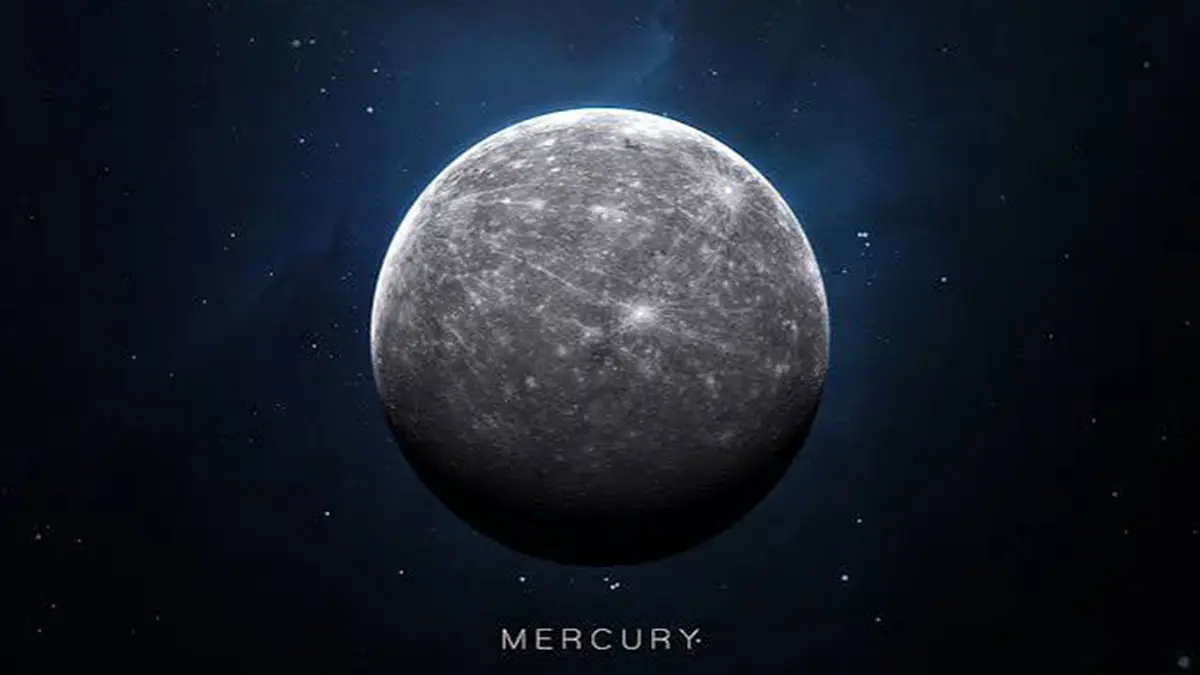
Mercury is the smallest of the Solar System’s eight planets and the closest to the Sun. It is rocky, with a large metallic core beneath its outer layers. Its heavily cratered appearance can resemble the Moon’s, but the two bodies have different internal structures and histories. Surface appearance alone does not explain a planet’s evolution.
Mercury completes an orbit in about 88 Earth days and rotates once in roughly 59 Earth days. A sunrise-to-sunrise cycle takes about 176 Earth days because rotation and orbital motion combine. Its proximity to the Sun also does not make it the hottest planet. Venus retains more heat beneath its dense atmosphere.
Mercury instead has an extremely tenuous envelope called an exosphere. It cannot redistribute heat like a substantial atmosphere. The National Aeronautics and Space Administration (NASA) describes daytime temperatures reaching about 430 degrees Celsius and nighttime temperatures falling near minus 180. These surface extremes are different from the slow cooling of the planet’s interior.
How cooling can leave cliffs on the surface
As a planetary interior cools and contracts, the outer rocky shell must adjust to a smaller underlying volume. Compression can push one block of crust over another along a fault. This movement produces a scarp, or steep surface step. Across Mercury, such landforms preserve evidence that parts of the crust have been shortened.
This does not mean the entire surface folds in one smooth, uniform movement. Deformation is distributed among geological structures of different sizes and ages. Researchers map these features and estimate the shortening associated with them. They then use the combined evidence to infer a change in the planet’s radius over geological time.
Earlier spacecraft observations had already established Mercury’s contraction. NASA’s 2016 account of small, relatively young scarps also suggested geologically recent faulting. The September study therefore does not introduce shrinkage as a wholly new discovery. It asks whether existing maps capture enough of the deformation to estimate its total extent reliably.
Why some geological evidence may be missing
The new analysis found fewer mapped shortening structures in rougher terrain. Impact debris can cover older features, while an irregular surface can make them harder to recognise. Another possibility is that local material properties affect how strain is accommodated. The authors considered these mechanisms rather than treating an incomplete surface record as a simple absence of contraction.
A revised estimate is not a newly measured rate. Total contraction describes accumulated change. A rate would require that change to be related to a defined interval of time. The distinction is similar to separating the total distance travelled from the speed at a particular moment; the quantities answer different questions.
The study’s correction depends on how the observed surface relationships are interpreted. Better data could refine the size of the adjustment. Accounting for hidden deformation can improve an estimate of contraction. However, a model does not turn every buried or indistinct feature into a directly observed fault.
What another mission can add
Much of the detailed evidence about Mercury comes from NASA’s Mercury Surface, Space Environment, Geochemistry and Ranging mission, known as MESSENGER. Its orbital observations transformed knowledge of the planet’s surface and interior. The spacecraft’s images remain valuable after the mission itself ends, because researchers can apply new methods to existing measurements.
The next major opportunity is BepiColombo, a joint mission of the European Space Agency and the Japan Aerospace Exploration Agency. Its two scientific orbiters are designed to investigate complementary aspects of Mercury, including the planet and its magnetic environment. Combining such observations can connect surface geology with the processes operating below and around it.
As of this edition’s date, the European Space Agency’s arrival plan placed orbital capture on 21 November 2026. The main scientific phase was planned for April 2027. Arrival, separation into the required orbits and routine science are distinct mission stages. Future observations could test geological interpretations; they should not be described as results already obtained.
Conclusion
The Mercury study highlights a basic challenge in planetary science: the visible surface may preserve only part of a planet’s history. Accounting for missing deformation could change estimates of past cooling and contraction. The central finding is about that incomplete geological record, not a sudden acceleration in the shrinking of Mercury today.