

Why in news?
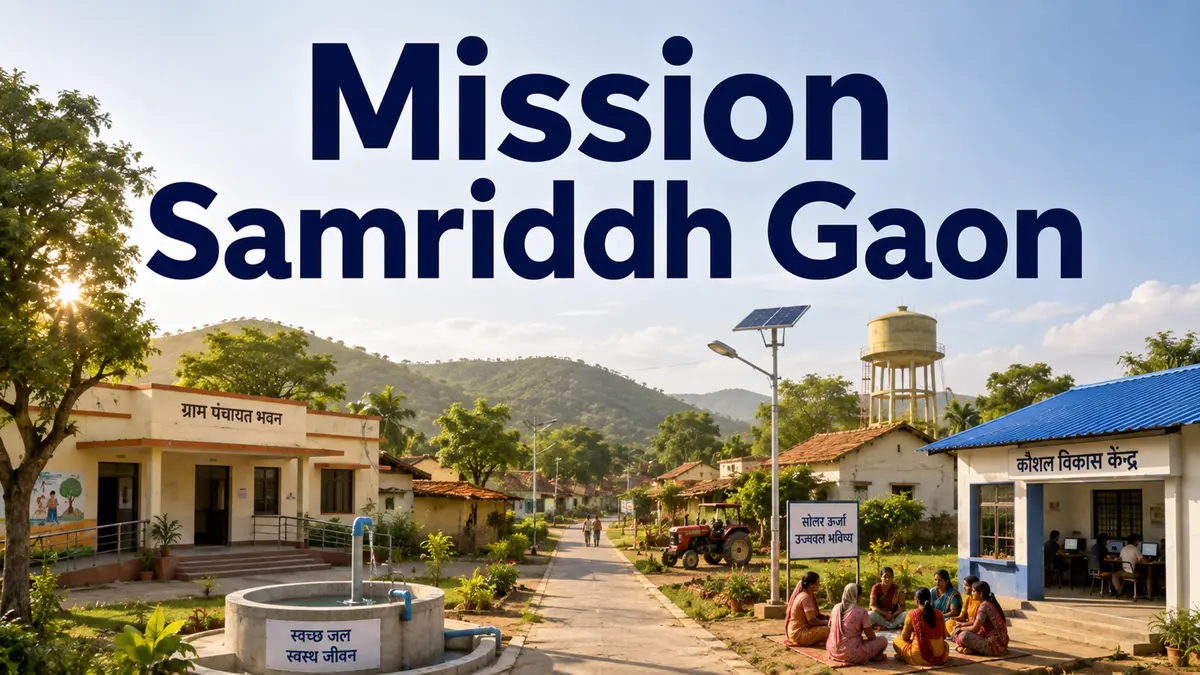
Union Minister Shivraj Singh Chouhan launched Mission Samriddh Gaon in New Delhi on 25 August. The pilot will cover Budni and Khategaon blocks in Madhya Pradesh. It seeks poverty-free, employment-rich villages with essential services. Planning will begin with each household and extend to village and block levels.
The problem the mission addresses
Rural households often qualify for several public schemes. However, different departments maintain separate processes and timelines. A family may receive one benefit while another urgent need remains unaddressed. Fragmentation can weaken the combined impact of public spending.
Mission Samriddh Gaon tries to organise these interventions around actual household needs. It does not replace every existing programme. Instead, it seeks convergence among Central and state schemes. The approach treats livelihoods, services and local infrastructure as connected concerns.
How planning is expected to work
The announced design begins with a family-level plan. Officials must identify needs, eligibility and available schemes for each household. Gram panchayat plans can then aggregate common gaps. Block plans should address infrastructure or services beyond one village’s capacity.
This sequence can reveal missing links between private and public assets. A livelihood loan has limited value without skills or market access. Irrigation equipment needs dependable water and power. A school building also needs teachers, transport and safe access.
The mission stresses participation by residents, elected representatives and administrators. Such participation can improve information about local priorities. It can also expose households missed by databases. Women must have a meaningful voice because work and care burdens often remain undercounted.
Where the pilots are located
Budni is a development block in Sehore district. Khategaon is a block in Dewas district. Both districts lie in central Madhya Pradesh. Using two separate administrative settings can test coordination before any wider rollout.
The pilots should not be treated as representative of every Indian village. Rural conditions vary across drylands, tribal areas, coasts and mountain regions. A successful model must allow local adaptation. It should preserve the common planning method without imposing identical projects.
Employment and migration
The mission aims to create adequate local employment and reduce compelled migration. Migration itself is not automatically a failure. Workers may move voluntarily for education, experience or higher incomes. The policy concern is distress movement caused by absent livelihoods or services.
Durable local employment needs more than short-term works. Agriculture can gain through storage, processing and better market connections. Non-farm enterprises need credit, skills and demand. Rural public services also create skilled jobs when staffing remains stable.
Why convergence is difficult
Eligibility rules differ between schemes. Departmental budgets may not arrive together. Databases can contain missing or outdated records. These differences can delay a household plan even when every agency agrees with its objective.
A clear nodal authority is therefore essential. It must track responsibilities without weakening departmental accountability. Residents need a simple grievance process for omissions and errors. Public dashboards can report progress without exposing sensitive personal information.
How the pilot should be evaluated
Success should be measured through outcomes, not only scheme enrolment. Relevant measures include reliable income, service access and fewer unresolved household needs. Women’s control over assets and earnings also matters. Independent verification can check whether benefits reached the intended families.
Baseline data should be recorded before implementation. Otherwise, later change cannot be attributed confidently. Evaluation should compare household experience across both blocks. Lessons should shape any expansion instead of treating the pilot as automatic proof.
Convergence is the central idea
Mission Samriddh Gaon seeks to connect existing resources through family, panchayat and block plans. Its value will depend on accurate data, participation and accountable follow-up. A new label alone cannot overcome fragmented delivery.
Conclusion
The mission offers a household-centred route to rural development. Its two pilots can show where schemes reinforce or obstruct one another. Detailed local planning may improve both livelihoods and essential services. The approach needs transparent measures and strong grievance handling. Wider expansion should follow verified results and documented lessons.