

Why in news?
A joint committee detected banned pesticide aldrin in Rajasthan’s Chandraloi River. The inquiry followed deaths of mugger crocodiles near Kota, and the Forest Department accepted the chemical’s detection but disputed responsibility. The National Green Tribunal case remains pending.
Background
Four mugger crocodiles were found dead in the river during December 2024. Earlier pollution had also affected crocodiles in this water system.
The National Green Tribunal took suo motu cognisance on 19 December 2024. It created a joint committee to investigate the deaths.
The committee included central and state pollution-control officials, and wildlife authorities and a Wildlife Institute of India representative also participated.
Members inspected the area on 24 and 25 January 2025, and their water analysis detected aldrin, a prohibited organochlorine pesticide.
What is a mugger crocodile?
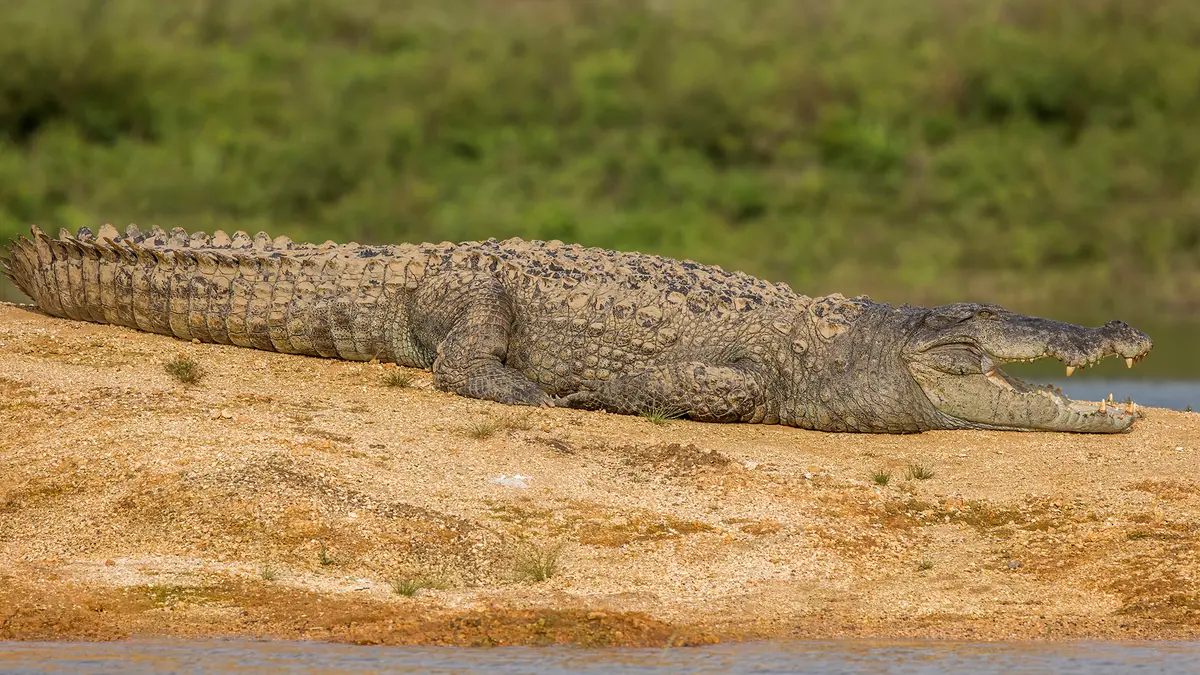
The mugger or marsh crocodile has the scientific name Crocodylus palustris. It is one of India’s three native crocodilian species.
- The mugger mainly inhabits freshwater rivers, lakes and reservoirs, and the saltwater crocodile uses estuaries, mangroves and coastal waters.
- The gharial is a river specialist with a very narrow snout.
Identification and behaviour
- The mugger has the broadest snout among living crocodiles, and it has a strong tail and partly webbed feet.
- It uses freshwater marshes, rivers, lakes and artificial reservoirs, and it can travel over land when water bodies shrink.
- Females dig holes for eggs during the dry season, and adults eat fish, reptiles, birds and mammals.
The species occurs from southern Iran through Pakistan, India and Nepal to Sri Lanka. India holds a major share of its global population.
Conservation status
- The International Union for Conservation of Nature (IUCN) classifies the mugger as Vulnerable.
- The Convention on International Trade in Endangered Species (CITES) places it in Appendix I.
- India lists the species in Schedule I of the Wildlife Protection Act.
CITES Appendix I generally prohibits international commercial trade in wild specimens. Schedule I provides the strongest wildlife protection under Indian law.
What is aldrin?
Aldrin is a synthetic organochlorine insecticide, and farmers once used it against termites and soil insects.
Organochlorines break down very slowly, and aldrin can transform into dieldrin after entering the environment.
- Persistence means the chemical remains for a long period; Bioaccumulation means it builds up inside one organism.
- Biomagnification means concentrations rise along a food chain.
Top predators may receive higher doses through contaminated prey, and aldrin can harm the nervous systems of humans and wildlife.
Legal position of aldrin
India prohibits aldrin’s manufacture, import and use, and it was banned nationally during the 1990s.
Aldrin was also among the original “Dirty Dozen” persistent organic pollutants. The Stockholm Convention places it in Annex A for elimination.
What did the inquiry establish?
The committee established that aldrin was present in river water. This finding raises serious questions about illegal use or old contamination.
However, fish bio-assay tests showed high survival in collected water samples, and many crocodiles also remained alive in the habitat.
Causation is not yet settled. Detection of aldrin proves contamination. It does not alone prove that aldrin caused every crocodile death, and the responsible source also remains unidentified.
The Forest Department argued that pesticide control belongs to agriculture authorities, and it placed industrial pollution within pollution-control agencies’ responsibility.
This division of duties cannot replace a coordinated response, and investigators still need source tracing, regular monitoring and wildlife-health assessment.
Why are crocodiles useful ecological indicators?
Crocodiles live long and occupy high food-chain positions, and their tissues can reflect persistent contamination accumulated over time.
Sudden deaths may reveal changes in water quality or prey. A proper investigation should include toxicology, pathology and water testing.
Conclusion
The Chandraloi case reveals a serious pollution-control gap, and aldrin’s detection is confirmed, while exact causation remains under inquiry. Effective action requires cooperation across wildlife, agriculture and pollution agencies.