

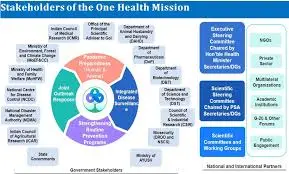
Why in News? At the fifth meeting of the Scientific Steering Committee of India’s National One Health Mission, officials emphasised strengthening integrated surveillance and developing artificial‑intelligence‑enabled systems to detect emerging pathogens. The meeting reviewed progress on creating networks of laboratories and establishing early‑warning systems that link human, animal and environmental health.
Background
One Health is an approach that recognises the interconnectedness of human health, animal health and the environment. Most emerging infectious diseases, including COVID‑19 and Ebola, originate in animals. Addressing these threats requires collaboration across sectors such as health, agriculture, wildlife, forestry and climate.
The National One Health Mission was launched by the Government of India in 2024 to build such cooperation. It is anchored by the Office of the Principal Scientific Adviser and implemented by the Indian Council of Medical Research (ICMR). Governance is two‑tiered: an Executive Committee headed by the Union Health Minister oversees policy and resources, while a Scientific Steering Committee chaired by the Principal Scientific Adviser guides technical strategy. In February 2024 the government approved the establishment of the National Institute of One Health in Nagpur to anchor the mission.
Key Components
- Integrated surveillance: The mission is building networks of high‑containment laboratories (BSL‑3/4) and metagenomics/genomics hubs to monitor viruses, bacteria and antimicrobial resistance across humans, animals and the environment. Surveillance has begun at zoos, bird sanctuaries and livestock markets.
- Early‑warning and artificial intelligence: Teams are developing AI‑enabled tools to analyse diverse data sets and flag unusual disease patterns. Federated data platforms will allow information sharing across ministries and states while preserving privacy.
- Capacity building and research: The mission plans to upgrade diagnostic laboratories, support research into vaccines and therapeutics, and develop “plug‑and‑play” vaccine platforms that can quickly adapt to new pathogens. Training programmes will build a workforce skilled in epidemiology, veterinary science and environmental science.
- Community engagement: Outreach programmes encourage safe animal‑husbandry practices, wildlife conservation and youth participation in surveillance. Awareness campaigns aim to reduce the risk of zoonotic transmission.
Conclusion
The National One Health Mission is India’s response to the growing threat of zoonotic diseases and climate‑driven health risks. By bringing together diverse sectors, investing in modern laboratories and harnessing data science, the mission seeks to create an early‑warning system that can prevent outbreaks before they become epidemics. Continued political support and coordination across ministries will be essential for its success.
Sources: NOA