

Why in news?
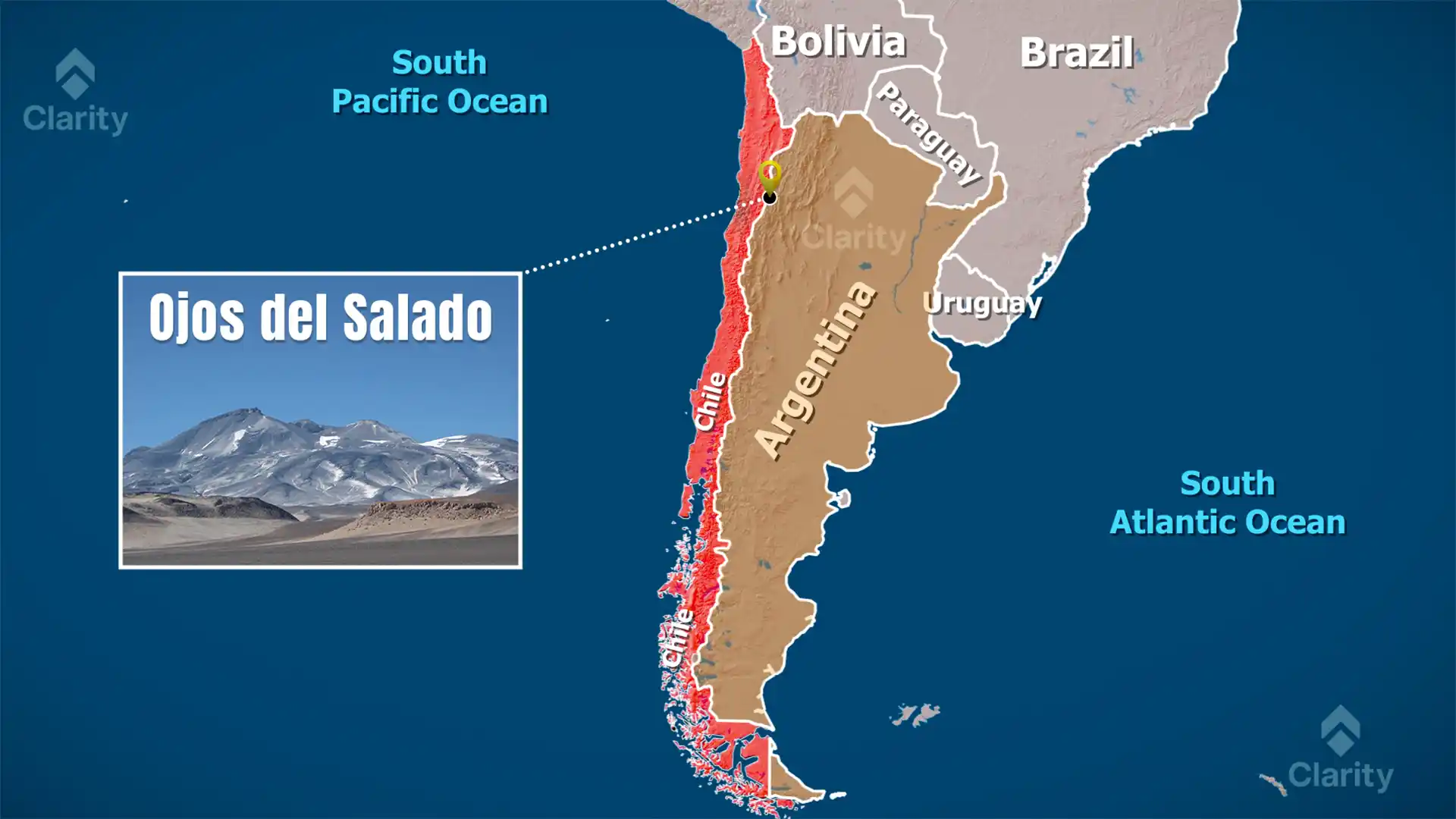
A recent expedition by Latin American researchers caught the world’s attention when they measured a high‑altitude crater lake on Nevado Ojos del Salado in the Andes. Their findings show that the small lake near the summit remains liquid despite freezing temperatures. The study has renewed interest in this remote volcano, which straddles the Chile‑Argentina border.
Background
Nevado Ojos del Salado is a dormant volcano located on the frontier between Chile and Argentina in the Andes. It rises to about 6,893 metres, making it the highest active volcano on Earth and the second‑highest mountain in the Western Hemisphere after Aconcagua. The mountain is part of a volcanic complex characterised by overlapping lava domes and flows. The surrounding landscape is extremely arid because the volcano sits on the edge of the Atacama Desert.
Distinctive features
- Crater lake: At roughly 6,480–6,500 metres above sea level lies a small crater lake, thought to be the world’s highest permanent body of water. Its existence reflects geothermal warmth beneath the surface.
- Twin summits: The volcano has two main peaks separated by a saddle. The Chilean summit is slightly higher and contains the lake on its flank.
- Volcanic history: While Ojos del Salado is considered active, its last confirmed eruption occurred more than a millennium ago. Minor fumarolic activity suggests heat remains beneath the mountain.
- First ascent: The first recorded climb was in 1937 by Polish mountaineers. Today, climbers often approach from a highway north of the volcano, although the high elevation and dry air pose considerable challenges.
Significance
- Geological interest: Studying Ojos del Salado helps volcanologists understand magma dynamics in high‑altitude environments and the interaction between volcanoes and desert climates.
- Extreme ecosystem: The crater lake may harbour microbes adapted to low oxygen and high UV radiation, offering insights into the limits of life on Earth and the potential for life on Mars.
- Mountaineering challenge: Due to its height and remoteness, the volcano attracts climbers seeking to summit the highest volcano on the planet. Proper acclimatisation is essential to avoid altitude sickness.
Source: The Hindu