

Why in news?
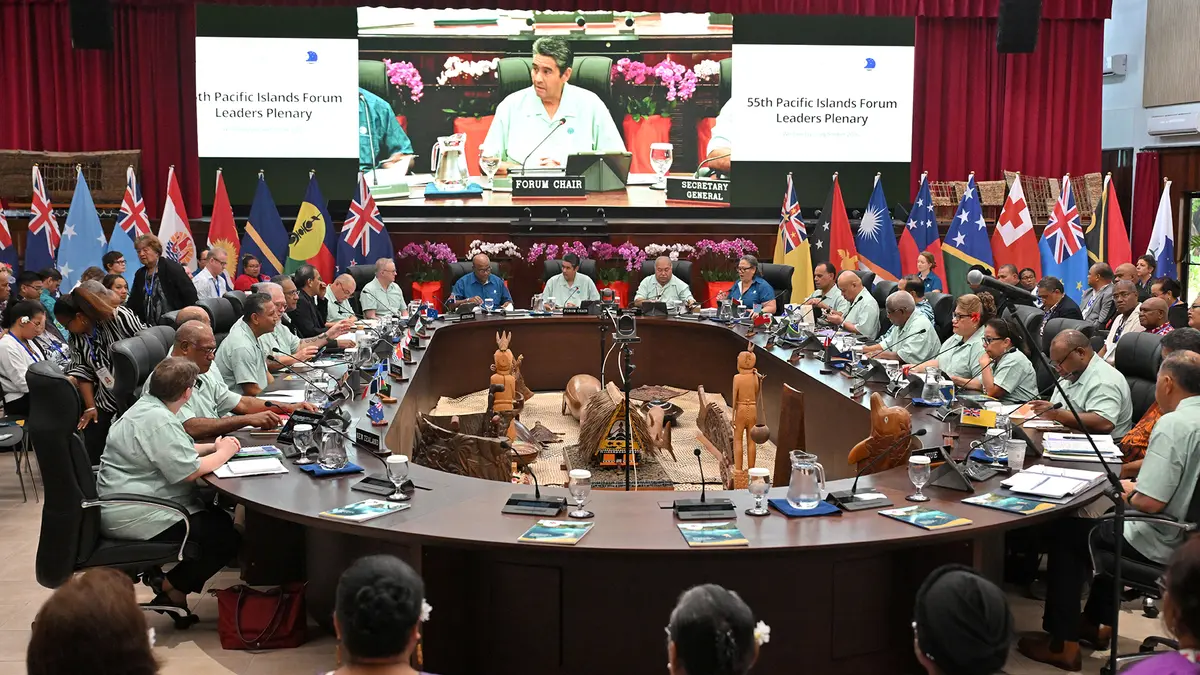
India outlined its Pacific partnership priorities at a dialogue session in Koror, Palau, on 1 September 2026. Minister of State for External Affairs Pabitra Margherita addressed the gathering. It formed part of the 55th Pacific Islands Forum Leaders’ Meeting. India emphasised cooperation in healthcare, education, digital technology, climate resilience and disaster management.
What the Forum represents
The Pacific Islands Forum was established in 1971. It brings together eighteen countries and territories, including Australia and New Zealand. Its membership also includes small island countries and territories across the Pacific. Therefore, it should not be described simply as an organisation of eighteen independent island nations.
The Forum helps members develop shared positions on regional priorities. Leaders reach decisions through consensus, with outcomes recorded in a communiqué. The Pacific Islands Forum Secretariat supports coordination and implementation. This arrangement gives smaller members a platform for collective diplomacy without replacing their national governments.
India participates as a dialogue partner, not as a Forum member. Dialogue sessions allow outside partners to discuss cooperation with the region. They do not give those partners ownership of Pacific priorities. Effective engagement must therefore respond to what the members themselves identify as important.
Why the location matters
Palau lies in Micronesia in the western Pacific Ocean. It is southeast of the Philippines and southwest of Guam. The meeting venue, Koror, lies within this island country. These locations place the gathering far from the Pacific’s eastern shores and major continental capitals.
The Forum’s members are spread across a vast ocean area. Their small land areas do not describe the full geographical scale of their interests. Maritime zones support fisheries, transport links and other economic activities. Ocean health therefore connects livelihoods, public revenue and regional cooperation.
Distance also affects access to services and markets. Widely separated islands face particular challenges in transport, communications and emergency response. Climate risks differ between low-lying atolls and larger, higher islands. A useful partnership must account for these differences instead of treating the Pacific as one uniform setting.
India’s engagement with Pacific countries
India’s cooperation operates through several channels. These include bilateral relationships and the Forum for India-Pacific Islands Cooperation. That separate platform connects India with fourteen Pacific island countries. It should not be confused with the broader Pacific Islands Forum or its eighteen-member structure.
The third India-Pacific Islands Cooperation summit took place in Papua New Guinea in 2023. India’s recent engagement builds on commitments developed through that process. Margherita highlighted practical cooperation in health, skills and digital services. His remarks also connected development partnerships with climate resilience and disaster preparedness.
These priorities have value when they improve access rather than merely supply equipment. A health project needs trained workers, maintenance and dependable supporting services. A digital project needs affordable connectivity and systems that people can use. This makes long-term operation as important as the initial announcement.
Regional priorities and strategic choices
The Forum’s 2050 Strategy for the Blue Pacific Continent provides a long-term regional framework. It connects ocean protection with development, security, technology and climate resilience. Its approach places Pacific peoples and regional ownership at the centre. Outside assistance is most useful when it reinforces these priorities.
Security in this setting extends beyond military competition. Disasters, damaged ecosystems and weak connectivity can directly affect everyday safety and economic stability. Fisheries management also requires cooperation across maritime boundaries. A narrow focus on strategic rivalry can overlook these immediate concerns.
For India, consistent delivery would strengthen the credibility of its partnership. Projects should match local demand and remain manageable after external support ends. Coordination with regional institutions can reduce duplication between partners. Respect for members’ choices is essential when larger powers seek influence in the same ocean region.
Conclusion
The Pacific Islands Forum gives an ocean-spanning region a collective political voice. India’s participation offers opportunities for practical and sustained cooperation. The strongest projects will reflect local needs and regional priorities. Geography makes reliable transport, services and climate resilience particularly important. Partnership should therefore be measured through durable benefits for Pacific communities.