

Why in news?
Physicians writing in The Conversation, republished by MedicalXpress on 26 September, called for greater attention to peripheral artery disease. This condition restricts blood supply, commonly to the legs, and can make walking painful. Their discussion accompanies a Canadian action plan seeking earlier diagnosis and better access to coordinated care. The concern is that patients may reduce activity or dismiss symptoms as ageing before receiving an assessment. Disease in the leg arteries can also indicate increased cardiovascular risk elsewhere. The item is a clinical awareness initiative, not the discovery of arteries or a newly proven treatment. Leg pain has several possible causes and cannot establish this diagnosis by itself.
What makes a blood vessel an artery?
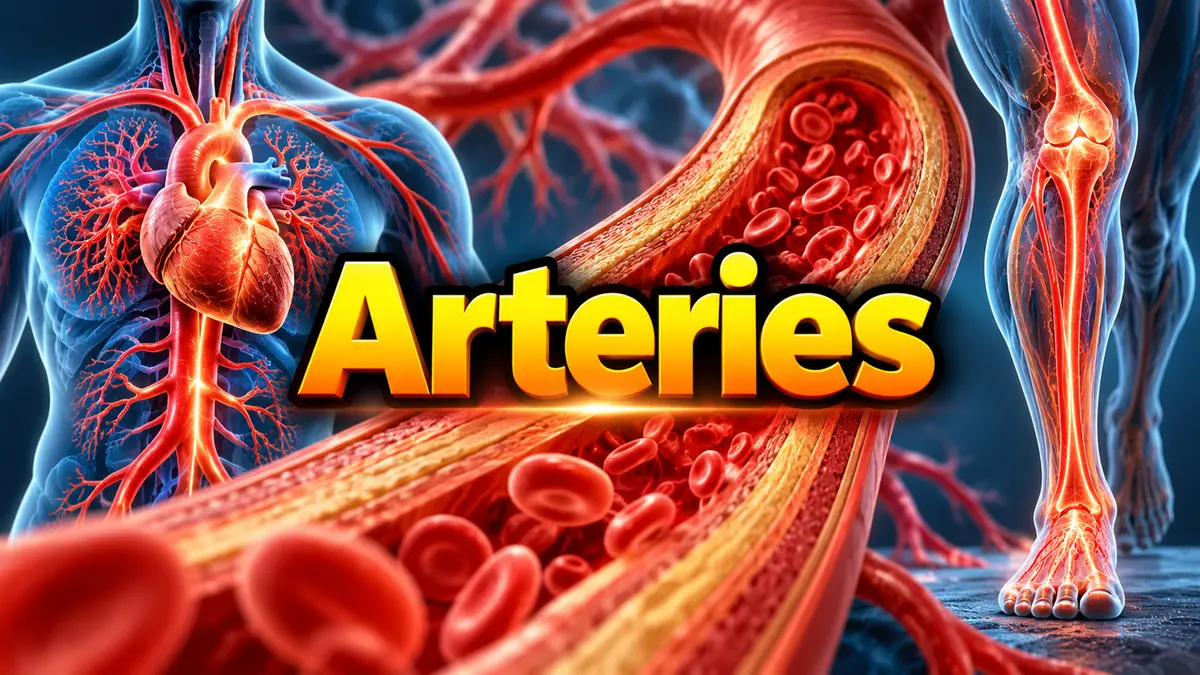
An artery carries blood away from the heart. Veins carry blood towards it. This direction-based distinction is more accurate than saying all arteries contain oxygen-rich blood. The pulmonary arteries carry oxygen-poor blood from the heart towards the lungs. After acquiring oxygen, blood returns through the pulmonary veins before the heart pumps it around the body.
The circulation therefore has two connected circuits. One links the heart and lungs; the other supplies the body's tissues. The aorta is the main artery leaving the heart for the body. Its branching vessels distribute blood to different regions. Arterial disease matters because tissues depend on an adequate supply, especially when their activity increases.
How a narrowing becomes a walking problem
Peripheral artery disease, or PAD, commonly involves atherosclerosis: deposits called plaques developing within arterial walls. These deposits contain substances including cholesterol, fats and calcium. They can narrow the route through which blood flows, while associated clot formation can obstruct it further. The result is a supply problem, rather than a primary injury to the leg muscle itself.
Walking increases the muscles' demand for oxygen. A narrowed artery may supply enough blood at rest but fail to meet this higher demand. The resulting ache, cramp or discomfort may ease when the person stops. This pattern is called claudication. Understanding the demand–supply relationship explains why symptoms can be linked to activity rather than remain constant throughout the day.
Why the familiar symptom is not the whole disease
Not everyone develops the same pattern. Some people have unusual symptoms, while others notice little discomfort or none at all. Severe disease can cause pain at rest or wounds that heal poorly. The absence of classic walking pain therefore cannot rule out arterial disease, just as the presence of leg pain cannot confirm it.
The National Heart, Lung, and Blood Institute also warns that plaque may affect arteries supplying the heart and brain. PAD is consequently more than a mobility problem confined to one limb. Its recognition creates an opportunity to assess wider cardiovascular health. This connection explains why treatment considers smoking, blood pressure, cholesterol and diabetes alongside the affected leg.
How clinicians distinguish the possible causes
Assessment starts with symptoms, medical history and examination. Joint disease, nerve problems and venous conditions may produce complaints that resemble arterial symptoms. Clinicians consider these alternatives rather than diagnosing from one description. They may examine pulses and skin changes and select further tests according to the person's findings and risk factors.
One test compares blood pressure at the ankle with pressure in the arm. This is the ankle–brachial index; “brachial” refers to the arm. The comparison helps assess whether blood reaches the lower limb normally. Exercise testing or ultrasound may provide additional information. A measurement needs clinical interpretation and is not a substitute for a complete assessment.
Treatment addresses both circulation and long-term risk
Management depends on severity and the individual's circumstances. It can include supported exercise, smoking cessation and treatment of cardiovascular risk factors. Clinicians may prescribe medicines to lower cholesterol or reduce clot-related risk. These approaches aim to improve function and reduce serious complications; they are not simply ways to suppress a painful symptom.
Some patients need a procedure to improve blood flow. Angioplasty opens a narrowed vessel from within, whereas bypass surgery creates an alternative route around a blockage. Neither procedure is necessary for every patient. Nor does restoring flow remove the need for ongoing risk-factor management, because atherosclerosis can affect more than one part of the circulation.
The access problem behind the Canadian initiative
The physicians describe barriers to testing, specialist services and coordinated follow-up, particularly for underserved communities. Their action plan proposes better awareness, earlier detection and connected care pathways. It also calls for Indigenous-led approaches in the Canadian setting. These are proposals for organising care, not evidence that every recommended service is already available.
Conclusion
The practical lesson is to recognise a possible circulation problem without turning every leg ache into an arterial diagnosis. Understanding arteries explains both the walking symptoms and the wider cardiovascular concern. Appropriate assessment can distinguish causes and guide care before serious complications develop. Earlier recognition is useful only when people can also reach the testing and treatment they need.