

Why in news?
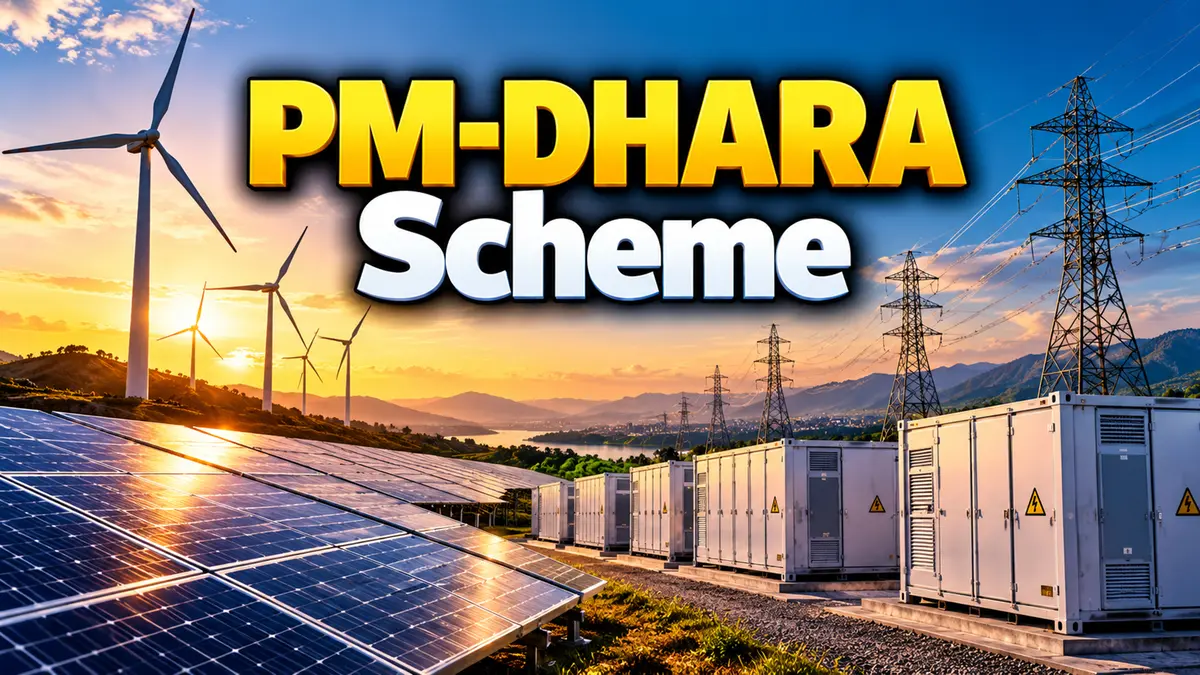
The Union Cabinet approved PM-DHARA on 30 September 2026 to strengthen renewable-energy transmission and battery storage. The announcement expands DHARA as Developing Harmonized and Accelerated Renewable-energy Access. Its planned network additions would support the integration of 135 gigawatts of renewable generation, alongside 50 gigawatt-hours of battery storage. The announced programme runs through the financial year 2032–33. Renewable plants need adequate transmission routes, while their variable output may not coincide with demand. The scheme addresses both problems: moving electricity across space and shifting its availability across time. These are approved infrastructure plans, not capacity already connected or storage already operating.
Why generation needs a matching network
A power plant produces electricity, but transmission infrastructure carries it towards consumption centres. Lines move bulk power, and substations connect or transform different parts of the network. A new solar or wind project therefore needs more than a successful generating installation. Its output must enter a network capable of carrying it when production is available, without compromising the reliability of electricity supply.
India's earlier Green Energy Corridor programmes address this integration problem. The Ministry of New and Renewable Energy describes the second intra-state phase as supporting around 20 gigawatts across seven states. State Transmission Utilities implement that programme through transmission lines and substations. Intra-state means infrastructure within a state; it is different from a transmission connection running between states. PM-DHARA builds on the wider need for stronger state networks as renewable capacity grows.
Capacity and actual delivery must remain distinct. A network planned to integrate a certain generating capacity does not carry that maximum output continuously. Wind conditions, sunlight, maintenance and demand all vary. The useful result is electricity reaching consumers when it can be used. A generating plant waiting for a connection and a completed line waiting for generation both illustrate why construction schedules need coordination.
Storage solves a different part of the problem
Solar generation can be strong when consumption is relatively low, then decline as evening demand rises. Batteries can absorb some electricity at one time and return it later. They convert electrical energy into stored chemical energy and reverse that process during discharge. This does not create additional energy: conversion and operation involve losses. The benefit is greater flexibility in when available energy can serve demand.
Storage can also help manage shorter variations, such as a sudden change in solar output. But a battery designed for brief grid support differs from one intended to supply power for several hours. Its usefulness depends on both the rate at which it can discharge and the amount it can store. Transmission and storage are consequently complementary investments, not interchangeable substitutes for the same task.
Understanding the two capacity figures
A gigawatt measures power; a gigawatt-hour measures energy. Power is the rate of production or delivery, while energy accumulates over time. The programme's 135-gigawatt figure refers to renewable generation to be integrated. Its 50-gigawatt-hour figure concerns storage volume. The numbers should not be added or compared as though they describe the same physical quantity.
Consider a hypothetical battery storing ten gigawatt-hours and discharging at two gigawatts. Simple division gives five hours of supply at that rate, before allowing for losses and operating restrictions. This is an illustration, not a specification for PM-DHARA projects. The announced storage-energy total alone does not reveal how much power the combined batteries will deliver at once or for how long.
From an approval to working infrastructure
The government announced an overall outlay of ₹1,86,405 crore, including central assistance of ₹54,082 crore. These are programme figures, not money already spent. The announced approach uses tariff-based competitive bidding for new projects and a cost-plus route for augmenting existing infrastructure. In plain terms, new projects involve competition over the tariff, while existing-network additions use an approved cost-based framework.
State Transmission Utilities have a central implementation role. Projects still need planning, financing, construction and coordination with the generating facilities they will serve. Batteries also need suitable charging and discharge arrangements. An infrastructure announcement therefore cannot establish the final price a household will pay. Retail bills depend on the wider costs and regulatory decisions of the electricity system.
Conclusion
PM-DHARA addresses two obstacles between renewable generation and dependable supply: network access and the timing of output. Its practical success will be visible when completed assets work together and reduce the gap between available generation and usable electricity. Approval establishes the programme; timely connections, reliable storage and sound operation must deliver its intended benefits.