

Why in news?
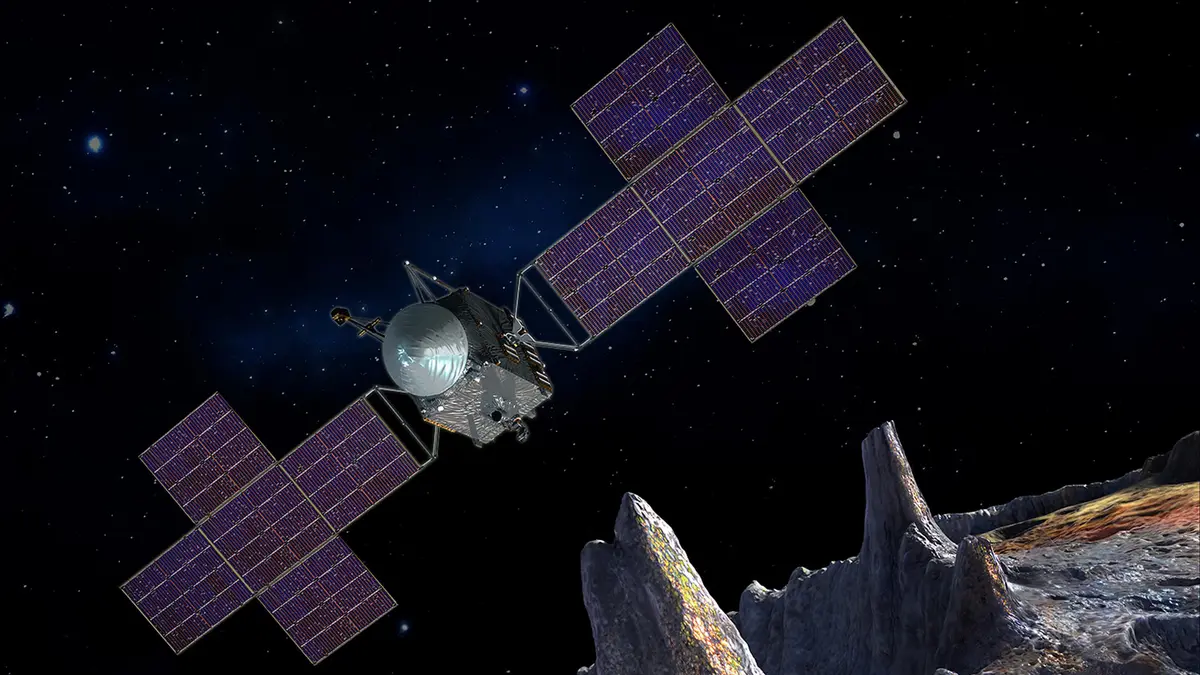
NASA’s Psyche spacecraft, en route to the metal‑rich asteroid 16 Psyche, photographed Mars as a thin crescent in early May 2026. The picture was taken from roughly 5 million kilometres away while the spacecraft prepared for a gravity‑assist flyby on 15 May 2026. This flyby will bend the craft’s trajectory and accelerate it toward the asteroid, saving propellant and enabling instrument calibration.
Background
Psyche is part of NASA’s Discovery Programme. Launched on 13 October 2023 atop a Falcon Heavy rocket, the spacecraft uses solar‑electric propulsion powered by xenon gas. Its mission is to explore the asteroid 16 Psyche, which scientists believe may be the exposed core of an early planetesimal—one of the building blocks that merged to form planets in our solar system. The spacecraft will reach the asteroid in late 2029 and spend two years mapping its surface, gravity and magnetic field.
Mars flyby and mission details
- Gravity assist: On 15 May 2026 Psyche will skim 2,800 miles (about 4,500 km) above Mars’ surface at roughly 12,333 miles per hour. Mars’ gravity will change the craft’s speed and direction, helping it reach the asteroid without using extra propellant.
- Imaging: The wide‑angle camera captured Mars as a crescent because the spacecraft was almost behind the planet relative to the Sun. The high phase angle created a thin line of sunlight along Mars’ limb, offering a unique perspective and enabling calibration of the imaging system.
- Instruments: Psyche carries a multispectral imager for high‑resolution colour mapping, a gamma‑ray and neutron spectrometer to measure elemental composition, a magnetometer to detect any remnant magnetic field, and an X‑band gravity science experiment. It also tests NASA’s Deep Space Optical Communications (DSOC) system, which uses lasers to transmit data.
- The asteroid 16 Psyche: Psyche lies in the asteroid belt between Mars and Jupiter, 2.5–3.3 astronomical units from the Sun. It is irregularly shaped (about 280 × 232 km) and thought to be a mixture of metallic iron‑nickel and silicate rock, with metal making up between 30 % and 60 % of its volume. Discovered in 1852 by Italian astronomer Annibale de Gasparis, it orbits the Sun every five Earth years and rotates once every four hours.
Significance
The Psyche mission will give scientists a direct look at what may be an exposed planetary core, providing clues about how rocky planets like Earth formed. The Mars flyby and the photograph of the planet as a crescent demonstrate the precision of interplanetary navigation and provide a rare view of Mars at a high phase angle. The mission also pioneers new technology, such as optical communications, that could transform future deep‑space exploration.