

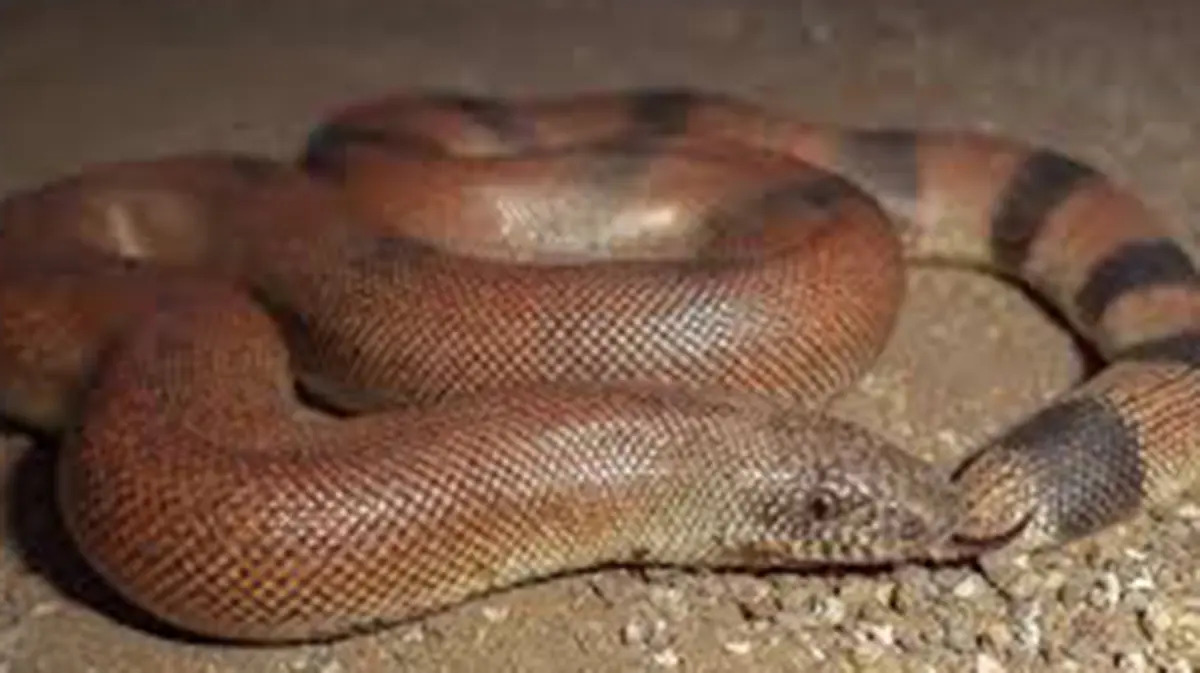
Why in News? Enforcement agencies recently intercepted an illegal trade network and seized several red sand boas in Telangana. The case drew attention to the species, which is often trafficked due to false beliefs about its medicinal or magical properties.
Background
The red sand boa (Eryx johnii) is a non‑venomous burrowing snake found in the dry regions of Iran, Pakistan and India. Its body is cylindrical and stout, with a wedge‑shaped head, small eyes and a short, blunt tail. Colouration ranges from reddish‑brown to dull yellow or grey, helping it blend into sandy soils.
Ecology and Reproduction
- Habitat: Red sand boas live in semi‑desert scrub, dry deciduous forests and rocky foothills. They spend much of their time underground, emerging at dusk to hunt rodents, lizards and occasionally other snakes.
- Behaviour: These snakes are generally slow‑moving and rely on ambush predation. They are solitary and avoid confrontation, making them easy targets for collectors.
- Reproduction: Females are ovoviviparous; they give birth to live young rather than laying eggs. A litter may contain six to fourteen snakelets.
Threats and Conservation Status
- Illegal trade: In parts of India the red sand boa is wrongly believed to bring wealth or cure diseases, leading to a lucrative black market. Specimens are sold domestically and smuggled to Southeast Asia and China. The snake is also collected for the pet trade.
- Legal protection: The species is listed under Schedule IV of the Indian Wildlife (Protection) Act, 1972, and in Appendix II of the Convention on International Trade in Endangered Species (CITES). Possession, sale or export without permission is illegal. Nevertheless, populations have declined in parts of southern India, prompting the IUCN to classify the species as Near Threatened.
Conclusion
The red sand boa is a harmless burrowing snake that plays a useful role in controlling rodent populations. Myths about its powers have fuelled illegal trade, putting pressure on wild populations. Stronger enforcement, public awareness and community‑based conservation can help protect this little‑known species and preserve ecological balance.
Sources: Animalia species profile, DC