

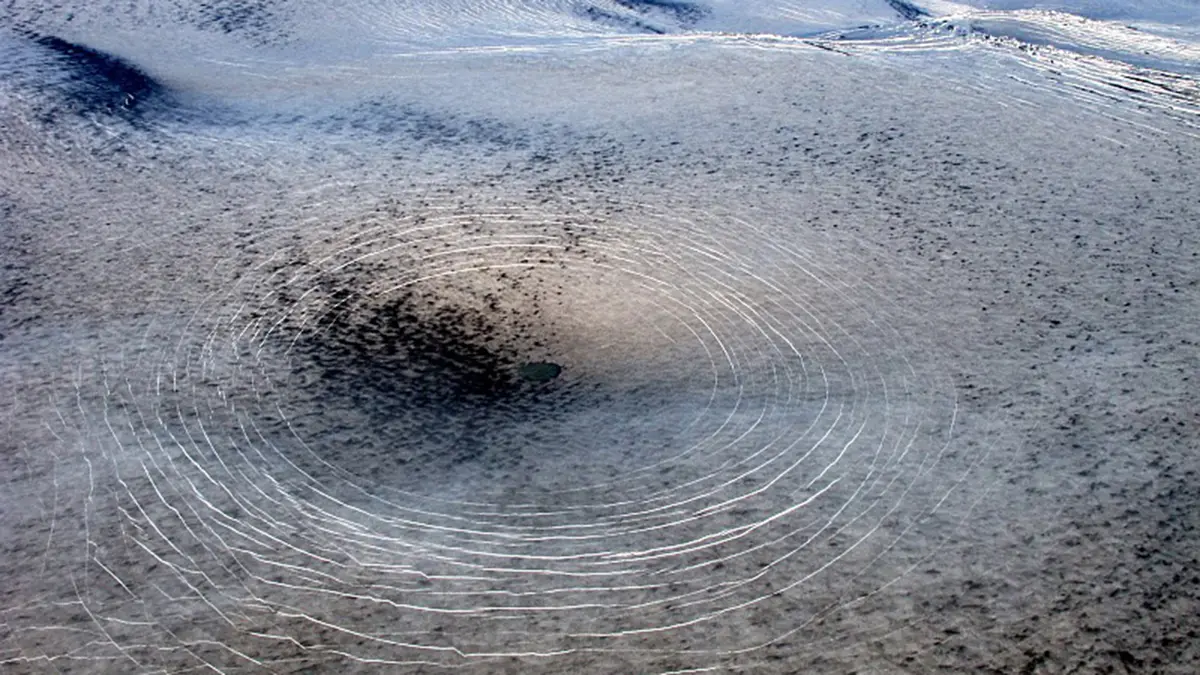
Why in news?
After decades of debate, a March 2026 study definitively confirmed that the Silverpit structure beneath the North Sea is a hypervelocity impact crater created by an asteroid strike 43 – 46 million years ago. The finding answers a long‑standing geological mystery and sheds light on Earth’s vulnerability to cosmic impacts.
Background
The Silverpit crater lies about 80 miles (130 km) off the English coast, roughly 700 m below the seabed. Discovered in 2002 through seismic surveys, the 3‑kilometre‑wide crater is ringed by concentric faults extending about 20 km. Scientists initially proposed an asteroid origin, but alternative explanations—including salt movement and volcanic collapse—were suggested. The lack of direct evidence kept the debate unresolved.
New evidence
- Seismic imaging: Researchers led by Heriot‑Watt University analysed new high‑resolution seismic data, revealing a central peak and ring structures consistent with a meteor impact.
- Shocked minerals: Samples from an oil well near the crater contained quartz and feldspar grains showing deformation patterns (“shocked” minerals) that only form under extreme pressures generated by an asteroid or comet impact.
- Impact modelling: Computer simulations suggest a roughly 160‑metre‑wide asteroid struck the sea floor at a shallow angle from the west. The collision would have thrown a 1.5‑kilometre‑high curtain of rock and water into the air and generated a tsunami more than 100 metres high.
Why it matters
- Rare preservation: Impact craters are rare on Earth because erosion and plate tectonics erase most of them. Silverpit is exceptionally well preserved beneath marine sediments, offering a valuable window into ancient impacts.
- Planetary science: Studying impact structures helps scientists understand how collisions shaped Earth’s crust and climate. It also informs efforts to assess and mitigate modern asteroid threats.
Source: The Economic Times