

Why in news?
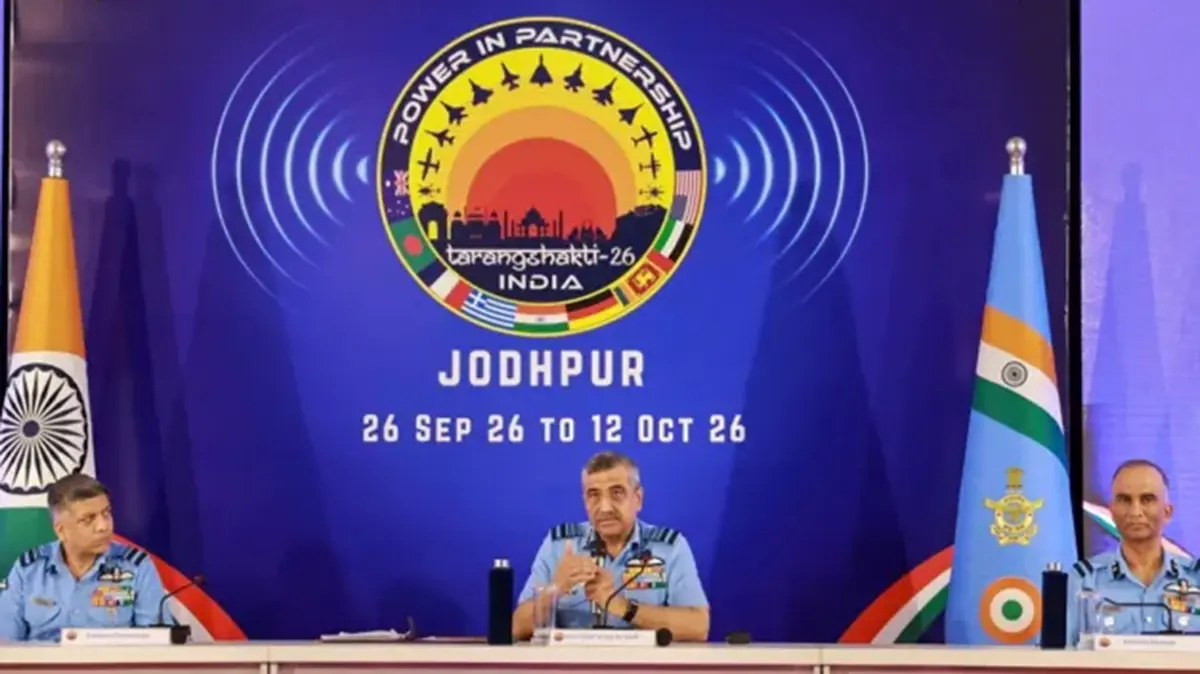
The Indian Air Force has announced the second edition of Exercise Tarang Shakti, scheduled for 26 September–12 October. Reporting on the pre-exercise briefing places the main activity at Jodhpur and adjoining air bases. Seven foreign air forces are expected alongside India, with additional countries attending as observers. The exercise brings different aircraft, procedures and national teams into a shared training environment. Its purpose is to improve operational learning and the ability to work together, rather than merely display individual aircraft. As of 23 September, these are announced plans. Participation in an exercise also does not create an automatic commitment to fight together in a future conflict.
From bilateral practice to a multinational setting
The Indian Air Force, or IAF, conducts exercises with foreign partners to practise operations and exchange experience. A bilateral exercise involves two countries; a multinational exercise introduces several different systems at once. That makes coordination more demanding. Crews may use different aircraft, communications arrangements and established procedures. The objective is not to erase those differences, but to understand how selected capabilities can operate safely and effectively within an agreed training plan.
Tarang Shakti began in 2024 with phases at Sulur in Tamil Nadu and Jodhpur in Rajasthan. Official accounts from participating air forces describe joint work in areas such as air defence, reconnaissance and airlift. The Australian deployment included electronic-attack aircraft and supporting personnel. The significance lay in the operations and relationships exercised together, not simply the presence of foreign equipment. The second edition builds on that experience rather than beginning an entirely new format.
Who is expected, and where?
The Indian Express's account of the 22 September briefing lists Australia, Bangladesh, France, Germany, Sri Lanka, the United Arab Emirates and the United States. India is the eighth air force in that participating group; it should not be counted as an eighth foreign country. The report also identifies 32 observer countries. Observing and deploying aircraft are different forms of involvement. The announced roster should therefore not be described as 40 countries all flying combat missions.
Jodhpur lies in western Rajasthan, within the wider Thar desert region. Its role as a host base connects the exercise with surrounding military aviation infrastructure and training airspace. A large exercise requires arrangements on the ground as well as room to fly. Aircraft need servicing, fuel, mission preparation and support teams. The operational setting consequently includes airfields, maintenance areas and coordination between participating units, rather than only the portion visible in aerial photographs.
The announced aircraft and mission roles
The Week's briefing account identifies expected United States F-35 fighters, French Rafales and United Arab Emirates F-16s. Bangladesh is expected to bring a C-130J transport aircraft. Indian aircraft listed in the reporting include Rafale, Mirage 2000, Jaguar, Tejas, MiG-29 and Su-30 fighters. These are planned deployments, not a record of aircraft already arriving. Their different roles also explain why the exercise cannot be understood as a competition between fighter models alone.
The announced training includes combat beyond and within visual range, air mobility, aerial refuelling and combat search-and-rescue. Beyond-visual-range missions involve engagements without pilots directly seeing the opposing aircraft. Refuelling practice extends the time aircraft can operate away from their bases. Search-and-rescue rehearses recovering personnel under demanding conditions. Transport aircraft, tankers and controllers therefore contribute to the exercise alongside fighters. Coordinating those functions is a central part of the learning.
What interoperability means in practice
Interoperability is the ability of different forces and systems to work together for a defined task. It is not the same as owning identical aircraft. Shared planning helps crews understand the mission, timing and limits of their roles. Communications procedures help them exchange information and avoid misunderstandings. Rehearsal then exposes assumptions that might remain invisible during separate national training. In that sense, a useful exercise can reveal a weakness rather than merely confirm a strength.
Air operations also involve different functions. Reconnaissance gathers information; airlift moves personnel or supplies; air defence seeks to protect against aerial threats. Combining such roles requires a common understanding of what is happening and who is responsible. A fighter's individual performance does not settle whether the whole mission works. The links between aircraft, controllers and support teams can be just as important as the characteristics of any one platform.
Official United States reporting on the 2024 exercise emphasised cooperation across these capabilities and the exchange of perspectives. That background helps explain the value of a multinational format. A team can encounter a different way of organising an otherwise familiar task. Participants can then assess which practices fit their own requirements. Learning in this setting does not mean unrestricted access to another country's sensitive systems or complete integration of national command structures.
The less visible work on the ground
Aircraft deployments depend on technicians, logistics staff and planners as well as pilots. Australia's official 2024 account, for example, described personnel support alongside its three deployed aircraft. Such deployments test the ability to sustain operations away from a home base. They also create repeated working contact between teams. Procedures for maintenance, coordination and safety become practical matters that people must apply together, rather than concepts discussed only in a conference room.
Information sharing has its own limits and requirements. During the 2024 edition, the IAF held a symposium on air-domain awareness at Jodhpur. That subject concerns understanding activity in the air and turning observations into a useful operational picture. Discussions examined cooperation and the challenges associated with different systems. A common training event offers a setting for such exchanges, while each country retains responsibility for the information and capabilities it chooses to share.
How to judge the exercise's outcome
An announced aim is not yet an achieved result. Meaningful assessment would consider whether teams coordinated safely, understood procedures better and identified lessons for later training. The number of aircraft or flags alone cannot establish those outcomes. Likewise, an exercise scenario is a controlled learning environment, not a prediction of a real conflict. Its value lies in improving preparedness while making limitations and coordination problems visible before an actual emergency.
Conclusion
Tarang Shakti 2026 is planned as another step in India's multinational air-force training. Its practical challenge is connecting different people, procedures and capabilities within a common mission framework. The immediate position on 23 September remains preparatory, with the exercise scheduled to begin later in the week. Its eventual significance will depend on operational learning and sustained working relationships. Planned participation and impressive aircraft displays alone do not prove operational readiness.