

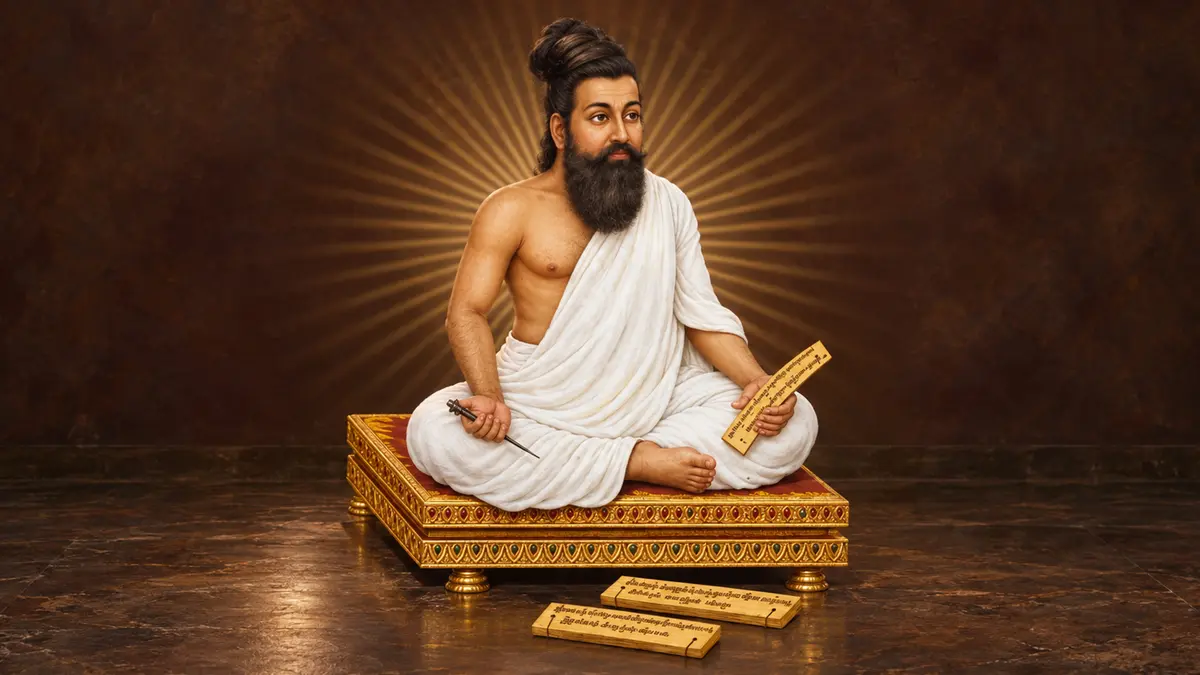
Why in news?
Prime Minister Narendra Modi presented Vladimir Putin with a Russian translation of the Thirukkural on 11 September 2026. Reports placed the exchange during their meeting in New Delhi. The gift renewed attention to Thiruvalluvar’s work on personal conduct, public life and love. Its importance lies in the text itself, beyond the diplomatic ceremony.
A compact work with a broad design
The Thirukkural is a classical Tamil work traditionally attributed to Thiruvalluvar. It contains 1,330 couplets arranged in 133 chapters, with ten couplets in each chapter. Its brevity should not be mistaken for narrow scope. The chapters consider how people conduct themselves within families, society, government and intimate relationships.
The three main divisions are Aram, Porul and Inbam, also called Kamam. Aram concerns virtue and ethical life. Porul addresses wealth, social relationships and public affairs. Inbam explores love. Translations differ in their preferred English labels because a single English word cannot capture every shade of the Tamil terms.
Aram has 38 chapters, Porul 70 and Inbam 25. Their respective totals are 380, 700 and 250 couplets. These divisions add up to the complete 1,330. Understanding this structure connects individual sayings with their larger intellectual setting. The book is more than a collection of isolated motivational messages.
How the couplets work
The poetic form is the kural venba. Its first line has four metrical feet and its second has three. A metrical foot is a unit of poetic rhythm, not necessarily an ordinary written word. Describing every couplet simply as “seven words” loses that important distinction.
The compact form encourages concentrated expression. An image, contrast or observation can carry a wider ethical argument. A reader may understand the immediate situation while still needing commentary to explore its implications. This helps explain why the work supports both memorisation and sustained discussion rather than only one kind of reading.
Translation introduces another layer of interpretation. A literal rendering may preserve a key term but sound unfamiliar. A freer rendering may communicate the argument while losing rhythm or ambiguity. Reading a translation alongside the Tamil and a commentary can therefore reveal differences that a single polished English sentence hides.
Ethics beyond private behaviour
The work connects individual conduct with the quality of collective life. Truthfulness, restraint, learning and consideration for others are not confined to private morality. They also shape relationships of power and responsibility. This connection makes the Thirukkural relevant to discussions of leadership without turning it into a modern administrative manual.
Porul is consequently broader than money alone. It considers the conduct of rulers and the qualities required in public relationships. A discussion of wealth can include how it is acquired and used. The moral question is not only whether an action succeeds, but also whether its means are acceptable.
The final division changes the mode of expression through the experience of lovers. Union, separation, longing and emotional misunderstanding enter the work’s field of vision. This matters when describing its scope. A summary restricted to governance or moral instruction would leave out a substantial part of its literary character.
What is known about its historical setting?
The author’s precise dates and biography remain debated. Literary references, language and later traditions inform competing interpretations, but do not establish an uncontested year of composition. A commemorative date should therefore not be mistaken for a securely dated historical event. Claims of an exact ancient publication year require particular caution.
Religious and philosophical communities have interpreted the work through different traditions. Its ethical reach has encouraged readers across those boundaries. That reception should not be confused with proof of the author’s personal affiliation. Nor is it necessary to settle every biographical dispute before explaining what the surviving text actually discusses.
The Central Institute of Classical Tamil’s digital manuscript work also shows how texts reach modern readers. Manuscripts may contain variant spellings, misplaced leaves or an omitted couplet. Editors compare and document such features. The standard text and an individual surviving manuscript are related, but they are not automatically identical objects.
Why a translated book can matter diplomatically
A literary gift offers a way to represent a country through its intellectual traditions. In this case, a Tamil work reaches a Russian-speaking recipient. That highlights India’s linguistic diversity within an international exchange. The gesture can encourage interest in the text without demonstrating any measurable change in bilateral policy.
Its longer-term value depends on what readers can access beyond the ceremony. Accurate translations, scholarly introductions and readable editions can support genuine engagement. A famous title alone cannot convey the arguments of 133 chapters. Cultural exchange becomes more substantial when the work is available for study, comparison and discussion.
Conclusion
The Thirukkural brings ethical reasoning, public life and emotional experience into a tightly organised poetic work. The diplomatic gift creates a fresh reason to examine that achievement. A careful account preserves its structure and acknowledges uncertain biography. Its continuing relevance is best explained through its ideas, not exaggerated claims about its history.