

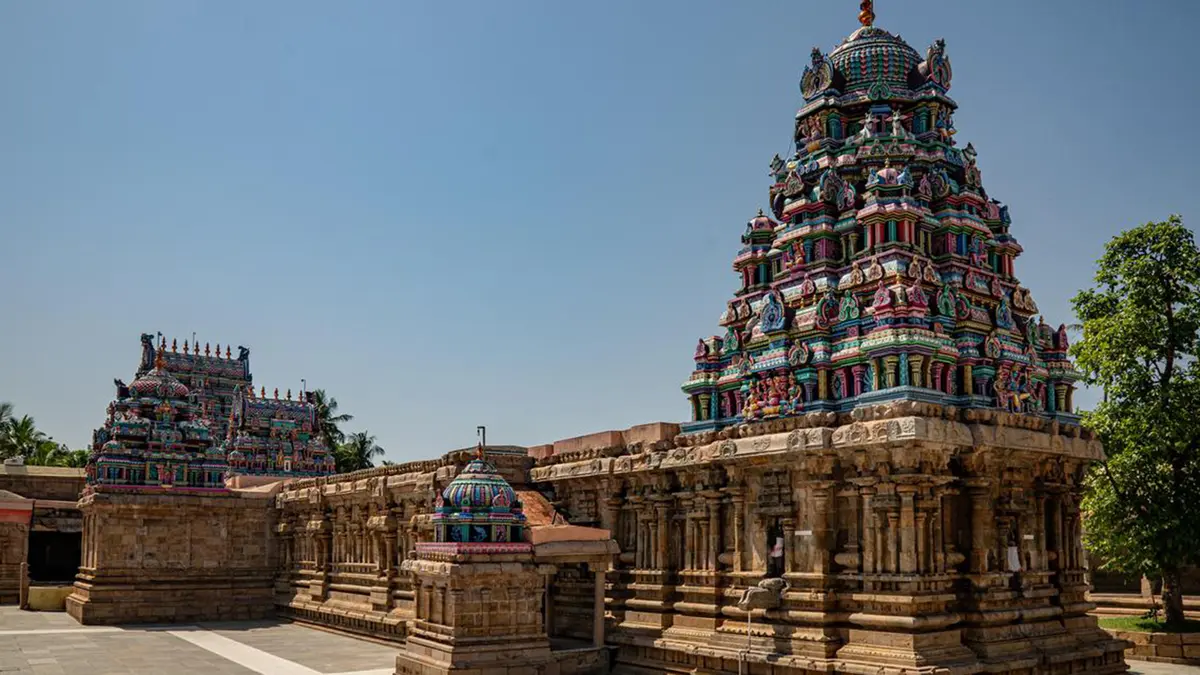
Why in news?
A detailed report highlighted the restoration of Thukkachi’s historic Shiva temple. The project combined traditional craft with modern structural technology. It won a 2024 regional award from the United Nations cultural agency. The work now guides other temple restoration projects in Tamil Nadu.
Background
Abathsahayeswarar Temple stands at Thukkachi near Kumbakonam, and the village lies in Tamil Nadu’s Thanjavur district.
The temple is dedicated to Shiva. Its main surviving form belongs to the later Chola period during the twelfth century.
It remains a living place of worship, and conservation therefore had to protect historic fabric while allowing continuing religious practice.
The United Nations Educational, Scientific and Cultural Organization is commonly called UNESCO.
Date correction: The main temple is a twelfth-century later Chola monument, not a tenth-century structure.
What was its early history?
- An earlier temple at the site was known as Thenkallathi.
- Chola ruler Kulottunga I supported the recitation of Tevaram hymns there.
- Vikrama Chola ruled during the early twelfth century.
- He renovated or rebuilt the temple on an ambitious scale.
- The renewed complex received the name Vikramacholeeswaram.
- Later additions and repairs allowed worship to continue across centuries.
The Tevaram contains Tamil Shaiva devotional hymns, and the recitation endowment supported regular worship.
Some historians describe it as Vikrama Chola’s only known major temple project. This conclusion depends upon presently available inscriptions and remains.
The structure follows a chariot-like temple form called Kara Kovil. Sculpted features make the stone base resemble a ceremonial vehicle.
Its image of Sarabeshwarar is considered among the earliest surviving examples. Sarabeshwarar is a composite fierce form associated with Shiva.
Which temple terms should readers know?
- The garbhagriha is the innermost sanctum containing the main deity.
- The vimana is the tower rising above the sanctum.
- A mandapa is a pillared hall for worship or gatherings.
- A gopuram is a monumental gateway tower.
- A prakara is an enclosure wall or surrounding passage.
- A kumbhabhishekam is the ritual reconsecration after major restoration.
What condition was the temple in?
Years of weathering and weak repairs had damaged the complex, and vegetation covered parts of the entrance gopuram.
Sections of the outer prakara wall had collapsed, and the Kali shrine and its large mandapa had become structurally unsafe.
Water entry weakened mortar and displaced stone blocks, and unscientific cement repairs also disturbed traditional movement of moisture.
The challenge extended beyond appearance because engineers first had to identify the structural failures.
Who carried out the restoration?
Tamil Nadu’s Hindu Religious and Charitable Endowments Department led the project, and it treated the work as a pilot programme.
Philanthropist Dr. R. Vasanthakumar of Karpagam University provided ₹5 crore, and this funding supported the detailed conservation process.
The National Centre for Safety of Heritage Structures at the Indian Institute of Technology Madras provided technical guidance.
Professor Arun Menon led the institute’s team. Traditional sthapathis, or master temple architects, worked with engineers, historians and epigraphists.
Agamas are traditional texts and rules guiding temple design and worship.
Agama specialists protected ritual requirements, and residents contributed knowledge and received routine maintenance training.
How did the work proceed?
- A detailed project report was prepared during 2022.
- Drones and digital mapping recorded the whole temple before intervention.
- Photogrammetry created measurable models from overlapping photographs.
- Workers numbered every granite block before careful dismantling.
- Engineers examined foundations, loads, cracks and displaced masonry.
- Craftspeople reused sound original stones in their recorded positions.
- Missing elements received compatible stone and traditional lime mortar.
- Mechanical grinders prepared mortar while cranes moved heavy blocks safely.
- Drainage and roofs were repaired to prevent renewed water damage.
- The main restoration work finished during 2023.
Modern equipment improved measurement and worker safety, and traditional materials preserved physical compatibility with the old structure.
Lime mortar can release trapped moisture more effectively than hard cement, and its strength also suits many historic masonry systems.
What is living heritage conservation?
A living monument still serves its original community function, and conservation cannot treat it only as a motionless museum object.
Daily worship, festivals and ritual movement must continue safely. Repairs should not erase historic evidence.
Authenticity means retaining genuine materials, workmanship and cultural meaning, and it does not require leaving dangerous damage untouched.
What recognition did the project receive?
The temple’s kumbhabhishekam took place on 3 September 2023, and worship resumed after structural and ritual completion.
On 6 December 2024, UNESCO announced an Asia-Pacific Award of Distinction, and the award praised sensitive and technically sound conservation.
Do not confuse: This was a regional heritage conservation award. It did not make the temple a UNESCO World Heritage Site.
What wider lessons emerged?
- Documentation should precede dismantling or structural intervention.
- Original stones should remain in place whenever safely possible.
- Traditional materials require scientific testing, not blind imitation.
- Engineers and craftspeople must solve structural problems together.
- Local communities should understand and maintain the completed work.
- Routine drainage care can prevent another expensive restoration.
Tamil Nadu incorporated these lessons into its Manual for Temple Restoration and Conservation. The pilot can therefore influence many later projects.
Conclusion
Thukkachi shows how technology can support traditional conservation, and the strongest restoration preserves structure, worship and community knowledge together.