

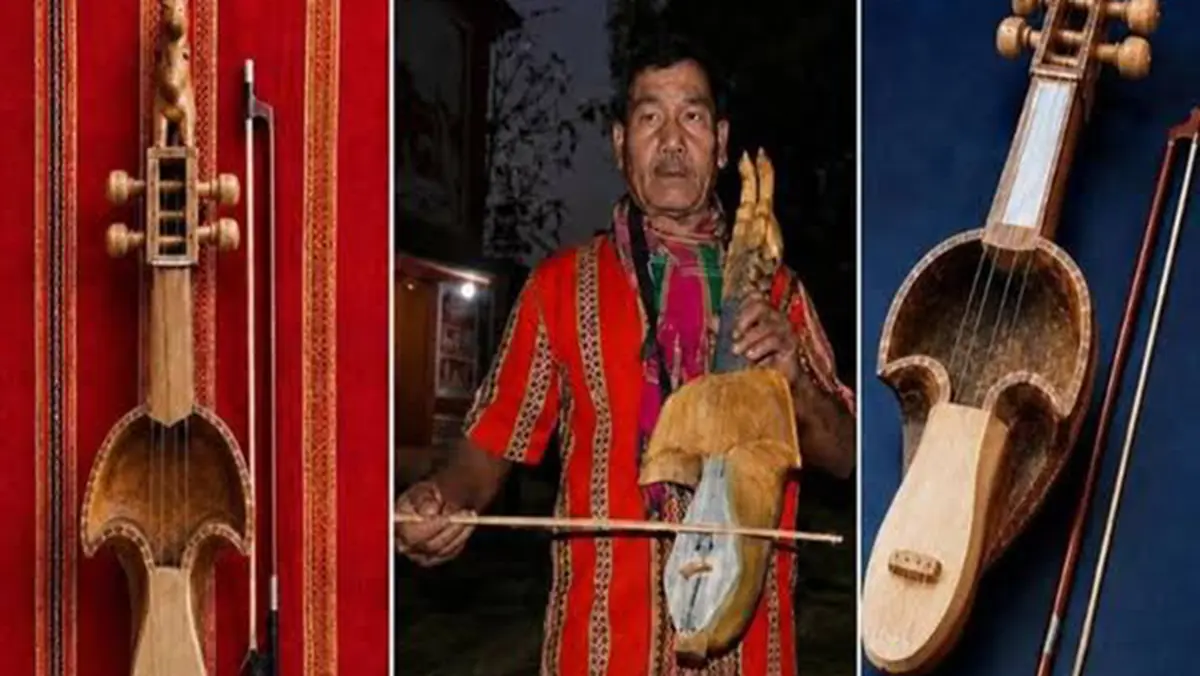
Why in news?
Tripura artisan Debabrata Das displayed the Sarinda at Indie Haat 2026. The national handicrafts exhibition ran in New Delhi from 10 to 19 July. His display included traditional bamboo musical instruments from Tripura. The newly registered Geographical Indication drew particular attention.
Background
The traditional bowed string instrument called Tripura Sarinda is also locally known as Sarinda Uakhrap.
For generations, communities have used its strings, resonator and bow during folk songs, dances and gatherings.
How does the instrument produce sound?
- The player holds the instrument upright against the body.
- A bow moves across the strings, making them vibrate and create sound.
- The hollow chamber strengthens vibrations, while finger movements change string length and pitch.
The method resembles other bowed instruments, but regional shape, materials and playing traditions create its identity.
Traditional construction
| Part | Role and material |
|---|---|
| Body | Artisans shape bamboo or wood into the main instrument body. |
| Resonator | A hollow lower chamber strengthens the string vibrations. |
| Membrane | A thin covering may stretch across the resonating chamber. |
| Strings | Examples use metal, muga thread or traditionally animal gut. |
| Tuning pegs | Pegs tighten or loosen strings and change their pitch. |
| Bow | A horsehair bow creates sound by rubbing the strings. |
Traditional descriptions mention three strings and pegs, although handmade instruments can vary between artisans.
Reported examples are usually around 65 to 70 centimetres long.
What is a Geographical Indication?
A Geographical Indication (GI) identifies goods whose quality, reputation or characteristic connects with a particular place.
India protects these names through a 1999 law, implemented during 2003 through a Registry in Chennai.
GI registration is not a patent
| Protection | What it protects |
|---|---|
| Geographical Indication | A product name and qualities connected with its region |
| Patent | A new invention meeting legal patent conditions |
| Trademark | A sign distinguishing one commercial source from another |
| Copyright | Original literary, artistic and related creative expression |
A GI belongs collectively to eligible regional producers, without giving one person ownership of every similar instrument.
Official registration timeline
| Date | Development |
|---|---|
| 18 March 2024 | Nabadiganta Welfare Society filed application number 1198. |
| 26 November 2025 | The application appeared in GI Journal number 210. |
| 27 March 2026 | The Registry issued the registration certificate. |
| June 2026 | Tripura publicly celebrated the completed GI recognition. |
| July 2026 | The instrument appeared at the national Indie Haat exhibition. |
This Class 15 registration remains valid for ten years and can be renewed for further ten-year periods.
Why can GI recognition help?
- It protects the registered regional name against misleading commercial use.
- It can improve recognition for genuine local makers.
- It records traditional production knowledge and may support training for younger artisans and musicians.
- It can create better exhibition and market opportunities.
Registration cannot guarantee income or continued practice without producer organisation, quality control and market access.
Tripura’s recognised GI products
State reports describe Sarinda as Tripura’s fourth GI-recognised product.
- Tripura Queen Pineapple represents the state’s horticultural heritage.
- Tripura Pachra-Rignai Textile protects an indigenous textile tradition.
- Matabari Peda protects a sweet associated with Tripura Sundari Temple.
- Tripura Sarinda protects the regional musical instrument name.
Conclusion
The GI tag can protect Sarinda’s identity, while living practice must sustain its music.