

Why in news?
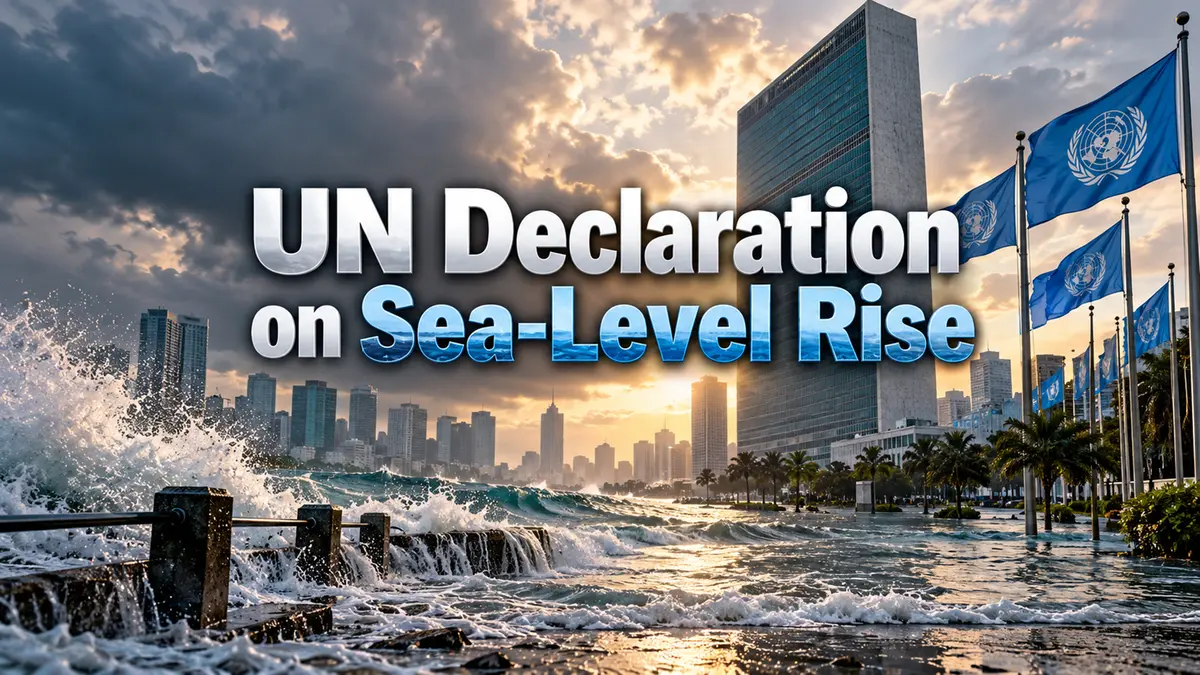
World leaders approved a declaration on sea-level rise at a United Nations high-level meeting on 24 September. The text addresses a problem that extends beyond flooded coastlines: rising seas can threaten homes, livelihoods and the territorial foundations of states. It supports continuity of statehood and stability of maritime zones, alongside adaptation and assistance for affected communities. The United Nations meeting account described approval of the text for subsequent formal General Assembly adoption. This was therefore an important political agreement, not the creation of a new ocean treaty at that meeting. For low-lying countries, the central concern is retaining rights and functioning institutions even as their physical environment changes.
Why a changing coastline becomes a question of rights
Sea-level rise has two principal physical drivers: seawater expands as it warms, and melting land ice adds water to the ocean. The effect is not identical along every coast. Land subsidence, changes in ocean circulation and other regional conditions can make local water levels rise faster or slower than the global average. Coastal planning therefore needs local observations as well as global climate evidence.
A higher average sea level gives tides and storm-driven water a higher starting point. Flooding can reach farther inland, while erosion and saltwater intrusion affect settlements and freshwater supplies. A community need not wait for an island to disappear completely before conditions become difficult. Roads, water systems and livelihoods may face disruption much earlier.
These physical changes raise a second question: what happens to the rights connected with the coast? Small island states can have extensive maritime resource areas despite limited land. The Alliance of Small Island States welcomed the negotiated text as a major common statement on protecting those interests. Its concern combines survival of communities with continuity of their political and economic institutions.
Understanding baselines and maritime zones
The United Nations Convention on the Law of the Sea, or UNCLOS, provides the legal framework for maritime zones. A baseline is the reference line from which their breadth is measured. The normal baseline follows the coast's low-water line, although the Convention provides other arrangements for particular coastal configurations. A moving shoreline consequently raises difficult questions about the reference points underlying existing entitlements.
The territorial sea can extend up to twelve nautical miles from the relevant baseline. Beyond it, an exclusive economic zone can reach a maximum of 200 nautical miles from that baseline. In this zone, the coastal state has specified resource rights and jurisdiction. It does not possess the same unrestricted authority as over land; other states retain relevant navigation and overflight freedoms.
The declaration supports maintaining maritime zones already established consistently with UNCLOS despite physical changes caused by rising seas. It also preserves a state's ability to update them. This is a statement about continuity of lawful entitlements, not permission to draw arbitrary new boundaries. That distinction matters wherever neighbouring claims or maritime limits already require legal agreement.
Statehood does not reduce to a shrinking map
The negotiated text favours a presumption of continued statehood, including sovereignty, responsibilities and United Nations membership, consistently with international law. It also calls for support that helps affected states maintain institutional functions. The practical issue is not only whether a flag remains recognised. Governments need to keep serving people, representing their interests and carrying out obligations.
This approach separates two matters that are often compressed into one alarming image. Land may become less habitable, while the state and its people retain political rights and identity. The declaration does not physically prevent inundation. Nor does recognition by itself supply housing, water, public services or the resources needed to maintain government. Legal continuity and practical adaptation must work together.
Protecting people requires choices, resources and implementation
The text connects infrastructure planning, ecosystem protection, finance and community participation. It recognises that responses must respect people's choices and dignity. Where international movement is involved, arrangements still depend on agreement with relevant states and applicable law. The declaration therefore does not create an automatic visa or a universal right to settle in another country.
Its implications are substantial even without treating every commitment as an immediately enforceable benefit. A coastal protection plan needs to identify which services are exposed and which options remain workable. Finance must reach projects that communities can actually use. Where relocation becomes necessary, protecting livelihoods and social connections is part of the task, not an afterthought to moving buildings.
Adaptation also differs from mitigation. Adaptation reduces harm from changing conditions; mitigation addresses the emissions driving further warming. Preserving maritime rights cannot substitute for either. The agreement's practical value depends on turning diplomatic support into functioning institutions, usable finance and locally appropriate protection. A statement of concern alone cannot deliver those outcomes.
Conclusion
The September agreement treats sea-level rise as a challenge to communities, institutions and rights as well as coastlines. Its continuity provisions seek to prevent physical loss from automatically becoming political dispossession. They must be accompanied by measures that keep people safe and public services functioning. As of this edition, the high-level meeting had approved the text for the next formal step; implementation remained the larger task.