

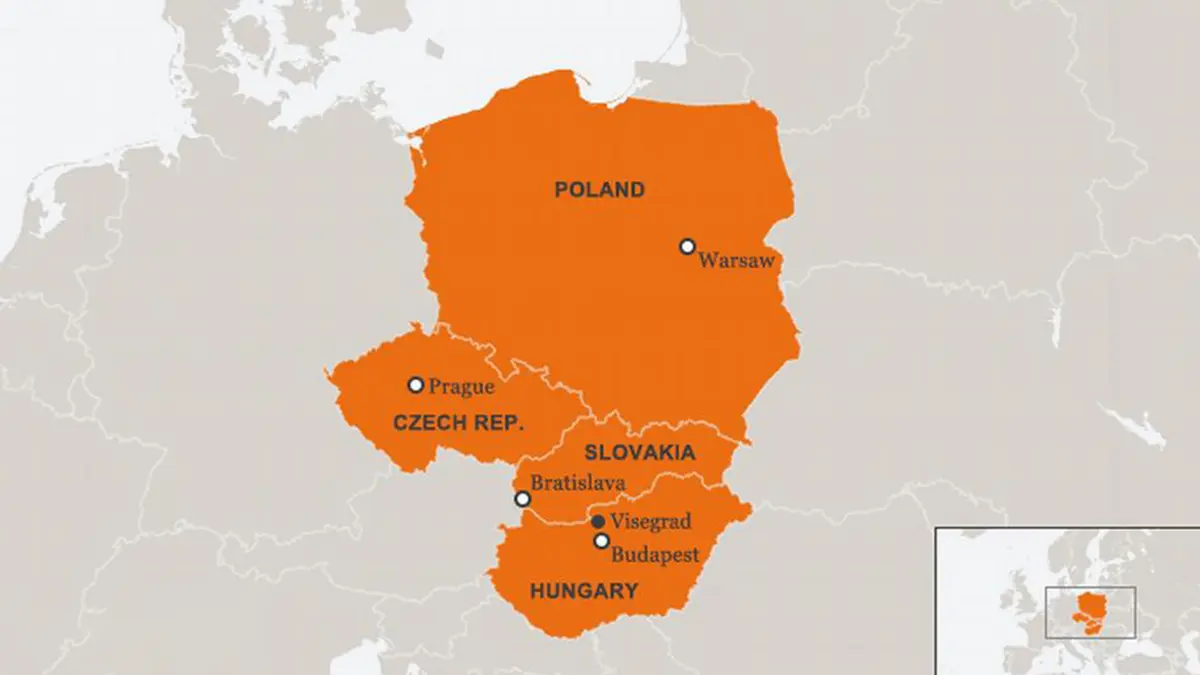
Why in news?
The four Visegrád countries backed India's campaign for a permanent United Nations Security Council seat at their first joint ministerial meeting with India. The meeting took place in New York on 21 September, alongside the United Nations General Assembly. According to Business Today's account, ministers also agreed on annual foreign-minister meetings and an annual business forum. The Visegrád Group brings together Czechia, Hungary, Poland and Slovakia, giving India a collective channel for engaging these Central European partners. Their support strengthens the diplomatic case for reform, but it does not create a new Council seat. Changing permanent membership requires a much wider agreement and amendment of the United Nations Charter.
Four countries, not a separate European government
The group is often called the Visegrád Four, or V4. Czechia is also known by its formal name, the Czech Republic. The four members remain sovereign countries with their own governments, foreign policies and bilateral relations with India. Their forum allows them to coordinate on shared interests rather than transferring their national powers to a new authority. A common declaration is therefore politically meaningful, but it is not automatically a binding decision for other European states.
Its regional setting helps explain its usefulness. These neighbouring Central European states went through related political and economic transformations after communist rule. They also needed to develop connections across borders while integrating with wider European institutions. Their cooperation now spans areas such as education, culture, transport and economic development. However, shared geography does not require identical positions on every international dispute. Agreement has to be built among four governments rather than assumed from the group's name.
Why a group founded by three states has four members
The modern initiative began on 15 February 1991, when leaders of Poland, Hungary and Czechoslovakia met in Visegrád, Hungary. Their agenda included democratic transition and closer integration with European institutions. This was a period of profound institutional change, when countries were rebuilding political relationships and economic arrangements. The founding cooperation offered a way to pursue common objectives together instead of treating neighbouring states only as competitors for outside attention.
Czechoslovakia separated peacefully into the Czech Republic and Slovakia in 1993. Both successor countries continued in the cooperation, producing the four-member format. All four later joined the European Union, but that did not make regional coordination redundant. Countries can work within a larger union while consulting in smaller groups on matters of particular regional interest. The V4 is consequently a forum within the broader European setting, not an alternative membership system replacing the European Union.
How cooperation turns into practical programmes
The political forum works through consultations and a rotating presidency rather than a large supranational administration. Meetings can bring together leaders, ministers or officials responsible for specific subjects. Cooperation with an outside partner, such as India, is commonly described as a V4-plus format. This arrangement can put several related bilateral relationships around one table. It does not remove the need for separate negotiations where national laws, budgets or institutions differ.
It would nevertheless be inaccurate to say the cooperation has no lasting organisation at all. The International Visegrad Fund, established in 2000, has a secretariat and supports regional projects, scholarships and artistic exchanges. The distinction is between the relatively informal political forum and this established funding institution. Educational or cultural cooperation can thus have practical support mechanisms even when political discussions themselves do not produce enforceable common rules.
What India's engagement adds
The New York discussions covered political cooperation, defence, technology, research, education and people-to-people relations. A recurring ministerial meeting can provide a place to review progress and resolve difficulties. A business forum can bring companies into the relationship, but announcing it does not itself establish investment flows or signed commercial contracts. Those outcomes depend on subsequent participation, workable proposals and decisions by the institutions involved.
For India, the format can complement existing relationships rather than require a choice between bilateral and regional diplomacy. A research partnership may involve universities in one country, while another project involves firms across several members. Bringing ministers together can help identify common priorities. Whether this produces useful cooperation will depend on the follow-through: programmes, participating organisations, resources and a timetable that survives beyond the meeting announcement.
Why endorsement is different from a permanent seat
The Security Council has primary responsibility for international peace and security under the United Nations Charter. It contains five permanent members and ten elected members serving two-year terms. Permanent membership is not awarded through the ordinary election for those temporary seats. Nor can a regional group confer it on another country. Support from the V4 therefore belongs to the political process of building agreement on Council reform.
Article 108 sets out the Charter-amendment requirement. An amendment needs adoption by two-thirds of General Assembly members, followed by ratification by two-thirds of United Nations members. That ratification must include all five permanent Security Council members. Diplomatic support and legal implementation are separate stages. Even widespread endorsements leave questions about the shape of an expanded Council and the terms of membership to be settled through negotiation.
Conclusion
The meeting gives India another organised channel for Central European cooperation and additional support for its reform campaign. Its immediate achievement is political coordination, not a change in the Council's composition. The next meaningful results would be sustained ministerial engagement, workable sectoral projects and progress towards the broader agreement that Charter reform requires.