

Why in news?
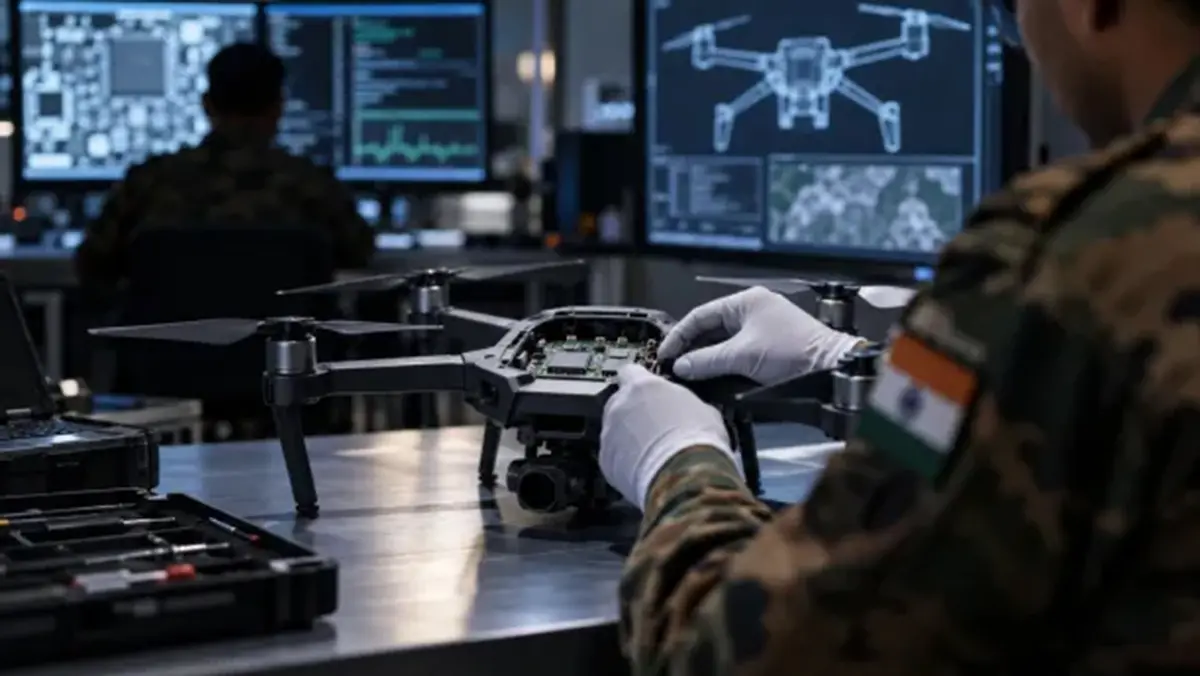
The Indian Army is expanding its ability to examine electronic equipment for hidden security weaknesses. The Indian Express reported on 21 September that a Delhi laboratory had been inaugurated, with at least five more planned. Its name is Assessment and Analysis of Electronic Systems Hardware for Vulnerabilities and Security Threats (AASHVAST). The laboratories examine hardware and the low-level software controlling devices such as drones. This matters because domestic assembly can still involve components and software whose origin is difficult to establish. According to the report, drones must undergo these checks, while surveillance-camera testing is a planned extension. The operating Delhi facility and the proposed network represent different stages of the initiative.
What the laboratory's name means
AASHVAST expands to Assessment and Analysis of Electronic Systems Hardware for Vulnerabilities and Security Threats. Its focus reaches below the applications a user normally sees. Hardware includes the physical chips, circuit boards and communication modules inside a device. Firmware is the software embedded in such components that helps them start, communicate and perform their basic functions. A device may appear normal to its operator even when a weakness exists in this underlying layer.
The newspaper describes the testing suite as a development by QuickPay for the Army's electronics-maintenance establishment. It also places the initiative within concerns about Chinese-origin components and proprietary communication systems. Those concerns explain the inspection effort; they do not establish malicious behaviour in every product from a particular country. Security assessment must examine the actual component, software and configuration rather than treating a supplier's nationality as a complete technical finding.
Why firmware deserves separate attention
An ordinary software update can change what an application does, but firmware can control how the underlying device behaves. In a networked camera, that may affect communication and access controls. In a drone, low-level components support the wider control and communication system. A weakness in one of those components can therefore matter beyond the component itself. Its consequences depend on the function it performs and whether surrounding safeguards prevent the weakness from being exploited.
A vulnerability is a weakness that could be exploited. A deliberately inserted backdoor is one possible security problem, but an accidental coding error can also create risk. Finding a weakness does not by itself establish who introduced it or whether an adversary has used it. Conversely, failing to discover one during a test does not prove that none exists. The coverage and quality of the assessment matter as much as its final label.
Following the component through the supply chain
The company selling a finished device may not manufacture all its chips, write all its software or control every later update. A supply chain connects those different contributors. A change in a subcontractor or component version can alter the security profile without changing the product's familiar name. Procurement therefore needs information about what is actually supplied and how it is supported, not just the country printed on the final invoice.
The United States National Institute of Standards and Technology describes supply-chain risk as broader than deliberate sabotage. It also includes counterfeit products and weaknesses caused by poor development or manufacturing. This framework explains why inspection and traceability work together. Examination asks what is in a device and how it behaves. Traceability helps establish where it came from and which supplier can correct a defect. Neither activity completely replaces the other.
Protection, detection and recovery
Firmware resilience can be understood through three connected tasks: prevent unauthorised changes, detect changes that occur, and recover securely. The institute's platform-firmware guidance uses this approach. An authenticated update mechanism, for example, helps a device distinguish an authorised update from an unauthorised replacement. Detection provides evidence that something has changed. Recovery then needs a trustworthy way to restore operation, rather than reinstalling the same compromised material.
Connected devices also need support throughout their service life. The institute's device-security baseline includes identification, configuration, data protection, controlled access, software updates and awareness of security state. These are general engineering principles, not a certification of AASHVAST. Their practical implication is that an initial laboratory clearance cannot end responsibility. Equipment versions, update arrangements and access permissions must remain under control after deployment, when exposure and operational conditions may change.
What the expansion can and cannot establish
Additional laboratories could make examination more accessible and help spread testing work across locations. That benefit depends on trained staff, appropriate tools and consistent procedures. Their findings also need to lead to action: correcting software, rejecting an unsafe configuration or requiring a supplier to provide support. A report filed without a repair or procurement decision has limited protective value. The inspection process matters because it can influence what equipment is accepted and how it is maintained.
The reported future extension concerns closed-circuit television (CCTV) systems, which use cameras to monitor particular locations. A camera's network connections and software deserve examination alongside the picture it produces. The current initiative concerns Army procurement, with drone inspection specified and camera testing envisaged. Wider coverage would require the proposed facilities to become operational and apply suitable procedures to those additional equipment categories.
Conclusion
AASHVAST addresses the gap between receiving an electronic product and understanding the components that control it. Its value will depend on whether testing leads to traceable equipment, corrected weaknesses and dependable support after purchase. The wider lesson is that secure procurement continues beyond assembly and delivery. It includes the firmware, the update process and the ability to respond when a vulnerability is discovered later.