

Why in news?
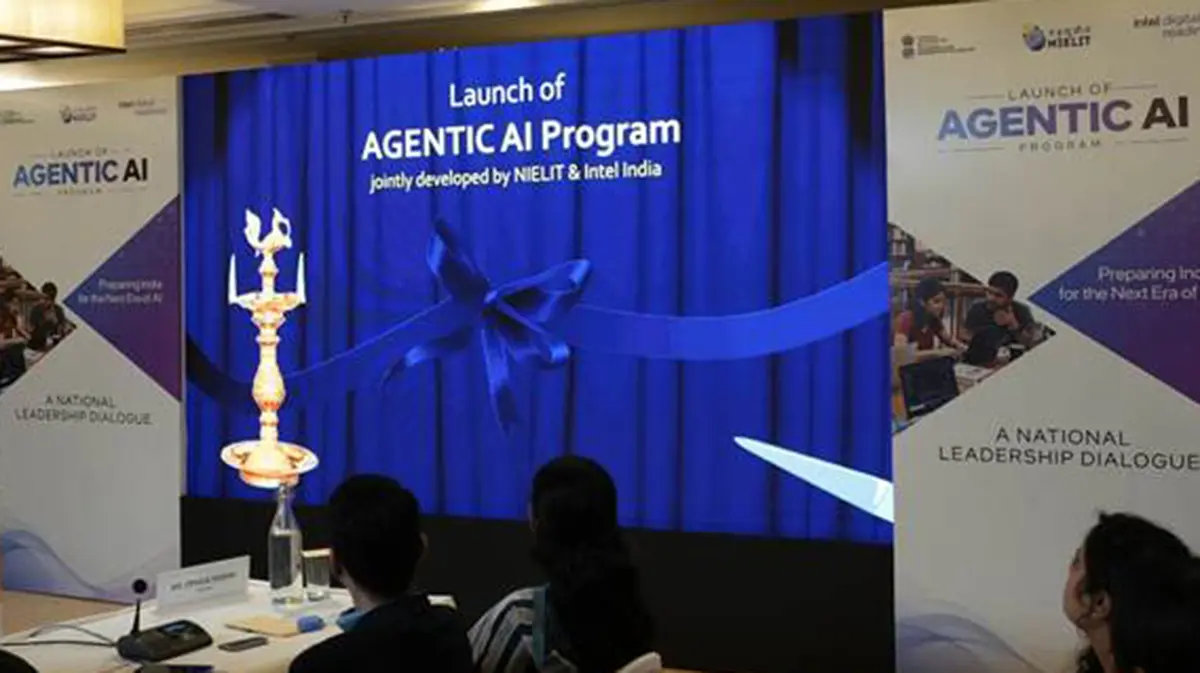
Two national learning programmes on agentic artificial intelligence were launched in New Delhi on 3 September. India's National Institute of Electronics and Information Technology and Intel India developed them together. One programme introduces the idea broadly, while the other teaches system engineering. The initiative responds to demand for skills beyond ordinary chatbot use.
What agentic artificial intelligence means
Generative artificial intelligence usually produces content after receiving a prompt. An agentic system can pursue a stated goal through several linked steps. It may plan work, call approved tools, check results and decide what follows. Human authority should still define its boundaries and review important outcomes.
An agent is not independent in the human sense. Its behaviour depends upon models, instructions, data, software tools and access permissions. Errors can therefore travel across an automated workflow. Greater ability to act creates greater need for supervision.
Multi-agent systems divide a task among specialised software agents. One may retrieve information, another may analyse it and a third may verify output. Coordination can improve complex workflows when roles are clear. It can also multiply errors when agents trust each other too readily.
The two learning tracks
The first course is called Agentic AI for Everyone. It covers workflow automation, individual agents and multi-agent arrangements. Learners can explore no-code tools and ways to govern automated processes. The course targets students, teachers, professionals and other interested learners.
The second course is called Engineering Agentic AI Systems. It develops skills for creating usable systems and moving them into deployment. Subjects include architecture, tool integration, orchestration, memory and deployment. Learners can use both low-code methods and conventional programming.
The programmes were introduced during a national leadership dialogue at the India Habitat Centre. Participants represented government, education and industry. This mix matters because workplaces need both technical capability and operational judgement. Training should connect demonstrations with real institutional problems.
The institutions behind the initiative
India's National Institute of Electronics and Information Technology is an autonomous scientific society. It operates under the Ministry of Electronics and Information Technology. Its mandate includes formal and non-formal learning in electronics and information technology. Its network can help reach learners beyond a few major technology centres.
Intel India contributes technology expertise and training experience. A public-private design can update content faster than a purely academic cycle. Public institutions can contribute reach, certification and alignment with national priorities. Clear responsibility is still needed for curriculum quality and learner data.
The effort also complements India's wider push for artificial intelligence skills and safe adoption. IndiaAI supports computing, datasets, innovation, applications and future skills through several programme pillars. Agentic systems can connect these areas through practical deployment. Training must remain useful across changing vendors and software products.
Skills that responsible deployment requires
Building an agent needs more than writing an effective prompt. Designers must restrict which tools it can use and what data it can read. They need logs that show each action and its reason. High-impact decisions require human approval and a clear escalation path.
Testing should include ordinary tasks, unusual inputs and deliberate attempts to misuse the system. Developers must check factual accuracy, privacy, security and unequal outcomes. They should also measure cost, speed and reliability. A polished demonstration is not evidence of safe daily operation.
Memory creates another challenge. Stored context can improve continuity but may retain personal or confidential information. Organisations need limits on collection, access and deletion. Users should know when an automated agent is acting on their behalf.
Opportunities and limits for India
Agentic tools may reduce repetitive work in administration, services and small businesses. They can organise records, prepare drafts and coordinate routine digital tasks. Staff can then focus on judgement and human interaction. Gains depend upon good processes, reliable data and suitable connectivity.
Automation can also change job roles and skill needs. Workers need opportunities to learn alongside new systems, not after displacement occurs. Courses should include domain knowledge, ethics and communication with technical material. Regional languages and accessible delivery can widen participation.
Course success should be measured through verified capability rather than enrolment alone. Useful indicators include completion, practical assessments and responsible workplace projects. Independent feedback can show whether learners actually solve problems safely. Curricula will need regular revision as the technology develops.
Conclusion
The new programmes address a growing need for practical agentic artificial intelligence skills. Their two levels can serve beginners and system builders differently. Technical learning must include permissions, verification, privacy and human control. Broad access will determine whether benefits extend beyond technology hubs. Careful evaluation should guide future expansion of the courses.