

Why in news?
India and Australia have been strengthening their strategic partnership to ensure a free, open and prosperous Indo‑Pacific. Understanding Australia’s geography, climate and resources helps explain the country’s strategic importance and its role as a partner for India.
Background
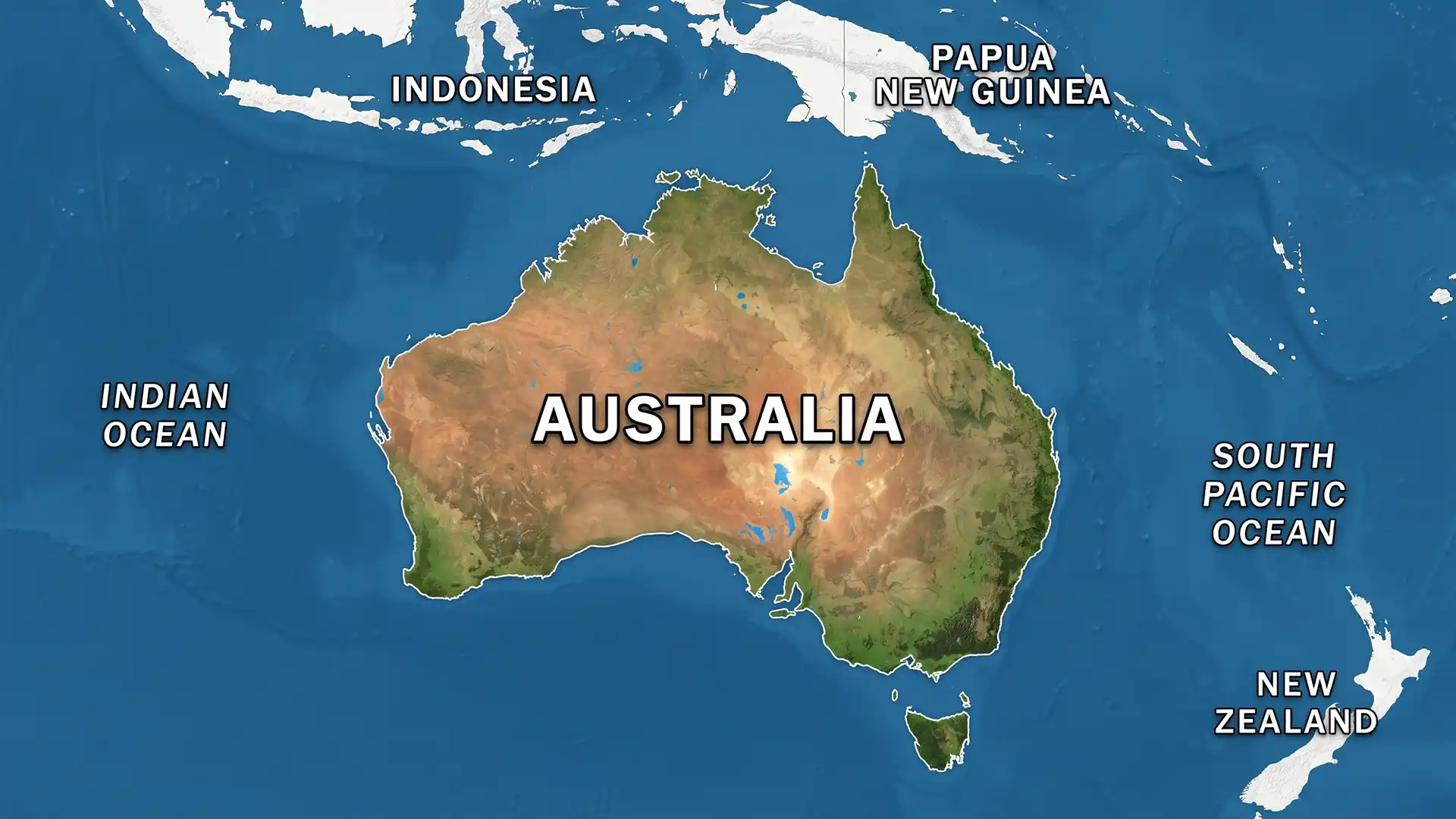
Australia is both the world’s smallest inhabited continent and its sixth‑largest country. It occupies an island continent in the southern hemisphere between the Indian Ocean to the west and the South Pacific Ocean to the east. The Coral Sea and Torres Strait separate it from Papua New Guinea, while the Timor and Arafura seas lie between Australia and Indonesia. The Tasman Sea to the southeast separates it from New Zealand. Australia’s coastline stretches more than 34,000 kilometres and includes the Great Barrier Reef off the northeastern coast.
Physical geography
- Relief and landforms: Australia is the flattest continent. The Great Dividing Range runs along the eastern seaboard from Victoria to Queensland, with peaks generally under 2,300 metres. The country’s highest mainland summit, Mount Kosciuszko in New South Wales, stands 2,228 metres above sea level.
- Rivers: The largest river system is the Murray–Darling Basin. Originating in the Great Dividing Range, the Murray and Darling rivers and their tributaries flow westward across New South Wales and Victoria into South Australia. These rivers support agriculture and inland towns.
- Deserts and the outback: About 40 percent of Australia’s interior is arid. Major deserts include the Great Victoria, Gibson, Great Sandy and Simpson deserts. The remote interior region, known as the outback, is sparsely populated and contains grasslands, scrub and iconic rock formations like Uluru and Mount Augustus.
Climate zones
The climate varies widely. Tropical conditions prevail in the north around Darwin and Cape York with little seasonal temperature change and monsoon rains. Central Australia has desert and steppe climates with extreme temperature swings between day and night. The southeast and southwest enjoy temperate climates with moderate rainfall, making cities such as Sydney, Melbourne and Adelaide favourable for habitation and agriculture. Because Australia lies south of the equator, seasons are opposite to those in the northern hemisphere.
Natural resources
Australia is rich in minerals and energy resources. According to Geoscience Australia, the country is among the world’s leading producers of bauxite (aluminium ore), iron ore, lithium, gold, lead, diamonds, rare‑earth elements, uranium and zinc. It also has large deposits of mineral sands (ilmenite, zircon, rutile) and produces coal, copper, nickel, silver and tin. These resources underpin Australia’s export economy and contribute to its strategic importance.
Conclusion
Knowledge of Australia’s geography helps contextualise its foreign policy and economic links with India. A vast continent with varied climates, fertile regions, mineral wealth and unique biodiversity, Australia is both a regional power and a key partner in the Indo‑Pacific.