

Why in news?
In June 2026 scientists operating the GRAPES‑3 cosmic ray telescope in Ooty reported a new feature in the energy spectrum of protons at around 166 teraelectronvolts. This “kink” or change in slope provides clues about the origin and acceleration of cosmic rays in our Galaxy. The finding demonstrates the ability of Indian scientists to make world‑class observations using home‑grown instrumentation.
Background
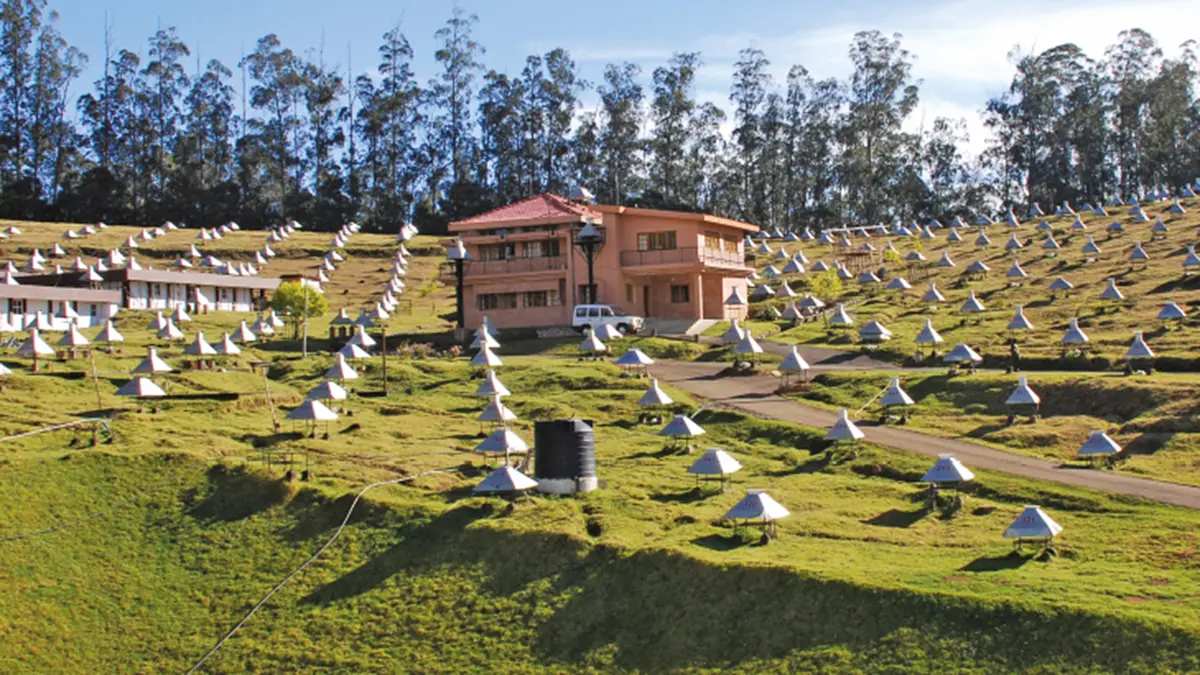
GRAPES‑3 (Gamma Ray Astronomy PeV EnergieS phase-3) is a ground‑based observatory located at 2,200 metres altitude in Ooty, Tamil Nadu. It was developed by the Tata Institute of Fundamental Research in collaboration with Japanese and international partners. The array consists of more than 400 plastic scintillator detectors spread over an area of 25,000 square metres, along with a 560‑square‑metre muon detector. It records the particle showers produced when high‑energy cosmic rays hit Earth’s atmosphere. Since becoming operational in 2000, GRAPES‑3 has measured the energy and composition of cosmic rays, studied solar storms and even used secondary particles to monitor thunderstorms.
Scientific achievements
- Precise spectrum: The observatory has measured the energy spectrum of protons, helium and heavier nuclei from 50 TeV to over one petaelectronvolt.
- Discovery of kink: Analysis of about eight million cosmic ray events revealed a change in the proton spectrum around 166 TeV, suggesting a transition between different acceleration mechanisms.
- Space weather studies: GRAPES‑3 monitors variations in cosmic ray intensity to study solar flares and interplanetary shocks that influence space weather.
- Thunderstorm research: The muon detector registers bursts of particles associated with lightning, helping scientists understand high‑energy processes in thunderstorms.
Conclusion
The GRAPES‑3 experiment showcases India’s growing capability in astrophysics. By combining many detectors and sophisticated analysis it reveals subtle features of cosmic rays that were once accessible only to larger observatories. Continued support for such facilities will deepen our understanding of the Universe and inspire young researchers.