

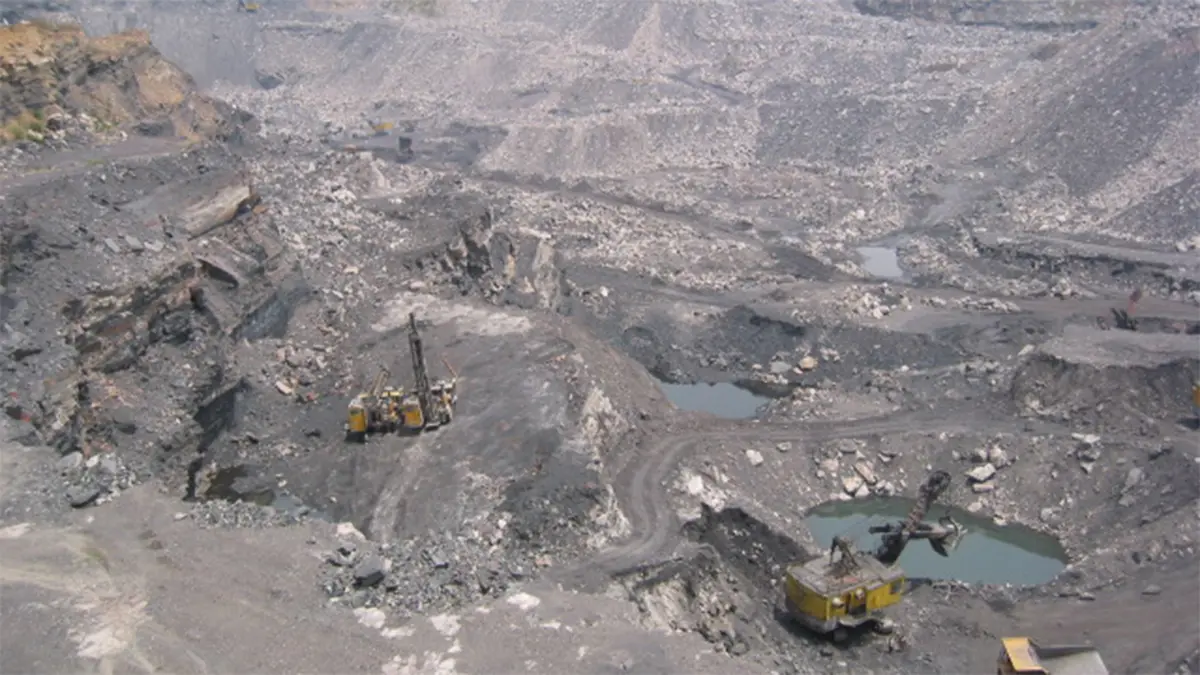
Why in news?
A paper published in Communications Earth & Environment in May 2026 shows that long‑burning underground fires in the Jharia coalfield of Jharkhand may reach extreme temperatures and emit far more greenhouse gases than previously estimated. The study combines field observations, mineral analysis and computer modelling to assess the climate impact of these fires.
Background
Jharia coalfield lies in Dhanbad district, Jharkhand, in the Damodar River valley. Covering about 280 square kilometres, it contains India’s largest reserves of high‑quality coking coal (about 19.4 billion tonnes) and has been mined since 1894. More than 20 underground mines and several opencast mines operate in the area. Spontaneous combustion and mining‑induced faults have sparked underground fires since 1916. These fires have destroyed homes, caused land subsidence and forced the relocation of thousands of families. Toxic fumes and sinkholes pose serious health and safety risks.
Findings of the new study
- Collapse structures: Researchers documented chimney‑like collapse structures up to ten metres wide and over 100 metres deep. These cavities act as vents, channeling heat and gases from burning coal seams to the surface.
- Extreme temperatures: Mineralogical evidence, including melted rock (paralava) and a glassy material nicknamed “birianiite,” indicates that temperatures inside these structures can approach 4,000 °C.
- Massive emissions: Modelling suggests that isolated collapse structures may emit more than 7 × 10² megatonnes of carbon dioxide equivalent annually. This estimate is nearly twice the annual territorial greenhouse gas emissions of the United Kingdom in 2023. It includes carbon dioxide, methane and carbon monoxide from smouldering coal.
Coking coal explained
Coking (or metallurgical) coal is a sedimentary rock high in carbon and low in ash and moisture. When heated without air it forms coke, a hard, porous material used to reduce iron ore in blast furnaces. It takes around 770 kilograms of coking coal to make one tonne of steel. By contrast, thermal coal, used in power plants, has more impurities and cannot form strong coke. Major producers of coking coal include China, Australia, Russia, the United States and Canada. India has roughly 37 billion tonnes of coking coal resources, mostly in Jharkhand, with smaller deposits in Madhya Pradesh, West Bengal and Chhattisgarh.
Significance
The study underscores that underground coal fires are not just a local hazard but a significant source of greenhouse gases. Accurately accounting for these emissions is vital for climate policy and environmental management. It also highlights the need for continuous monitoring, community relocation plans and innovative methods to extinguish or isolate fires. Given the importance of coking coal for steel production, balancing industrial needs with environmental and social costs remains a major challenge.