

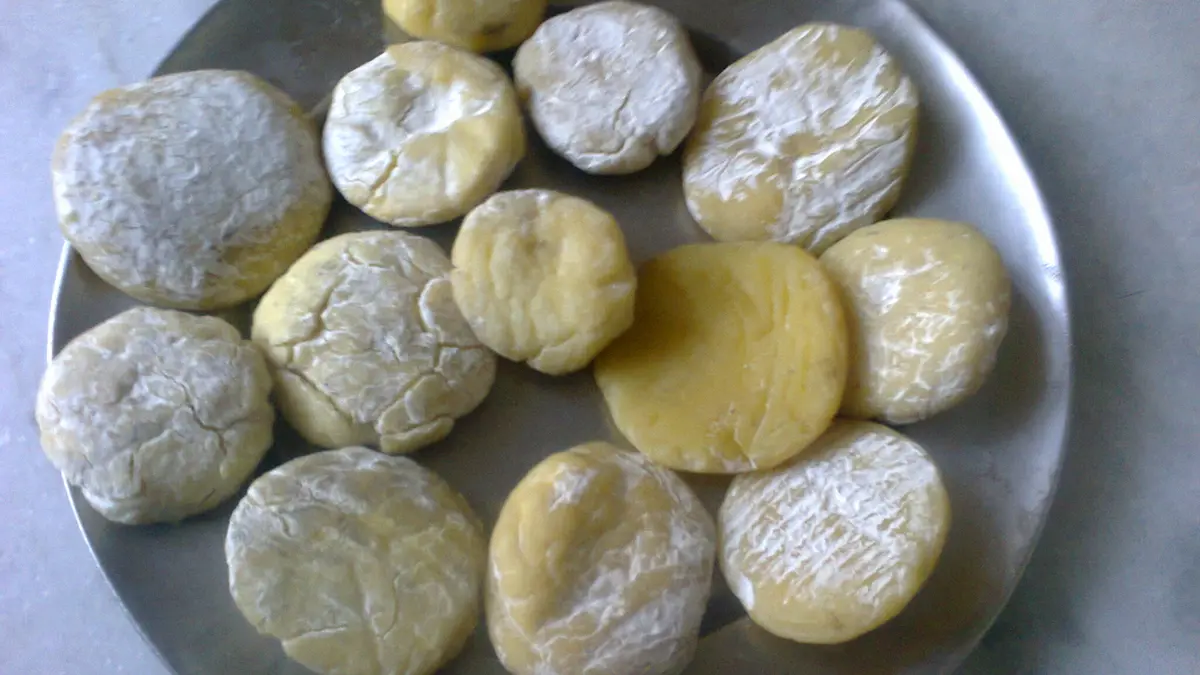
Why in news?
Union Minister Jitendra Singh has said that Udhampur's Kaladi cheese is ready for a commercialisation push using improved food technology. Kashmir Life's late-September briefing attributes a refrigerated shelf life of twenty-eight days to work by the Central Food Technological Research Institute in Mysuru. Kaladi is a traditional dairy product associated with Jammu's food culture, and its limited keeping time restricts distribution beyond nearby markets. The reported invitation for private partners concerns scaling a standardised process. It is not evidence that every traditional batch now lasts twenty-eight days, or that exports are already established. The claim specifically concerns refrigerated storage and the minister's account of the institute's intervention.
A regional cheese with a protected geographical identity
Kaladi is associated particularly with Udhampur in the Jammu region of the Union Territory of Jammu and Kashmir. India's geographical-indications registry records Udhampur Kaladi as a registered food product. Its registration certificate is dated 3 October 2023. The applicant is the Shyam Kaladi Cooperative Limited, based at Dharmthal in Udhampur district.
A geographical indication links a product's recognised identity with its place of origin. In this case, the registered name concerns Udhampur Kaladi, not every cheese made from milk. The connection with place is part of the product's value. Market expansion should preserve its producer connection and recognised characteristics. The protected name is not a loose description for unrelated products.
What makes the traditional process distinctive?
A January government account describes preparation from full-fat milk using whey water to bring about coagulation. Coagulation is the formation of curd as milk proteins come together. Whey is the liquid separated from that curd. The process and subsequent handling influence texture, moisture and flavour, which help distinguish a cheese from other milk products.
The government's development brief emphasised retaining Kaladi's familiar milky flavour, mouthfeel and stretchable texture. This explains why standardisation is not simply a matter of producing the largest possible quantity. A technically stable product that no longer resembles the regional food would fail a central part of the brief.
The earlier research brief and the latest announcement
On 21 January, the minister asked two Council of Scientific and Industrial Research laboratories to work together on Kaladi. These were the Central Food Technological Research Institute in Mysuru and the Indian Institute of Integrative Medicine in Jammu. Their brief included characterisation, nutrient profiling, shelf-life work and potential food applications.
The September account describes a later commercialisation stage. Kashmir Life reports the minister's claim that refrigeration-supported shelf life has reached twenty-eight days, with an invitation for private companies. That is evidence of an announced technology-transfer effort. It does not supply independent results for every future manufacturer's batches, packaging or transport conditions.
Why temperature is part of the shelf-life claim
The Food Safety and Standards Authority of India's dairy guidance explains that many milk products can support microbial growth. Time and temperature control are therefore important throughout processing, distribution and storage. Refrigeration can slow unwanted growth, but it does not correct unhygienic production or make a contaminated product safe automatically.
A refrigerated shelf life is not an ambient-temperature guarantee. If the intended storage conditions are interrupted during transport or retail, the validated period may no longer apply. A cold chain means maintaining suitable temperature conditions across those connected stages. The package, processing method and handling instructions form part of that system.
This is why a longer keeping time needs more than a number on a label. Producers must know the conditions under which the product was evaluated and reproduce the relevant process reliably. Retailers and consumers then need usable storage instructions. The twenty-eight-day announcement should be understood within that controlled setting, rather than as a universal property of Kaladi.
Origin protection and food safety serve different purposes
The geographical indication protects a place-linked product identity; food-safety requirements address how food is produced and handled. One does not replace the other. India's food-safety authority requires relevant businesses to follow hygienic practices and manage hazards across the food chain. A product can have a recognised heritage and still need careful process control.
Similarly, domestic registration is not automatic approval to sell in every overseas market. Commercial expansion requires suitable partners, consistent quality and compliance with applicable market requirements. These are implementation questions following the announcement. They are not reasons to dismiss the new technology claim, but they determine whether it becomes a dependable commercial product.
What wider distribution could change
A longer, reliable selling window could allow producers to reach more distant buyers and reduce pressure to sell immediately. It could also support more predictable supply for shops and food businesses. Those benefits remain conditional on costs, demand and the availability of suitable storage. The value reaching local producers matters as much as the distance the product eventually travels.
Conclusion
Kaladi's current development effort addresses a practical barrier between a local dairy tradition and a wider market. The announced refrigeration-based improvement is promising, but dependable commercialisation requires repeatable processing and an intact cold chain. Preserving the registered product's identity and producer connection is equally important. Technology adds value when the food remains recognisable, safe and economically useful to its source community.