

Why in news?
The German Navy has completed two live firings of Israel Aerospace Industries’ Naval LORA missile. An operational German vessel fired both weapons during trials in the North Atlantic. The manufacturer announced the successful exercise on 2 September 2026. Germany has not announced a purchase, so the event remains a test rather than an induction.
What happened during the trial?
The demonstration formed part of a German operational experimentation programme. A command trailer and a launcher were integrated with the participating naval vessel. The missiles were fired under two separate test scenarios. The manufacturer stated that both struck their assigned targets.
News agencies placed the ship between Ireland and Iceland during the exercise. This North Atlantic setting offered open water and realistic maritime conditions. It also lies across important approaches linking Europe and North America. Exact firing coordinates and target distances were not publicly released.
German officials described the trial as an examination of future capability. The Defence Ministry said any acquisition would give Germany its first ballistic missile. That statement does not amount to a procurement decision. Cost, configuration, doctrine and parliamentary processes would still require consideration.
What is LORA?
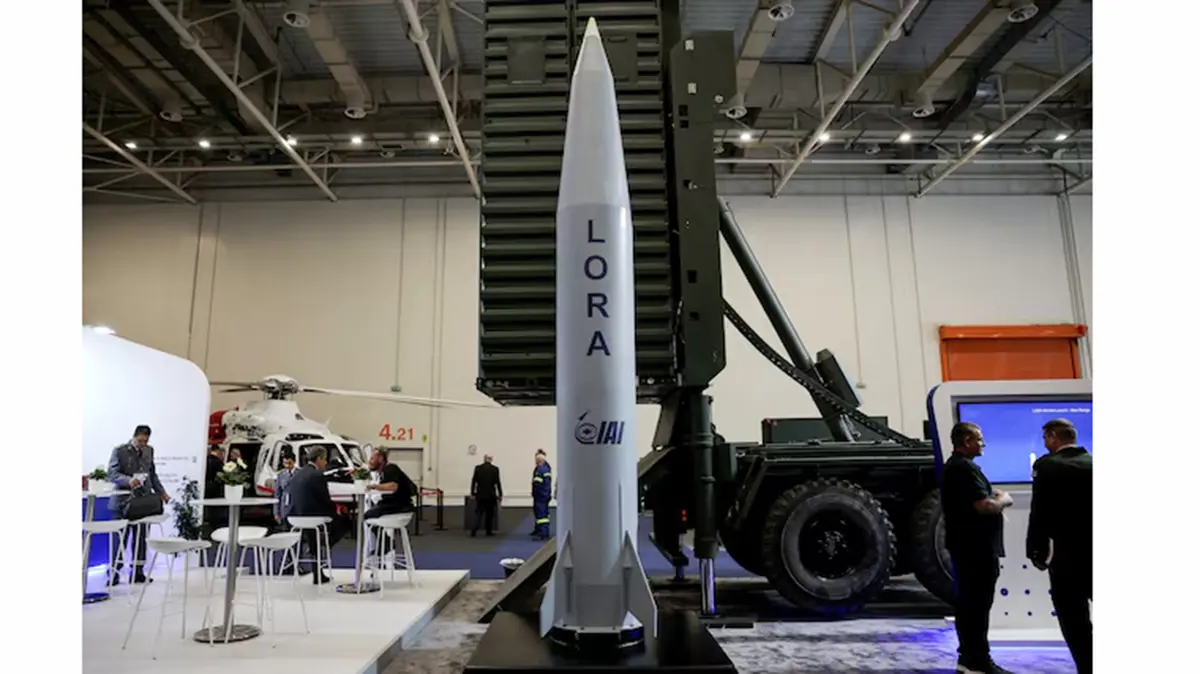
LORA means Long Range Artillery. It is a surface-to-surface ballistic missile developed by Israel Aerospace Industries. The system can operate from land launchers or suitably configured ships. A sealed canister protects each missile during storage and transport.
The manufacturer lists a length of 5.2 metres and a diameter of 624 millimetres. It gives a launch weight of about 1,600 kilograms. A single-stage solid rocket motor provides propulsion. Solid fuel permits faster preparation than systems requiring liquid fuelling before launch.
Published manufacturer material gives a range between 90 and 430 kilometres. German reporting referred to a possible reach of up to 500 kilometres. These figures may concern different configurations or official descriptions. They should not be merged into an unsupported single specification.
How guidance and flight differ from cruise missiles
LORA uses an inertial navigation system supported by satellite positioning. Inertial sensors track motion without continuous external signals. Satellite updates can reduce accumulated navigation error. The maker claims a circular error probable of ten metres under stated conditions.
Circular error probable is a statistical measure, not a guarantee for every shot. It describes the radius containing half of expected impacts. Electronic interference, target data and operating conditions can affect real performance. The ten-metre figure is therefore a manufacturer’s stated capability.
A ballistic missile rises and follows a largely unpowered arc after its boost phase. A cruise missile uses sustained propulsion and aerodynamic lift for much of its journey. Ballistic flight can produce high terminal speed and a steep approach. These features can shorten a defender’s response time.
Why a naval launcher matters
A mobile ship can change the direction and distance of an attack. It may hold targets at risk without relying upon fixed land sites. Naval basing also complicates an opponent’s surveillance. However, a ship needs secure communications and reliable target information.
Long-range precision strike could support sea denial and operations against coastal military targets. It may complement aircraft, submarines and land-based weapons. Such systems also raise escalation and command questions. Ballistic trajectories can be misread during a crisis.
Germany is strengthening defence after Russia’s invasion of Ukraine. The Bundeswehr is studying deeper conventional strike options within allied planning. A sea-based missile would be one possible element. Decisions must still fit North Atlantic Treaty Organization requirements and German law.
Limits of the available evidence
A successful trial proves that the tested arrangement worked on those occasions. It does not establish reliability across weather, combat or electronic attack. The manufacturer has not disclosed every flight profile or countermeasure. Independent operational evaluation would need many more data points.
Israel Aerospace Industries also presents LORA’s combat and survivability claims. Those statements should remain clearly attributed. German authorities can assess whether the system meets their own needs. Testing foreign equipment before purchase is a normal defence process.
Conclusion
The North Atlantic firings demonstrated a possible new German naval strike option. LORA combines mobility, solid-fuel readiness and a ballistic flight path. Its public range and accuracy figures remain source-specific claims. Germany has tested the weapon but has not confirmed procurement. Any adoption would require strategic, legal and operational scrutiny.