

Why in news?
Jharkhand’s Mandar received geographical indication recognition, as reported by News On AIR and local reporting on 29 September 2026. A geographical indication, or GI, identifies goods whose qualities, reputation or characteristics are linked to a particular place. Here, the recognised product is a traditional percussion instrument associated with Jharkhand’s community music and celebrations. The application was pursued by Raidih Mandar Producer Company Limited in Gumla, and the official register records it as registered. Recognition links the instrument’s identity with its place and makers, providing a basis to challenge misleading use of the protected designation. It does not give one company ownership of the entire musical tradition or of every similar drum.
The instrument and the people behind it
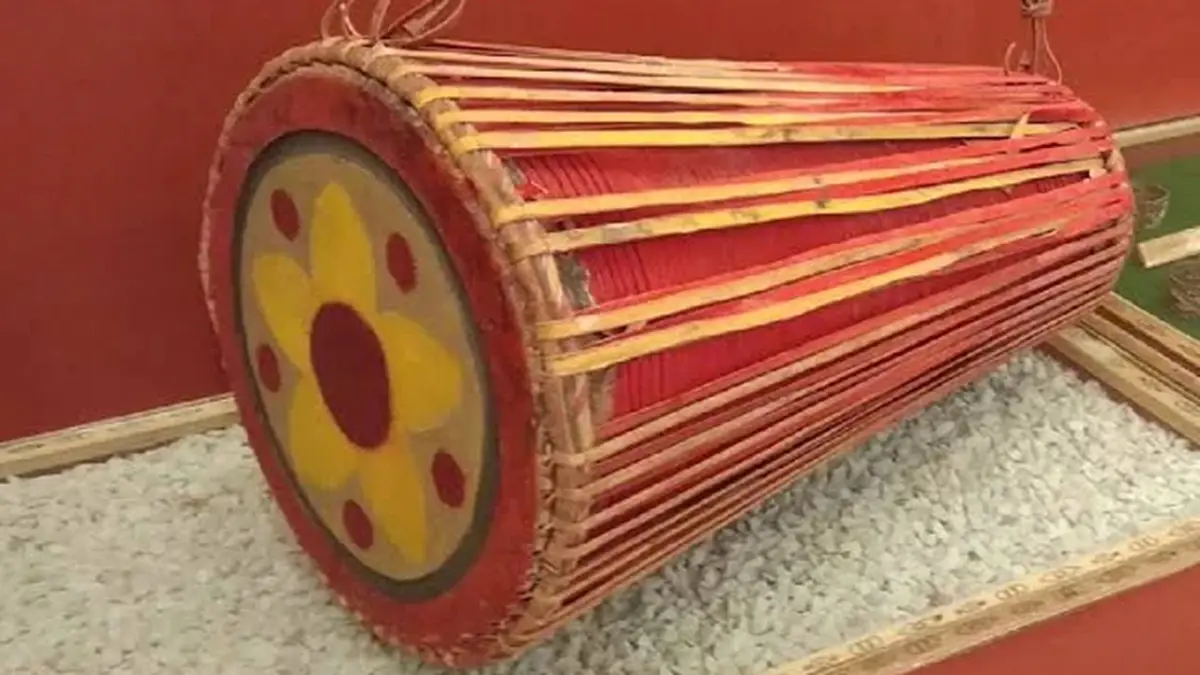
The Mandar provides rhythmic accompaniment for singing and dancing in Jharkhand’s cultural life. The current registration reporting highlights local red soil, traditional production methods and a distinctive sound. Its identity therefore involves more than the appearance of a finished object. Materials, skilled preparation and the knowledge of makers are part of the connection between the instrument and the region it represents.
Gumla was central to the application, although the reported geographical coverage is Jharkhand rather than the district alone. The Times of India identifies the applicant as a collective of artisans from Jarjatta village. Documentation assembled for the application drew on historical writing and other records. This effort matters because a place-linked reputation must be supported by evidence, not simply asserted through promotional language.
A percussion instrument produces sound when a player sets a surface vibrating. In a drum, the body and stretched playing surfaces influence how those vibrations are heard. The maker’s work consequently affects both durability and tone. Recognising that craft is different from claiming every instrument must sound identical. Handcrafted products can retain a shared identity while differing in the details of their making and use.
Physicist Amitabha Bhattacharyya’s account describes a two-sided terracotta body shaped on a potter’s wheel and fired in a kiln. Its two openings differ in diameter. Leather playing surfaces are secured and tensioned with strips, while a tuning paste changes how the membrane vibrates. The instrument thus brings pottery and drum-making skills together. Its sound depends on construction and adjustment, not merely decoration applied to an ordinary container.
What the register establishes
The official application record identifies Mandar under application number 777, filed on 24 September 2021. It names Raidih Mandar Producer Company Limited and lists the goods in the musical-instrument class. The record establishes registration status, but the news announcement should not be mistaken for the original application date. The process connects a defined product, a geographical area and a representative applicant.
This is a collective form of protection rather than a conventional brand belonging to any seller who buys the name. India’s system allows producer associations or organisations representing their interests to apply. Registration is valid for ten years and can be renewed. The European Commission’s India intellectual-property helpdesk explains that protection is territorial, so Indian recognition is not automatic registration in every overseas market.
Protection without a monopoly over culture
The World Intellectual Property Organization explains the central distinction: a GI protects the relevant designation, not the production technique itself. Qualifying producers within the defined area can use the indication under the applicable requirements. Someone outside that system cannot simply present unrelated goods as the recognised product. But GI protection does not generally prevent another maker from using a similar technique.
That distinction is especially important for a musical instrument. Registration does not prohibit a performer elsewhere from playing a drum or learning a musical tradition. Nor does it prove that all objects marketed under a familiar name meet the registered requirements. Reliable identification of makers and goods is needed to connect the legal protection with what a customer actually purchases.
Turning recognition into a durable benefit
The practical opportunity is to make genuine craft easier to identify and misleading origin claims easier to challenge. As an implementation matter, that requires more than announcing a registration. Producer participation, understandable labelling and consistent product information can help buyers recognise what the designation means. If customers cannot distinguish genuine goods, the legal recognition may deliver less benefit than its publicity suggests.
There is also no automatic guarantee of higher incomes. Demand, distribution costs and the bargaining position of artisans still influence returns. Preserving the tradition additionally depends on people continuing to make and play the instrument. Registration can strengthen its identity, but the craft still needs skilled makers, suitable materials and an active musical community.
Conclusion
The Mandar’s recognition gives a place-linked musical craft a clearer legal identity. The next task is to make that identity useful to the artisans and buyers it is intended to serve. Protection should help distinguish authentic goods without confusing ownership of a designation with ownership of music itself. Its lasting value will depend on credible use of the registration and continued support for the living craft.