

Why in news?
Ophthalmologists have sounded the alarm about rising rates of myopia among children and young adults. Globally, nearly half the world’s population could be nearsighted by 2050, prompting renewed efforts to educate parents and teachers about prevention and early treatment.
Background
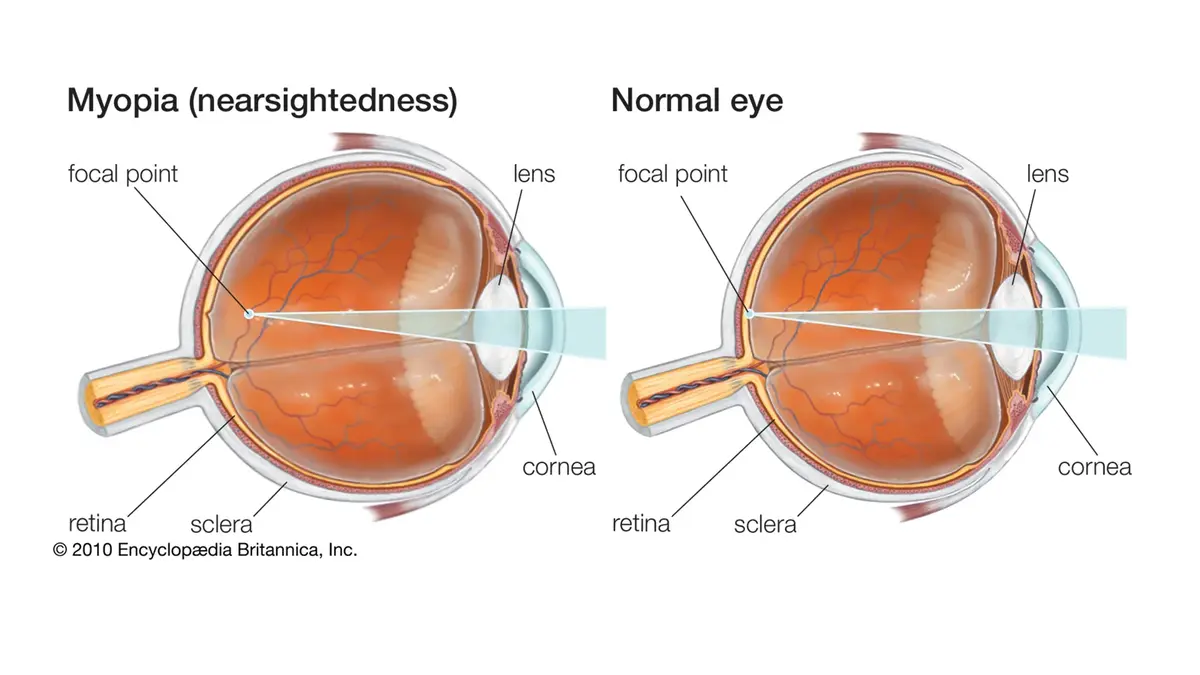
Myopia, or nearsightedness, is a common refractive error in which distant objects appear blurred while close objects remain clear. It occurs when the eyeball grows too long from front to back or when the cornea curves too steeply, causing incoming light to focus in front of the retina instead of directly on it. The condition usually begins in childhood and can progress until the late teens or early twenties.
Both genetic and environmental factors contribute to myopia. Children with one or both parents who are nearsighted have a higher risk. Spending many hours on near‑work activities such as reading or using digital screens and getting little time outdoors are associated with increasing rates of myopia. Symptoms include squinting, headaches, eye strain and difficulty seeing road signs or the board in class. Severe or “high” myopia can lead to complications like retinal detachment, glaucoma or cataracts later in life.
Prevention and management
- Regular eye exams: Children should have their vision checked annually so that myopia can be detected and corrected early.
- Outdoor time: Encouraging youngsters to spend at least one to two hours outdoors daily may slow the onset of myopia. Natural light and long‑distance viewing help eyes focus properly.
- Limit screen time: Frequent breaks when using computers or smartphones reduce eye strain. The “20‑20‑20” rule advises looking at something 20 feet away for 20 seconds every 20 minutes.
- Corrective lenses: Spectacles or contact lenses restore clear distance vision. Special lenses like orthokeratology (overnight reshaping lenses) or multifocal designs can slow myopia progression.
- Medications: Low‑dose atropine eye drops may slow progression in children when prescribed by an eye specialist.
- Surgical options: Procedures such as LASIK reshape the cornea for adults with stable vision, but they are not typically recommended for children.
Conclusion
Myopia is becoming a public‑health concern, especially in urban societies where children spend more time indoors. Early detection, lifestyle changes and appropriate treatment can help prevent serious complications and improve quality of life.